


Transparent LED screens are reshaping how commercial spaces use glass surfaces for digital communication. You see them in retail storefronts, shopping malls, airports, and modern building facades where brands want visibility without blocking natural light. However, most buyers still struggle with one core issue: they compare specifications without understanding real engineering trade-offs behind them.
We created this guide because we repeatedly see B2B buyers overpay or select the wrong configuration due to incomplete technical understanding. Many suppliers only present ideal specifications, not real-world limitations under long operating hours, heat conditions, or installation constraints.
At NSELED, we work closely with B2B buyers, wholesalers, and project contractors across Europe, Australia, Japan, and Southeast Asia to deliver customized transparent LED display solutions. Our engineering team helps clients evaluate pixel pitch, transparency ratio, structural mounting, and long-term maintenance requirements before production, reducing project risk and improving ROI.

What Are Transparent LED Screens?
Transparent LED screens are LED display systems designed with spaced pixel structures that allow visible light to pass through the display surface while showing digital content.
Unlike traditional LED walls that form a solid visual block, transparent LED systems intentionally reduce LED density to create a “see-through” effect. This design makes them ideal for glass-mounted advertising environments.
Definition and Basic Concept
A transparent LED screen is essentially a modular LED display built with strip-like PCB structures. These strips are mounted horizontally or vertically with gaps in between to maintain transparency.
From a production perspective, the key engineering challenge is maintaining image continuity while preserving structural openness. This is why pixel pitch selection directly determines whether a project succeeds or fails in real viewing conditions.
For example, in retail glass windows, a balance must be achieved between:
• Customer visibility from outside
• Product visibility from inside
• Screen readability under ambient light
If any of these three factors fails, the installation loses commercial value.
How Transparent LED Screens Work
Transparent LED screens work through synchronized control of LED light strips arranged in a grid-like pattern. Each strip consists of multiple LED beads, which are individually driven by built-in IC chips that precisely regulate brightness levels and refresh rates.
By coordinating the operation of many LED rows simultaneously, the screen forms a cohesive visual effect, such as dynamic images or videos. At the same time, the gaps between adjacent strips allow light and air to pass through, giving the screen its characteristic transparency. This design makes transparent LED screens ideal for applications like glass curtain walls, retail storefronts, and exhibition displays, where maintaining see-through visibility is essential.
However, real manufacturing introduces constraints:
- Power distribution must be uniform across long glass surfaces
• Signal transmission must avoid delay across modules
• Heat dissipation must remain stable without solid backplanes
Key Technical Parameters (Transparency, Brightness, Pixel Pitch)
| Parameter | Typical Range | Real-World Impact |
| Transparency | 60%–90% | Impacts daylight penetration and interior visibility |
| Brightness | 3000–6000 nits | Determines outdoor readability under sunlight |
| Pixel Pitch | P3.9–P10 | Affects clarity vs viewing distance balance |
Pixel pitch is the most misunderstood parameter. Many buyers assume smaller pitch always means better quality. In transparent LED systems, this is not always true.
Quick Question:
How does pixel pitch affect both transparency and image continuity?
Larger pitch increases transparency but reduces image continuity; smaller pitch improves clarity but lowers transparency.

Types of Transparent LED Screens
Transparent LED screens come in several structural types, each with different manufacturing complexity, cost, and failure risk. Simpler designs like lamp-bar strips are cheaper but more vulnerable to environmental damage. More advanced types, such as co-extruded or PCB-based screens, offer better protection and higher pixel density, yet require greater precision and introduce more potential failure points. Choosing among them involves balancing upfront cost against long-term reliability.
LED Film Screens
LED film screens are ultra-thin flexible displays that can be directly attached to glass surfaces using adhesive or magnetic structures. With thickness often less than 2 mm and transparency up to 90%, they can be applied to existing windows without blocking natural light or requiring heavy framing. Their flexible nature allows slight bending to fit curved glass, and the installation process is relatively quick, as no special cooling or ventilation is needed.
They are widely used in retail windows because they preserve architectural design — the storefront maintains its original look when the screen is turned off, and passersby can still see inside. However, their electrical structure is delicate. The fine conductive lines and thin-film circuits are susceptible to scratches, sharp bending, electrostatic discharge, and moisture ingress. As a result, handling and cleaning require extra care, and protective coatings or lamination are often applied in outdoor or high-traffic installations.
Key limitations:
• Sensitive to voltage drop over large areas
• Requires precise glass surface treatment
• Limited mechanical protection
LED Glass Screens
LED glass screens embed LED structures directly inside laminated glass panels, typically between two or more layers of glass with transparent interlayers such as PVB or EVA. This creates a fully integrated display surface where the LEDs are invisible when turned off, allowing the glass to retain its transparent and seamless appearance. The lamination process also protects the delicate LED components from moisture, dust, and mechanical impact.
This is the most architectural solution among transparent LED products, as it becomes a permanent part of the building envelope rather than an add-on display. It is often used in premium commercial buildings and flagship stores, where both aesthetics and durability are critical. Applications include glass curtain walls, partitions, railings, and even elevator doors — anywhere the goal is to combine dynamic visuals with high-end architectural transparency.
| Advantages | Disadvantages |
| High structural stability | High production cost |
| Premium visual integration | Difficult replacement if failure occurs |
| Strong weather resistance | Requires early-stage architectural planning |
LED Mesh / Curtain Screens
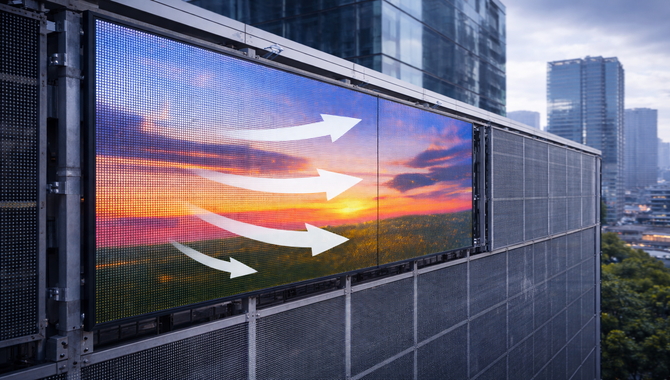
Mesh or curtain-type transparent LEDs are designed for large-scale outdoor applications such as building facades, stadium exteriors, and highway billboards. Unlike panel-based displays, they consist of a lightweight net-like structure with LED nodes mounted on a flexible grid or steel cable system. This open architecture allows the display to span hundreds of square meters without requiring heavy support frames, making installation on existing building exteriors both feasible and cost-effective.
They use spaced LED nodes to allow airflow and reduce wind load pressure, which is a critical advantage for high-rise or open-air installations. By leaving gaps between individual light points, wind passes through the display rather than pushing against a solid surface, significantly lowering structural stress and mounting requirements. This design also facilitates natural cooling and reduces maintenance frequency, as dust and rain are less likely to accumulate. Common examples include stadium perimeter screens and animated building wraps that remain visible and safe even in windy coastal regions.
Transparent LED Panels (Rental & Stage)
Panel-based systems are modular units designed for events, exhibitions, and stage backgrounds. Each panel typically features a rigid frame with a dense array of LEDs, allowing them to be tiled seamlessly into custom shapes and sizes — from small booths to massive concert backdrops.
Unlike transparent screens, these panels offer high brightness and contrast, making them suitable for indoor and outdoor use where full opacity is acceptable. Their modular nature also simplifies transport, assembly, and repair: a faulty panel can be swapped out quickly without dismantling the entire display. Common applications include trade show booths, live concert visuals, corporate keynote stages, and temporary pop-up installations.
They prioritize flexibility over transparency accuracy.
Common trade-offs:
• Faster installation
• Lower structural stability
• Reduced transparency compared to fixed systems
Key Features and Advantages
Panel-based systems are modular units designed for events, exhibitions, and stage backgrounds. Each panel is self-contained with its own power and data connectors, allowing rapid assembly into large video walls of almost any shape or size. Their rugged frames withstand repeated transport and stacking, making them a reliable choice for touring productions and temporary installations.
High Transparency and Visual Impact
Transparent LED screens allow up to 90% light transmission, making them suitable for glass storefronts. This high transparency is achieved by arranging LED chips on ultra-fine conductive lines or transparent substrates, leaving most of the screen area open. When installed on retail windows, they display dynamic ads or branding without blocking the view inside, preserving the store’s visual connection with pedestrians. Unlike traditional digital signage, they require no heavy framing or ventilation, blending seamlessly into existing architecture.
Energy Efficiency and Lightweight Design
Transparent LED systems consume less material and power due to reduced LED density. Wider spacing lowers diode count and energy use, making large installations more cost-effective. Modern driving IC systems improve efficiency significantly. They use PWM and auto-sleep modes, reducing heat and extending LED lifespan while cutting power by up to 40%.
Easy Installation and Maintenance
Transparent LED screens support modular installation, often without heavy steel structures. Individual panels or strips can be clipped or bolted directly to existing window frames or curtain wall mullions, reducing both material cost and building load.
However, maintenance complexity depends on system design. Front-accessible modules allow quick replacement from inside a building, whereas rear-access designs may require scaffolding or glass removal, significantly increasing downtime and labor costs.
Transparent LED vs Traditional LED Displays
Transparent LED screens and traditional LED walls serve fundamentally different commercial goals: the former enables product visibility through glass, while the latter delivers high-brightness imagery for large outdoor advertising displays.
Performance Comparison
| Factor | Transparent LED | Traditional LED |
| Light Transmission | High | None |
| Visual Impact | Medium | Very High |
| Architectural Integration | Excellent | Limited |
| Outdoor Brightness | Medium–High | Very High |
Installation and Structure Differences
Transparent LED systems need only minimal structural reinforcement thanks to their lightweight, self‑supporting design, whereas traditional LED walls demand heavy, costly full steel support frameworks for safe installation.
This fundamental difference in structural requirements dramatically increases installation costs for traditional LED walls in glass‑based environments, where transparent LEDs offer a far more economical and less invasive alternative.
Cost and ROI Comparison
Transparent LED is not always cheaper or more profitable, because lower material costs may be offset by higher driver electronics expenses and reduced brightness in direct sunlight applications.
Quick Question:
In which commercial scenario might transparent LED have lower ROI than traditional LED?
In directsunlight outdoor advertising where traditional LED’s higher brightness delivers better visibility and revenue.
Applications of Transparent LED Screens
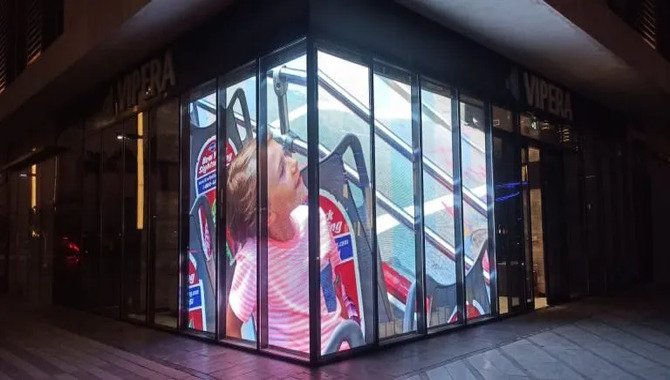
Transparent LED screens perform best where architecture and advertising must coexist, such as on curtain walls, airport glazing, or retail storefronts, preserving both natural light and visual impact.
Retail Storefronts and Shopping Malls
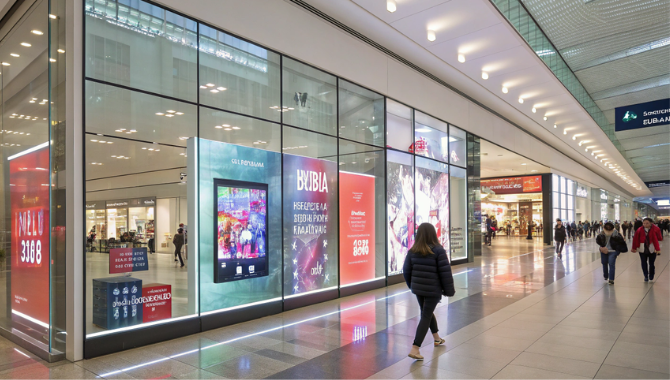
They allow dynamic advertising while maintaining product visibility behind glass, making them ideal for retail stores where passersby see both moving promotions and the actual merchandise on display.
Glass Curtain Walls and Architecture
Used in modern buildings to create digital facades, transparent LED screens turn entire glass exteriors into programmable media surfaces without blocking natural light or outward views from inside.
Events, Stages, and Exhibitions
Used for layered visual effects and stage depth enhancement, transparent LED screens create dynamic backgrounds that float between performers and rear projections, adding spatial dimensionality without blocking sightlines.
Corporate and Commercial Spaces
Common in lobbies and brand showrooms, transparent LED screens deliver high-end visual messaging while preserving open sightlines and architectural transparency, reinforcing modern aesthetics without bulky structural interference.
[Insert Image Here – Transparent LED in retail environment]
Alt text: transparent LED display installed on commercial glass storefront with daylight visibility
Transparent LED Screen Pricing Guide
Transparent LED pricing depends heavily on internal component selection rather than just visible specifications, as chip quality, driver ICs, and PCB design can dramatically affect long-term reliability and total cost of ownership.
Price by Screen Type
| Type | Price Range ($/sqm) | Key Driver |
| Film | 2000–3000 | Adhesive system complexity |
| Glass | 2500–4000 | Structural integration cost |
| Mesh | 800–1500 | Outdoor scalability |
| Panel | 1000–2000 | Modular frame design |
Key Cost Factors
- LED chip brand consistency
• Driver IC refresh rate capability
• PCB transparency ratio
• Cabinet structure material
Hidden Costs to Consider
- Structural engineering
• Control system calibration
• Long-distance shipping reinforcement
How to Choose the Right Transparent LED Screen
Selection should follow engineering logic, not catalog comparison, because real-world performance in transparency, heat dissipation, and maintenance access often matters more than spec sheets promise at first glance.
Based on Application Scenario
Retail environments prioritize transparency to keep products visible through glass, while transport hubs prioritize brightness for readability under direct sunlight and through airport terminal glazing at all hours.
Balancing Transparency and Resolution
Higher transparency reduces LED density, which reduces image sharpness and effective resolution, creating a direct design trade-off between see‑through effect and visual detail for close viewing distances.
Supplier Evaluation Criteria
- Aging test duration (minimum 72 hours)
• IC brand transparency
• Real project references
ROI and Lifespan Considerations
Typical operational lifespan ranges from 50,000 to 100,000 hours depending on thermal management quality, with passive cooling often sufficient for low‑density designs but active cooling required for high‑brightness models.
Common Problems and Solutions
| Problem Category | Description | Cause | Solution |
| Visibility Issues | Screen hard to see in strong light | Low brightness or poor calibration | Increase brightness and optimize calibration |
| Installation Limitations | Misalignment with glass or structure | Mounting system mismatch | Use custom brackets after structural check |
| Maintenance & Durability | Performance drops over time | Thermal expansion causes drift | Improve heat design and regular recalibration |
Video Placement 1
A factory video should show 72-hour aging test process, including thermal camera monitoring and dead pixel inspection under controlled conditions.
Quick Question:
After how many operating hours does thermal expansion drift typically begin?
It can start after hundreds to thousands of hours if thermal management is poor; quality designs delay drift beyond 50,000 hours.

Conclusion
Transparent LED screens are architectural systems that require careful engineering, not just product selection. Their performance depends on how well they manage heat, sunlight, operating hours, and installation conditions. Balancing transparency, pixel pitch, brightness, and maintenance access is critical. Buyers who overlook these factors often face higher costs or mismatched solutions for real-world applications.
If you’re planning a transparent LED project, partner with NSELED for expert guidance and customized solutions. We provide tailored configurations based on your environment, brightness needs, and budget. Contact us today for a fast quotation and professional project assessment.
FAQ
What is the transparency rate of a transparent LED screen?
Typical systems range from 60% to 90%, depending on LED spacing and structural design. Higher transparency allows more light and natural visibility through the screen while preserving image clarity.
How much does a transparent LED screen cost?
Most projects fall between $800 and $3000 per square meter depending on configuration. Factors include pixel pitch, cabinet size, brand, and installation complexity, with custom designs often reaching the higher end.
Are transparent LED screens suitable for outdoor use?
Yes, but only when brightness exceeds 5000 nits and proper waterproof structure is applied. Additionally, UV resistance and effective thermal management are essential for long-term outdoor reliability in direct sunlight.