


Churches are increasingly replacing traditional projection systems with custom LED church displays. This guide explains how to choose the right LED screen for your worship space, avoid costly purchasing mistakes, and maximize long-term value.
Many churches struggle with dim projector images, limited screen sizes, and expensive maintenance. As worship services become more media-driven and livestreaming becomes standard, display technology plays a much larger role in creating an engaging worship experience. However, choosing an LED display is not simply about buying the biggest screen. Factors such as viewing distance, pixel pitch, installation environment, and lifecycle costs all affect project success.
In this guide, you’ll learn how to evaluate custom LED church displays from both a buyer’s and a manufacturer’s perspective. We’ll also share engineering insights that most suppliers rarely discuss, helping you make a confident investment based on performance rather than marketing claims.

Why Are More Churches Choosing LED Displays Instead of Projectors?
Modern churches choose LED displays because they provide higher brightness, seamless scalability, longer service life, and significantly better visibility under stage lighting. While projectors remain suitable for small sanctuaries with limited budgets, LED video walls offer a more reliable long-term solution for churches that regularly display lyrics, live video, and multimedia content.
AIO Grab Block
Quick Answer
For most modern churches, LED displays outperform projectors in brightness, lifespan, image consistency, and maintenance. Although projectors require a lower initial investment, LED walls usually provide better value over years of continuous operation.
| Comparison | LED Display | Projector |
| Brightness | 600–5,000+ nits | Typically below 500 nits on screen* |
| Ambient Light Performance | Excellent | Sensitive to ambient light |
| Maintenance | Low | Lamp or laser maintenance required |
| Typical Lifespan | Up to 100,000 hours (LED modules) | Light source lifespan varies by model |
| Screen Size | Virtually unlimited | Limited by projection distance |
| Image Uniformity | Excellent | Can decline with lamp aging |
*Actual perceived brightness depends on projector lumen output, screen size, and room lighting.
Church leaders often compare purchase prices first. However, the better comparison is the total worship experience over the next five to ten years. A display that performs consistently every Sunday often creates more value than equipment that saves money only at the beginning.
According to the U.S. Department of Energy, solid-state lighting technologies generally deliver longer operating life and lower maintenance than many traditional lighting systems. Although LED video walls differ from standard lighting products, they benefit from the same underlying LED technology, making long operational life one of their biggest advantages.
Common Challenges with Traditional Church Projection Systems
Projection systems have served churches well for decades, but today’s worship environments create new demands. Modern services frequently combine live cameras, motion graphics, worship lyrics, sermon presentations, and online streaming. These applications expose the limitations of projection technology.
The most common issue is brightness. Stage lighting, sunlight entering through stained-glass windows, or architectural lighting can significantly reduce projected image visibility. Even increasing projector lumen output cannot completely overcome reflected ambient light because the image still depends on a projection surface.
Another challenge is screen size. Larger sanctuaries require larger projection screens, longer throw distances, and careful projector positioning. Ceiling structures, balconies, lighting trusses, and decorative architecture often restrict installation flexibility.
Maintenance also becomes an ongoing operational expense. Depending on the projector type, churches may need periodic lamp replacement, optical cleaning, filter maintenance, or laser engine servicing. Downtime during important services creates additional inconvenience.
Factory Insight
When we evaluate replacement projects, we often discover that image quality complaints originate from environmental conditions rather than projector specifications. Stage lighting angles, reflective wall finishes, and mounting positions all influence visibility. Before recommending an LED wall, our engineering team usually analyzes the sanctuary layout first instead of focusing only on display specifications. This approach frequently saves customers from purchasing unnecessary brightness levels.
Why LED Displays Improve Worship Engagement
An LED display does more than produce a brighter image. It helps every attendee participate more comfortably, whether they are seated in the front row or near the back of the sanctuary.
High contrast allows worship lyrics to remain readable even when colorful stage backgrounds are displayed simultaneously. Consistent brightness also improves camera performance during livestreaming, reducing exposure fluctuations that often occur with projection systems.
LED walls also remove many design limitations. Since they use modular cabinets, churches can create display sizes and aspect ratios that match the architecture instead of adapting the architecture to fit a standard projection screen.
Several studies published by the Society of Motion Picture and Television Engineers (SMPTE) emphasize the importance of display quality, contrast, and viewing conditions for visual communication. While these standards primarily target professional media environments, the same viewing principles apply to worship spaces where audiences need clear, comfortable visuals.
Churches that regularly livestream services benefit even more. LED walls provide stable backgrounds for camera systems and eliminate many brightness inconsistencies that cameras encounter when filming projected images.
Factory Insight
Many buyers focus exclusively on brightness specifications such as 4,500 or 5,000 nits. In practice, uniformity often matters more than peak brightness for indoor worship environments. During factory calibration, we measure cabinet-to-cabinet color consistency and brightness deviation before shipment. Poor calibration may not appear obvious on the installation day, but it becomes increasingly noticeable after thousands of operating hours.
Which Churches Benefit Most from LED Walls?
Not every church requires an LED wall. Small chapels with fewer than 80 attendees and minimal multimedia usage may continue using projection systems effectively, especially when lighting conditions remain controlled.
However, churches with growing congregations usually experience different priorities. As attendance increases, visibility becomes more important than simply displaying content. Large sanctuaries also tend to incorporate professional lighting, multiple cameras, and hybrid worship services, all of which benefit from LED technology.
The following table provides general recommendations.
| Church Size | Recommended Solution | Primary Reason |
| Under 100 attendees | Projector or Small LED Screen | Budget-focused |
| 100–300 attendees | Fine Pitch LED Display | Better lyric readability |
| 300–800 attendees | Large LED Video Wall | Improved visibility and livestreaming |
| 800+ attendees | Custom LED Display System | Scalable, immersive worship experience |
We also recommend evaluating future expansion before making a purchasing decision. Buying a slightly larger modular LED system today often costs less than replacing an undersized display three years later.
At the same time, we do not recommend selecting an ultra-fine pixel pitch simply because it represents newer technology. For example, using P1.2 for a sanctuary where the closest viewing distance exceeds six meters usually provides little visible improvement while significantly increasing project costs. Selecting the appropriate pixel pitch based on viewing distance delivers a much better return on investment.
Factory Insight
One difference between experienced manufacturers and trading companies lies in engineering verification. Before production begins, we typically simulate viewing distances, cabinet layouts, and structural loads using project drawings. This process allows us to recommend whether P1.8, P2.0, or P2.5 offers the best balance between visual performance and budget, preventing customers from paying for resolution that worshippers cannot actually perceive.
Internal Link Suggestion: Church LED Display Solutions / Indoor LED Display Solutions
External References: U.S. Department of Energy (energy.gov), SMPTE (smpte.org)
What Is a Custom LED Church Display?
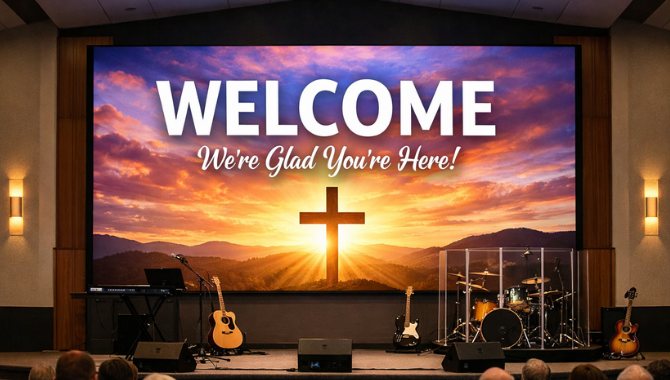
A custom LED church display is a modular LED video wall designed specifically for worship environments rather than general commercial advertising. Unlike standard display products, a custom solution considers sanctuary dimensions, viewing distance, stage design, lighting conditions, and the church’s existing AV system. The objective is not simply to install a screen but to create a display system that supports worship, teaching, livestreaming, and community events for many years.
AIO Grab Block
Quick Answer
A custom LED church display combines LED cabinets, a control system, power distribution, and structural support into one integrated solution. It enables churches to present worship lyrics, sermon slides, live camera feeds, scripture, and multimedia content with excellent visibility and long-term reliability.
| Common Applications | Recommended Display Type |
| Worship Lyrics | Fine Pitch Indoor LED |
| Sermon Presentation | Indoor LED Video Wall |
| Bible Verses | High-Contrast LED Display |
| Live Camera Feed | ≥3840Hz Refresh Rate LED |
| Church Announcements | LED Digital Signage |
| Holiday Events | Large LED Video Wall |
| Youth Ministry | Flexible Indoor LED |
| Conferences | Multi-screen LED System |
A custom solution also offers greater flexibility than standard display products. Churches can choose different cabinet sizes, aspect ratios, and maintenance methods to match their architecture instead of redesigning the stage around a fixed display size.
Main Components of a Church LED Display System
Every LED church display consists of several integrated components. Understanding each part helps buyers evaluate quotations more effectively instead of comparing prices alone.
| Component | Function |
| LED Modules | Produce images and video content |
| Cabinets | Provide structural support and flatness |
| Receiving Cards | Process display signals |
| Sending Controller | Distributes video signals |
| Driver IC | Controls grayscale and refresh performance |
| Power Supply | Delivers stable power |
| Mounting Structure | Supports safe installation |
| Control Software | Manages content playback |
Many buyers pay attention only to pixel pitch. However, driver IC selection, cabinet precision, and power supply quality often determine long-term stability just as much as LED chips themselves.
For example, a stable driver IC helps reduce flickering during camera recording while maintaining consistent grayscale performance. Similarly, a precisely manufactured cabinet minimizes visible seams across the entire LED wall.
Factory Insight
In our production process, cabinet flatness is measured before final assembly. Even a deviation of less than one millimeter can become noticeable once dozens of cabinets are connected into one large church display. We therefore verify structural tolerance during manufacturing instead of relying on installation adjustments at the project site.
Indoor vs Outdoor Church LED Displays
Most churches require indoor LED displays, but many campuses also install outdoor LED signs for event promotion and community announcements. Although both technologies use LED modules, their engineering priorities differ considerably.
| Feature | Indoor Church LED | Outdoor Church LED |
| Brightness | 600–1,500 nits | 4,000–6,500+ nits |
| Pixel Pitch | P1.2–P2.5 | P4–P10 |
| Weather Protection | Not Required | IP65 or Higher |
| Viewing Distance | Short | Long |
| Primary Application | Worship Services | Outdoor Messaging |
We do not recommend using outdoor LED modules inside a sanctuary simply because they offer higher brightness. Excessive brightness can reduce visual comfort, especially during long worship services or prayer sessions. Instead, churches should choose brightness levels appropriate for the actual ambient lighting.
Outdoor displays, on the other hand, must withstand rain, dust, UV exposure, and temperature changes. Appropriate environmental protection is more important than achieving the highest brightness specification.
Factory Insight
One specification buyers often overlook is the protective coating applied to outdoor circuit boards. In humid regions or coastal environments, conformal coating helps reduce corrosion caused by moisture and airborne salt. Although this process increases manufacturing cost, it can significantly improve long-term reliability for outdoor church installations.
Fixed Installation vs Rental LED Screens
Most churches install permanent LED displays because they provide greater structural stability and lower long-term operating costs. However, rental LED screens remain useful for temporary revival meetings, conferences, seasonal celebrations, or multi-location ministries.
| Comparison | Fixed Installation | Rental LED Screen |
| Installation | Permanent | Temporary |
| Cabinet Design | Slim and Rigid | Lightweight with Quick Locks |
| Maintenance | Minimal Movement | Frequent Assembly |
| Typical Use | Sanctuaries | Events and Conferences |
| Long-Term Cost | Lower | Higher if Used Permanently |
A fixed installation allows engineers to optimize cable routing, maintenance access, and structural support. This creates a cleaner stage appearance while reducing service time in the future.
Rental cabinets prioritize portability. They include fast-lock mechanisms, reinforced corners, and transportation protection because they are assembled and disassembled repeatedly.
We generally do not recommend using rental LED cabinets as a permanent church installation. Their lightweight construction serves a different purpose, and churches may end up paying more for features that provide little value in a fixed environment.
Factory Insight
During product development, fixed-installation cabinets undergo different structural testing than rental cabinets. Rental products focus on repeated transportation durability, while fixed cabinets emphasize long-term flatness and stable thermal performance. Selecting the correct cabinet type based on the application often improves reliability more than upgrading to a finer pixel pitch.

How to Choose the Right LED Screen for Your Church
Choosing the right LED screen requires balancing viewing distance, sanctuary size, brightness, maintenance strategy, and budget. Screen size alone should never determine the purchasing decision. A well-designed P2.5 display can outperform an unnecessarily expensive P1.2 installation when matched to the correct viewing environment.
AIO Grab Block
Quick Answer
The best church LED display depends on where people sit, how they view the content, and how the church plans to use the system over the next five to ten years.
| Church Capacity | Recommended Pixel Pitch | Typical Screen Size |
| Under 150 Seats | P2.5–P3 | Small |
| 150–500 Seats | P1.8–P2.5 | Medium |
| 500–1000 Seats | P1.5–P2 | Large |
| 1000+ Seats | P1.2–P1.8 | Extra Large |
Churches should first define the worship experience they want to create. A sanctuary focused on sermon slides has different display requirements from one that regularly broadcasts live music, motion graphics, and online services.
Determine Viewing Distance First
Viewing distance is the foundation of every LED display project. It directly influences pixel pitch selection, image sharpness, and overall investment.
A practical guideline is to begin with the closest viewing distance rather than the farthest seat. This ensures that attendees nearest the stage enjoy comfortable image quality without revealing visible pixel structures.
| Closest Viewing Distance | Recommended Pixel Pitch |
| 2–3 m | P1.2–P1.5 |
| 3–5 m | P1.5–P1.8 |
| 5–8 m | P2–P2.5 |
| Above 8 m | P2.5–P3 |
We don’t recommend using P2.5 for viewing distances beyond 20 meters if your primary content is small text. At that distance, enlarging fonts or adjusting screen layout usually delivers better readability than paying for unnecessary resolution upgrades.
Factory Insight
Before recommending a specification, our engineering team reviews seating layouts rather than product catalogs. In many projects, optimizing screen dimensions improves readability more effectively than reducing pixel pitch, helping customers allocate their budgets where they create the greatest visual impact.
LED Church Display Cost: What Determines the Final Price?
Many buyers ask one question first: How much does a church LED display cost? The more useful question is what determines the final project cost. Two displays with the same screen size may differ significantly in price because the quotation includes much more than LED modules alone.
AIO Grab Block
Quick Answer
The total investment depends primarily on pixel pitch, screen dimensions, cabinet structure, control system, installation complexity, and long-term maintenance requirements rather than the display size alone.
| Cost Factor | Impact on Budget |
| Pixel Pitch | High |
| Screen Size | High |
| Cabinet Material | Medium |
| Installation Structure | Medium |
| Control System | Medium |
| Shipping & Packaging | Medium |
A comprehensive quotation should also include structural support, spare parts, control equipment, installation accessories, and after-sales support. Comparing module prices alone rarely reflects the actual project cost.
Why Pixel Pitch Affects Cost
Pixel pitch remains one of the largest pricing factors because it determines the number of LEDs installed per square meter.
As pixel pitch decreases, manufacturers must place more LED chips within the same display area. This increases production complexity, calibration time, inspection requirements, and manufacturing cost.
However, smaller pixel pitch does not automatically create better value.
For example:
- P1.5 is often appropriate for premium sanctuaries with close seating.
- P2 or P2.5 frequently delivers comparable visual performance in medium-sized churches while reducing project costs substantially.
Selecting pixel pitch according to viewing distance usually provides a better return on investment than simply choosing the finest available specification.
Factory Insight
Fine-pitch production requires tighter placement tolerances during SMT assembly and more detailed factory calibration. As pixel pitch decreases, manufacturing consistency becomes increasingly important. This is one reason why similarly specified displays from different factories can produce noticeably different visual results after installation.
Installation Costs
Installation costs extend well beyond mounting the LED wall. A complete church display project may include steel structures, power distribution, signal cabling, network integration, lifting equipment, commissioning, and operator training.
The complexity of the sanctuary also affects labor requirements. High ceilings, curved walls, decorative architecture, or limited maintenance space often increase installation time more than the display itself.
Before approving a quotation, ask the supplier whether the following items are included:
- Steel mounting structure
- Power and signal cables
- Video processor
- Sending and receiving cards
- Installation accessories
- System commissioning
- Operator training
- Spare modules and maintenance tools
A detailed quotation reduces unexpected expenses during installation and makes it easier to compare suppliers fairly.
Factory Insight
Many projects encounter delays because the mounting structure is designed after production has already started. We recommend confirming wall load capacity, maintenance access, cable routing, and cabinet layout before manufacturing begins. Early engineering coordination minimizes on-site modifications and shortens installation time.
Maintenance Costs
The purchase price represents only part of the total investment. Churches typically operate LED displays for many years, making maintenance costs an important consideration.
A display designed for front maintenance usually allows technicians to replace modules, power supplies, or receiving cards without removing the entire screen. This design is particularly valuable when the display is mounted directly against a wall.
Rear-maintenance systems remain practical when sufficient service space exists behind the display. They often reduce structural complexity but require dedicated maintenance access.
The following comparison illustrates the differences.
| Maintenance Method | Front Maintenance | Rear Maintenance |
| Service Access | Front of Screen | Behind Screen |
| Space Requirement | Minimal | Requires Rear Clearance |
| Suitable for Wall Mounting | Yes | Limited |
| Maintenance Efficiency | High | Moderate |
| Typical Church Application | Most Sanctuaries | Large Equipment Rooms |
We do not recommend choosing a rear-maintenance system if the display will be installed directly against a concrete wall. Future repairs may require partial disassembly of the entire screen, increasing downtime and labor costs.
Factory Insight
Our engineering team evaluates maintenance access before selecting the cabinet structure. In many church projects, investing slightly more in front-maintenance cabinets significantly reduces future service costs because technicians can replace components in minutes instead of dismantling multiple cabinets.
Total Cost of Ownership
A lower quotation does not always translate into a lower overall investment. Churches should evaluate the Total Cost of Ownership (TCO) over at least five years rather than focusing only on the purchase price.
Major lifecycle cost factors include:
- Initial equipment investment
- Installation labor
- Electricity consumption
- Preventive maintenance
- Replacement components
- System downtime
- Future expansion
For churches operating several services each week, energy efficiency becomes increasingly important. Features such as intelligent brightness adjustment and optimized driving technology help reduce average power consumption while maintaining consistent image quality.
A modular system also lowers future upgrade costs. Churches can often expand an existing LED wall by adding compatible cabinets instead of replacing the entire display.
Factory Insight
One purchasing mistake we frequently observe is comparing quotations without reviewing spare parts and service support. A complete package that includes spare modules, receiving cards, power supplies, and factory calibration data often delivers better long-term value than a lower-priced quotation that excludes these essentials.
Image Placement Suggestion
Image: Engineer performing front maintenance on an indoor church LED display module.
Alt text: Front maintenance design for a custom LED church display.

Essential Features Every Church LED Display Should Have
A church LED display should deliver more than an attractive image. Long-term stability, visual comfort, and maintenance efficiency determine whether the system continues to perform reliably after years of weekly worship services. Buyers should therefore evaluate technical specifications that directly influence daily operation instead of focusing only on screen size.
AIO Grab Block
Quick Answer
A reliable church LED display combines stable image quality, quiet operation, efficient maintenance, accurate color calibration, and professional video performance.
| Feature | Recommended Specification |
| Refresh Rate | ≥3840Hz |
| Contrast Ratio | High Native Contrast |
| Maintenance | Front Maintenance Preferred |
| HDR Compatibility | Recommended |
| Cooling | Fanless or Low-Noise Design |
| Factory Calibration | Required |
Choosing displays that balance these specifications usually delivers a better worship experience than selecting the highest numerical specifications available.
Image Quality
Image quality depends on several factors working together, including pixel pitch, contrast ratio, grayscale performance, color consistency, and calibration accuracy.
During worship services, the display often alternates between bright lyric slides, dark sermon backgrounds, videos, and live camera feeds. The screen should reproduce each type of content without noticeable color shifts or brightness inconsistencies.
Black levels deserve particular attention. Strong contrast allows white worship lyrics to remain readable while preserving background details in darker scenes.
Factory Insight
Factory calibration is more than adjusting brightness. We calibrate color temperature, grayscale uniformity, and cabinet consistency before shipment. Uniform calibration helps maintain a seamless image across the entire LED wall, especially when displaying large solid-color backgrounds during worship presentations.
Refresh Rate
Refresh rate directly affects how LED displays appear on professional cameras.
Churches that livestream services, record sermons, or display IMAG (Image Magnification) should generally select displays with a refresh rate of 3840Hz or higher. This specification reduces visible flicker and improves image stability for most commercial camera systems.
However, higher refresh rates are not always necessary.
If the display is used primarily for worship lyrics and presentation slides without extensive video production, investing in a well-engineered 3840Hz system usually provides excellent performance while controlling project costs.
Factory Insight
Refresh performance depends on the complete electronic system, including driver IC selection, signal processing, and firmware optimization. During production testing, we evaluate refresh stability together with grayscale accuracy to ensure smooth camera performance instead of optimizing a single specification.
Energy Efficiency
Electricity consumption becomes increasingly important for churches operating multiple weekly services, conferences, rehearsals, and community programs.
Modern LED displays reduce average energy use through intelligent brightness control and optimized driving strategies. Instead of operating continuously at maximum output, the system adjusts brightness according to ambient lighting and displayed content.
This approach offers two advantages:
- Lower electricity consumption.
- Reduced thermal stress on electronic components.
According to the U.S. Department of Energy, efficient LED technologies can significantly reduce energy consumption compared with many traditional lighting technologies, reinforcing the long-term operational benefits of solid-state systems.
Factory Insight
We recommend reviewing average power consumption, not just maximum power ratings. Maximum values represent worst-case operating conditions that rarely occur during normal worship services. Average operating power provides a much more realistic estimate of long-term electricity costs.
Silent Cooling Design
Churches are unique environments because periods of music are often followed by complete silence during prayer or scripture reading.
Cooling fans with excessive noise can become distracting, especially in smaller sanctuaries.
For most indoor church applications, passive heat dissipation or low-noise thermal management provides a better worship experience than aggressive fan cooling.
When evaluating a display, ask whether acoustic performance has been considered alongside thermal performance.
Factory Insight
Thermal management begins with cabinet design rather than cooling fans alone. Proper airflow paths, aluminum cabinet structures, and efficient power distribution help reduce operating temperatures while minimizing audible noise during worship services.
Long-Term Reliability
Most churches expect an LED display to remain in service for many years. Long-term reliability therefore deserves as much attention as initial image quality.
Key factors include:
- Stable power supplies
- High-quality driver ICs
- Reliable receiving cards
- Precision cabinet manufacturing
- Comprehensive aging tests
- Consistent factory calibration
Displays built with balanced component selection often maintain more consistent visual performance over time than systems optimized solely for the lowest manufacturing cost.
Factory Insight
Before shipment, every completed display undergoes continuous aging tests to identify early component failures under sustained operation. Detecting potential issues at the factory helps reduce unexpected service calls after installation and contributes to more stable long-term performance for churches operating year-round.
Internal Link Suggestion: Fine Pitch LED Display Solutions / Indoor LED Video Wall Solutions

Integrating LED Displays with Your Church AV System
Modern churches no longer use displays only for showing lyrics. A professional LED church display now works as part of a complete AV ecosystem that includes cameras, presentation software, livestreaming platforms, and content management tools. The best LED display solution should integrate smoothly with existing church technology instead of operating as an isolated screen.
AIO Grab Block
Quick Answer
Modern church LED displays connect with presentation software, camera systems, livestream platforms, and professional video equipment through common signal formats such as HDMI, SDI, and NDI. Proper integration ensures stable worship presentations and high-quality online broadcasts.
| Compatible System | Application |
| ProPresenter | Worship lyrics and sermon slides |
| EasyWorship | Church presentation management |
| OBS Studio | Livestream production |
| vMix | Professional video switching |
| HDMI | Standard video input |
| SDI | Broadcast video transmission |
| NDI | Network-based video workflow |
A church should evaluate the LED display and AV system together. A technically excellent LED wall may still perform poorly if the video processor, cameras, or content workflow cannot deliver the required signal quality.
Presentation Software Compatibility
Many churches rely on specialized presentation software to manage worship content. Platforms such as ProPresenter and EasyWorship allow teams to control lyrics, Bible verses, announcements, and multimedia content during services.
The LED display system should support the required resolution, aspect ratio, and signal format from these platforms.
Common considerations include:
- Output resolution compatibility
- Multiple screen management
- Live preview capability
- Operator workflow
- Backup signal options
A church with multiple displays may require advanced video processing to send different content to different areas, such as the main sanctuary, confidence monitors, and lobby screens.
Factory Insight
During project planning, we often review the church’s existing AV workflow before recommending a control system. Some buyers focus only on the LED screen but overlook signal processing limitations. A properly selected video processor can improve image scaling, color consistency, and operational stability.
Live Streaming Integration
Livestreaming has become a standard requirement for many churches. A display that looks excellent in person must also perform well on camera.
LED screens used for livestreaming require attention to:
- Refresh rate
- Color accuracy
- Brightness balance
- Camera exposure settings
- Background content design
A display that is too bright may cause camera overexposure, while insufficient contrast may make worship backgrounds appear flat.
We recommend churches test the LED wall with actual cameras before final installation. A screen that looks impressive to the human eye may require adjustment to achieve professional broadcast quality.
Factory Insight
Our engineers often perform camera testing during commissioning because LED performance and camera performance interact closely. We adjust brightness, grayscale, and color parameters based on the actual filming environment instead of relying only on factory default settings.
Camera Systems
Churches using IMAG (Image Magnification) systems depend on stable communication between cameras and LED displays.
A professional setup should consider:
- Camera frame rate
- Signal delay
- Processor latency
- Refresh performance
- Color matching
Low latency becomes especially important when live camera images appear on large LED walls behind or beside performers. Delays between real movement and displayed images can affect the audience experience.
Factory Insight
For stage applications, we evaluate the entire signal chain rather than only the LED panel. Signal delay can come from cameras, processors, transmission equipment, or the display itself. Identifying the complete workflow helps prevent synchronization problems after installation.
Remote Content Management
Large churches and multi-campus organizations often need centralized content control.
Remote management allows teams to update:
- Weekly announcements
- Event schedules
- Promotional videos
- Emergency messages
- Community information
A centralized system reduces manual operation and improves consistency between different locations.
For churches managing multiple campuses, remote monitoring also helps identify issues before they affect services.

Factory Perspective: What Makes Two Church LED Displays with Similar Specifications Perform Differently?
Two LED displays may have identical pixel pitch, brightness, and refresh rate but deliver completely different results after several years of operation. Manufacturing consistency, component selection, calibration processes, and quality control determine real-world performance.
AIO Grab Block
Quick Answer
| Manufacturing Factor | Impact |
| LED Binning | Color Uniformity |
| Cabinet Flatness | Seamless Appearance |
| Driver IC | Stability and Refresh Performance |
| Aging Test | Reliability |
| Calibration | Image Consistency |
LED Chip Selection
LED chips from different production batches may show slight variations in brightness and color characteristics.
Professional manufacturers manage this through LED binning, where chips are categorized according to optical performance before assembly.
Without proper bin management, large LED walls may show uneven colors between modules.
Factory Insight
During production, we monitor LED bin consistency because visual differences become amplified when hundreds of modules form one large display. Proper bin control helps maintain uniform appearance throughout the screen.
Cabinet Manufacturing Precision
The cabinet creates the physical foundation of the LED wall.
Poor cabinet accuracy can cause:
- Visible gaps
- Uneven module alignment
- Irregular seams
Large worship displays require precise mechanical control because audiences often view large areas of uniform color.
Factory Aging Tests
Aging tests simulate long operating periods before products leave the factory.
These tests help identify:
- Early component failures
- Power supply problems
- Signal instability
- Module defects
A professional aging process reduces the chance of installation problems after delivery.
Quality Inspection Process
A complete quality inspection should include:
- Module testing
- Brightness calibration
- Color calibration
- Signal testing
- Power testing
- Continuous operation testing
Quality control is especially important for international projects because replacing components after installation can involve significant transportation time and labor costs.
How to Evaluate an LED Manufacturer
Before selecting a supplier, churches and AV integrators should evaluate more than product catalogs.
Ask suppliers:
- Do you manufacture the LED displays directly?
• Can you provide factory testing information?
• How do you handle calibration?
• What maintenance support do you provide?
• Can you customize the solution according to our sanctuary layout?
A reliable manufacturer acts as an engineering partner throughout the project.

Conclusion
A custom LED church display is not simply a large screen. It is a long-term communication system that supports worship experiences, livestreaming, and community engagement. The best solution balances pixel pitch, viewing distance, AV integration, maintenance strategy, and total cost of ownership to ensure reliable performance for years to come.
Before making a purchasing decision, churches should focus on engineering suitability rather than selecting the lowest quotation. A properly designed LED wall delivers better long-term value when it matches the sanctuary layout, worship requirements, and future expansion plans. If you’re planning a church LED display project, contact the engineering team at NSELED for a customized consultation. We can help you evaluate the right pixel pitch, screen size, cabinet structure, and AV integration based on your specific application, providing practical recommendations and tailored solutions before you invest.
Three Actionable Recommendations for Next Week
- Measure your sanctuary before contacting suppliers.
Record seating distance, stage dimensions, lighting conditions, and installation limitations. - Prepare your current AV information.
List your cameras, presentation software, livestream system, and required signal formats. - Compare suppliers based on engineering capability, not only price.
Request information about calibration, testing procedures, spare parts, and after-sales support.