


Building an outdoor theater requires choosing the right display solution.
Many buyers struggle with poor visibility, high maintenance costs, or disappointing audience experiences after installation. In outdoor environments, sunlight, weather, and viewing distance create challenges that traditional display solutions cannot always handle effectively.
In this guide, you will learn how to choose the best display for your outdoor theater, compare LED screens and projectors, and make a smarter investment decision based on performance, cost, and long-term ROI.

Understanding Outdoor Theater Display Options
The best outdoor theater display depends on brightness, scalability, and environment.
You can choose between LED displays, projectors, or LCD video walls, but each option serves a different purpose and budget level.
To make the right decision, you need to evaluate not only the technology but also how it performs in real outdoor conditions such as daylight exposure, weather resistance, and installation flexibility.
LED Displays vs Projectors vs LCD Video Walls
Each display type has unique strengths and limitations. The key is to match the technology with your project requirements rather than choosing based on price alone.
| Display Type | Advantages | Limitations | Best Use Case |
| LED Display | High brightness, weatherproof, scalable | Higher upfront cost | Outdoor cinemas, DOOH |
| Projector | Lower initial cost, easy setup | Poor daylight visibility, maintenance-heavy | Backyard, temporary setups |
| LCD Video Wall | High resolution, good color accuracy | Not suitable for outdoor weather | Indoor or semi-outdoor use |
According to U.S. Department of Energy, LED technology is significantly more energy-efficient than traditional lighting systems, which contributes to lower long-term operating costs in large installations.
Key Differences in Brightness, Scalability, and Flexibility
Brightness is the most critical factor in outdoor environments. Projectors typically deliver 2,000–5,000 lumens, which struggle in ambient light. In contrast, LED displays provide 5,000–10,000+ nits, making them clearly visible even in daylight.
Scalability also plays a major role. LED displays use modular panels, so you can build almost any size or shape. Projectors and LCD walls have fixed size limitations, which restricts large-scale commercial applications.
Flexibility matters when dealing with different projects. LED systems allow:
- Custom shapes and curved designs
- Easy maintenance with front or rear access
- Adaptability for permanent or rental use
Scenario-Based Recommendations (When to Choose Each Option)
Choosing the right display becomes easier when you look at real-world scenarios instead of technical specs alone.
Choose LED displays if you:
- Need daytime visibility
- Run commercial or large-scale projects
- Want long-term ROI and durability
Choose projectors if you:
- Have a limited budget
- Operate only at night
- Need a temporary or portable setup
Avoid LCD video walls outdoors unless:
- The environment is fully protected
- The installation is semi-indoor
LED displays are the most future-proof solution for outdoor theaters, especially for B2B buyers focusing on performance and long-term value.

LED Screen vs Projector
To make the right decision, you need to compare these two technologies across real performance factors—not just specifications on paper.
Brightness and Daylight Visibility
Brightness determines whether your audience can actually see the screen. Projectors rely on lumens, while LED displays use nits, which measure direct light output.
In outdoor environments, ambient light becomes the biggest challenge. Even high-end projectors struggle during daytime or in urban environments with strong lighting.
| Factor | LED Display | Projector |
| Brightness | 5,000–10,000+ nits | 2,000–5,000 lumens |
| Daylight Visibility | Excellent | Poor |
| Night Performance | Excellent | Good |
If your project requires daytime operation, LED is the only reliable option.
Image Quality and Audience Experience
Image quality affects how immersive your outdoor theater feels. LED displays deliver consistent brightness, strong contrast, and wide viewing angles.
Projectors depend heavily on environmental conditions. Any ambient light reduces contrast and washes out colors. Wind, dust, or uneven surfaces can also affect projection quality.
LED displays provide:
- Stable brightness across the entire screen
- Better color saturation and contrast
- Wider viewing angles for large audiences
For commercial theaters or events, consistent image quality directly impacts customer satisfaction and repeat business.
Installation and Setup Complexity
Projectors appear simple at first, but they require precise setup. You need correct alignment, projection distance, and a suitable screen surface.
LED displays use modular panels, which simplify scaling and customization. Once installed, they require less adjustment.
| Factor | LED Display | Projector |
| Setup Time | Medium | Fast (initial) |
| Alignment Required | Minimal | High |
| Scalability | Highly flexible | Limited |
| Structural Needs | Mounting system required | Screen + projector positioning |
For large or permanent installations, LED systems offer more stability and flexibility.
Maintenance, Lifespan, and Reliability
Maintenance plays a major role in long-term costs. Projectors require frequent lamp replacements, filter cleaning, and calibration.
LED displays have a much longer lifespan. Many outdoor LED systems reach 100,000 hours or more, according to U.S. Department of Energy.
Projector challenges include:
- Lamp replacement every 2,000–5,000 hours
- Performance degradation over time
- Sensitivity to dust and weather
LED advantages include:
- Long lifespan
- Stable performance
- Weather-resistant design
Lower maintenance means lower operational risk and cost over time.
Total Cost of Ownership (TCO) and ROI Comparison
Initial cost often misleads buyers. Projectors look cheaper upfront, but ongoing expenses add up quickly.
LED displays require higher initial investment, but they reduce long-term costs through durability and efficiency.
| Cost Factor | LED Display | Projector |
| Initial Cost | High | Low |
| Maintenance Cost | Low | High |
| Lifespan | 80,000–100,000 hours | 5,000–20,000 hours |
| Energy Efficiency | High | Moderate |
| Long-Term ROI | Strong | Weak |
B2B buyers should focus on total lifecycle cost, not just upfront price. LED displays deliver significantly better ROI for long-term outdoor projects.
Key Technical Factors When Choosing an Outdoor Display
Choosing the right outdoor display depends on matching technical specifications with your real application needs.
If you ignore key parameters like pixel pitch, brightness, or IP rating, you risk poor visibility, higher costs, and reduced lifespan.
To make a smart investment, you need to understand how each technical factor directly affects performance, user experience, and long-term ROI.
- Pixel Pitch and Viewing Distance (How to Choose Correctly)
- Brightness (Nits) vs Ambient Light Conditions
- Screen Size, Resolution, and Aspect Ratio Planning
- Refresh Rate and Camera Compatibility
- Weatherproof Ratings (IP65/IP67) and Durability
- Energy Consumption and Operating Costs

Choosing the Right Display for Different Use Cases
The best display solution depends on your specific application, not just technical specifications.
Different scenarios require different priorities such as brightness, mobility, cost, and viewing distance.
If you choose a display without considering the use case, you may overspend or fail to meet performance expectations.
Outdoor Cinemas and Drive-In Theaters
Outdoor cinemas and drive-ins require large screens, high brightness, and long viewing distances. These projects often operate in semi-urban or open environments.
For these applications, LED displays offer clear advantages:
- High brightness for dusk-to-daytime operation
- Large seamless screen sizes
- Long lifespan for continuous use
Typical recommendation:
- Pixel pitch: P6–P10
- Brightness: 6,000–10,000 nits
LED displays are the industry standard for modern outdoor cinemas due to reliability and scalability.
Event and Rental Business Applications
Event companies need flexibility, fast setup, and reliable performance. Time efficiency directly impacts profitability in rental businesses.
LED rental displays are specifically designed for:
- Quick installation and dismantling
- Lightweight transport
- High refresh rate for camera use
Key features to prioritize:
- Modular cabinet design
- Front and rear maintenance
- Durable locking systems
Faster setup means more events per year, which increases revenue.
DOOH Advertising and Commercial Installations
Digital Out-of-Home (DOOH) advertising requires 24/7 operation, high brightness, and strong ROI performance.
These installations are typically located in:
- High-traffic urban areas
- Transportation hubs
- Commercial centers
LED displays are ideal because they provide:
- Continuous operation capability
- High visibility in all lighting conditions
- Scalable sizes for large audiences
According to World Out of Home Organization, DOOH advertising continues to grow globally due to its high engagement and visibility.
For commercial investors, LED displays deliver stronger long-term returns compared to traditional signage.
High-End Residential Backyard Theaters
Backyard theaters focus more on aesthetics, cost control, and ease of use rather than large-scale performance.
In these cases, both projectors and LED displays can work depending on budget.
Projectors are suitable if:
- The setup is used only at night
- Budget is limited
- Portability is required
LED displays are suitable if:
- You want premium image quality
- You need minimal maintenance
- The installation is permanent
For luxury residential projects, LED displays provide a premium experience with minimal long-term hassle.
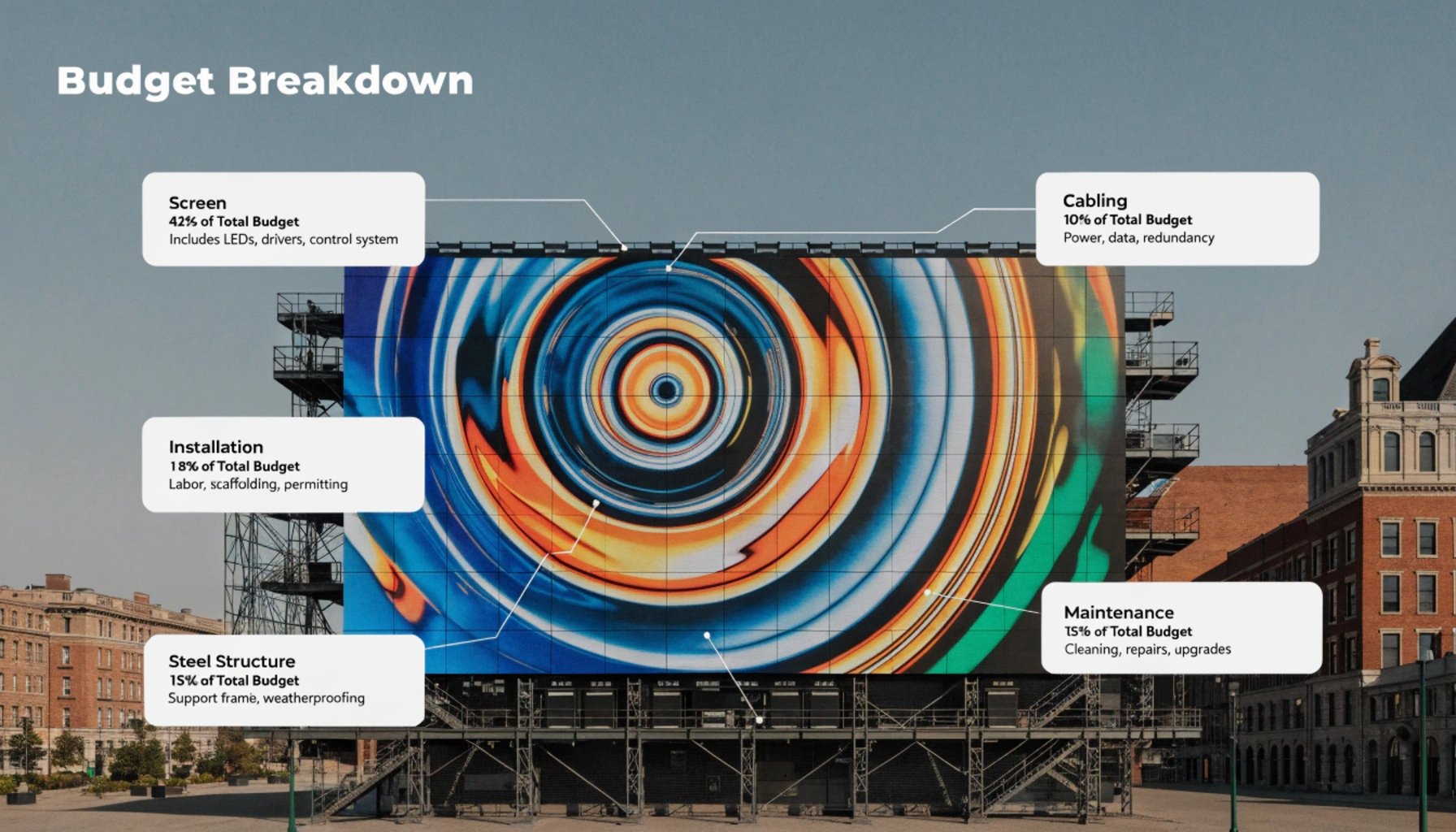
Cost Breakdown: How to Budget for an Outdoor Theater Display
The real cost of an outdoor theater display goes far beyond the initial purchase price.
To make a smart investment, you must evaluate total cost, including installation, operation, and long-term maintenance.
Many buyers focus only on upfront pricing, but experienced B2B buyers prioritize total cost of ownership (TCO) and long-term ROI.
LED Screen Pricing per Square Meter
LED display pricing varies significantly depending on specifications such as pixel pitch, brightness, and configuration.
Smaller pixel pitch and higher brightness usually mean higher costs. Outdoor displays also require weatherproof design, which increases pricing.
| Specification Factor | Impact on Price |
| Pixel Pitch | Smaller pitch = higher cost |
| Brightness (Nits) | Higher brightness = higher cost |
| Cabinet Quality | Better materials = higher cost |
| Brand & Manufacturing | Established factory = higher price |
Outdoor LED displays can range from $800 to $3,000+ per square meter, depending on specifications and quality level.
Installation and Infrastructure Costs
Installation costs are often underestimated, but they can account for a significant portion of the total budget.
You need to consider:
- Steel structure or mounting system
- Labor and engineering costs
- Electrical setup and cabling
- Transportation and logistics
For large projects, infrastructure costs may represent 20%–40% of the total investment.
Proper planning at this stage can prevent costly modifications later.
Maintenance and Long-Term Operating Costs
Ongoing costs determine the profitability of your project over time.
LED displays generally require less maintenance compared to projectors, but you still need to plan for:
- Module replacement
- Power consumption
- Routine inspections
According to U.S. Department of Energy, energy-efficient systems can significantly reduce long-term operational expenses.
Typical cost factors include:
- Electricity (based on brightness and usage hours)
- Spare parts and repairs
- Technical support
Lower maintenance directly improves operational stability and ROI.
Conclusion
Choosing the right display for an outdoor theater comes down to balancing performance, environment, and long-term cost. LED displays stand out as the most reliable solution for outdoor use, especially when brightness, durability, and scalability matter.
At the same time, your final decision should always match your specific use case. A small backyard setup may work with a projector, but commercial projects, events, and advertising applications require the stability and performance that LED technology provides.
If you are planning an outdoor theater project, working with an experienced manufacturer can help you avoid costly mistakes and optimize your investment. You can contact NSELED for customized LED display solutions, technical consultation, and project-based quotations tailored to your needs.
FAQs
What is the best display option for outdoor theaters?
LED displays are generally the best option because they provide high brightness, weather resistance, and long lifespan. Projectors are only suitable for small, nighttime, or temporary setups.
How bright should an outdoor LED screen be?
Most outdoor LED screens require at least 5,000–10,000 nits depending on ambient light conditions. Direct sunlight environments require higher brightness to maintain visibility.
Is LED better than a projector for outdoor use?
Yes, in most cases. LED displays perform better in brightness, durability, and long-term cost efficiency, making them the preferred choice for outdoor and commercial applications.