


Introduction
COB LED technology is becoming an increasingly important solution for high-end LED displays in 2026. As businesses demand finer pixel pitches, better image quality, stronger protection, and lower maintenance, LED manufacturers are looking beyond traditional packaging methods.

COB technology has continued to attract attention as the LED industry moves toward higher pixel density and more demanding professional applications. This trend highlights the growing role of COB in premium indoor LED displays and fine-pitch applications.
For distributors, system integrators, and project buyers, however, the important question is not simply whether COB is newer than SMD. Buyers need to understand how COB works, where it provides practical advantages, and which manufacturing factors determine its long-term performance.
Why COB LED Technology Matters in 2026
The LED display market is moving toward smaller pixel pitches and more sophisticated applications. Fine-pitch LED displays are increasingly used in corporate meeting rooms, control centers, broadcast studios, retail environments, education facilities, and other spaces where viewers may stand close to the screen.
These applications require more than high resolution. The display must maintain consistent brightness and color, provide reliable operation, resist accidental physical contact, and remain easy to maintain.
COB, or Chip-on-Board, technology addresses several of these requirements. Instead of using individual SMD packages, COB technology mounts LED chips directly onto a PCB and protects the chips with an encapsulation layer.
This structure allows manufacturers to create compact, high-density LED modules while improving surface protection. It is particularly valuable when a project requires a fine pixel pitch and a premium viewing experience.
However, COB should not be treated as an automatic upgrade for every LED project. Manufacturing quality, thermal design, calibration, component selection, and application requirements still determine the final performance.
What Makes COB LED Displays Different
The main difference between COB and SMD LED displays is their packaging structure.
With SMD technology, individual LED packages are manufactured separately before being mounted onto a PCB. With COB, the LED chips are directly bonded to the PCB and then protected by an encapsulation layer.
The resulting surface is more integrated and can provide stronger protection for the LED chips.
COB technology can also support very small pixel pitches. When pixels become smaller, the manufacturer needs to place more LED chips within a limited area. Direct chip packaging can provide a compact structure that supports this high-density design.
At the same time, COB production requires precise manufacturing processes. Chip placement, bonding, encapsulation, PCB quality, thermal management, and calibration all need to remain consistent.
For B2B buyers, this means that the manufacturer’s production capability can be just as important as the COB technology itself.
What Is COB LED Technology?
COB stands for Chip-on-Board. In an LED display, it refers to a packaging method in which LED chips are directly mounted onto a printed circuit board instead of being packaged into individual SMD components first.
After the chips are bonded and electrically connected, the LED surface is covered with a protective encapsulation material.
This creates a highly integrated LED module with a protected light-emitting surface.

How COB LED Displays Work
The basic working principle of a COB LED display is similar to other direct-view LED technologies.
Each pixel uses red, green, and blue LED chips to generate different colors. The display control system adjusts the brightness of these color channels to create images and video.
The major difference is the physical construction of the LED module.
In a COB module, LED chips are directly attached to the PCB. The encapsulation layer then protects the chips while creating a more uniform surface.
A complete COB LED display also contains driver ICs, power supplies, receiving cards, control systems, cables, cabinets, and thermal management components. Therefore, COB packaging should be viewed as one part of a complete LED display system.

The quality of every component can affect the final result.
COB vs. SMD LED Displays
SMD and COB are both established LED display technologies, but they serve different priorities.
SMD displays use individual LED packages and have a mature manufacturing ecosystem. They are available in many pixel pitches and brightness levels, making them suitable for indoor and outdoor applications.
COB displays use direct chip packaging and encapsulation. This can provide better surface protection and support high pixel densities, making COB particularly attractive for fine-pitch indoor applications.

| Feature | COB LED | SMD LED |
|---|---|---|
| LED packaging | LED chips mounted directly on PCB | Individual LED packages mounted on PCB |
| Surface protection | Strong protection through encapsulation | LED packages are more exposed |
| Fine-pitch capability | Excellent | Excellent, depending on product |
| Physical durability | Generally higher | Good, but more vulnerable to direct impact |
| Maintenance | Lower surface damage risk | Mature and relatively straightforward |
| Typical applications | Premium indoor, control rooms, conference rooms | Indoor, outdoor, rental, advertising |
| Cost | Generally higher | Generally more cost-effective |
Neither technology is universally better. The right choice depends on the environment, viewing distance, budget, and expected operating conditions.
Key Features and Benefits of COB LED Displays
COB technology provides several advantages that are particularly relevant to premium LED display projects.

Better Protection and Long-Term Durability
One of the most visible advantages of COB technology is its protected surface.
In a conventional SMD display, individual LED packages are exposed on the module surface. Accidental contact, transportation, installation, or cleaning can potentially damage these components.
COB encapsulation adds a protective layer over the LED chips. This can reduce the risk of physical damage and improve the durability of the display surface.
This feature is valuable in public environments, meeting rooms, retail spaces, and other locations where personnel may frequently work around the screen.
However, buyers should not assume that encapsulation eliminates all failure risks. The PCB, driver ICs, connectors, power supplies, and other components still require proper protection and quality control.
Fine Pixel Pitch and Improved Image Quality
COB is particularly well suited to fine-pitch LED displays.
A smaller pixel pitch increases pixel density and allows viewers to stand closer to the display without easily seeing individual pixels.
This is important for conference rooms, command centers, broadcast studios, and premium commercial spaces.
For example, a large display with a 1.2 mm or 1.5 mm pixel pitch can provide detailed content at relatively short viewing distances. However, the smallest available pixel pitch is not always the best choice.
If viewers are several meters away, an unnecessarily small pixel pitch may add cost without producing a noticeable improvement.
Therefore, pixel pitch should always be selected according to the actual viewing distance and content requirements.
High Contrast, Color Consistency, and Reliability
COB displays can provide a clean, uniform black surface that contributes to strong contrast and a premium visual appearance.
This is especially useful when displaying dark backgrounds, presentations, video content, or high-contrast graphics.
Color consistency, however, depends on more than the packaging technology.
LED chip binning, driver IC performance, PCB design, calibration, and manufacturing tolerances all influence the final image.
For large projects, module-to-module consistency is particularly important. A single module may look excellent during testing, but differences can become visible if modules from different production batches have inconsistent optical characteristics.
A reliable manufacturer must therefore control both individual module quality and batch-to-batch consistency.
Lower Maintenance Requirements
The encapsulated COB surface can reduce the risk of physical damage during cleaning and routine handling.
This may help lower maintenance requirements over the display’s service life, especially in high-traffic or frequently serviced environments.
COB can also make the surface easier to clean because there are fewer exposed LED package structures.
Nevertheless, a COB display is not maintenance-free. Power supplies, receiving cards, cables, driver components, and other electronic parts may still require inspection or replacement.
The practical benefit is that COB can reduce certain types of surface-related maintenance rather than eliminate maintenance altogether.
COB LED Applications and Solutions
COB technology is most attractive in applications that combine close viewing distances, high image-quality requirements, and strong reliability expectations.

Corporate, Conference, and Control Rooms
Corporate meeting rooms increasingly use large-format LED displays instead of traditional projection systems.
COB fine-pitch displays can provide seamless images without the visible bezels found between multiple LCD panels.
In conference rooms, the display may show presentations, spreadsheets, video calls, product demonstrations, or detailed graphics. Fine pixel pitch and consistent color are therefore important.
Control rooms have similar requirements. Operators may monitor maps, dashboards, surveillance feeds, or other data for extended periods.

In these environments, visual consistency and long-term reliability are often more important than achieving the lowest initial purchase price.
Retail, Education, and Commercial Spaces
Retail stores and shopping environments can use COB LED displays to create high-impact visual experiences.

The fine pixel pitch allows brands to display detailed product images and promotional videos even when customers stand relatively close to the screen.
Educational institutions can also use fine-pitch LED displays in lecture halls, classrooms, and multipurpose spaces.
For these projects, buyers should evaluate ambient lighting, viewing distance, screen size, installation conditions, and expected operating hours before selecting the LED specification.
Broadcast and Other High-End Indoor Applications
Broadcast environments place strict requirements on LED display performance.

A display used in front of cameras needs an appropriate refresh rate and processing system to minimize flicker and scanning issues.
COB fine-pitch technology can provide the high pixel density required for studio and production environments.
Other potential applications include financial institutions, museums, premium showrooms, virtual production environments, command centers, and high-end experience centers.
These projects generally require a combination of image quality, reliability, and long-term consistency.
COB vs. SMD LED: Which Technology Should You Choose?
The choice between COB and SMD should be based on project requirements rather than the assumption that one technology is always superior.
Durability, Image Quality, and Maintenance
COB has a clear structural advantage in surface protection because the LED chips are covered by an encapsulation layer.
This makes it attractive for installations where accidental contact or frequent cleaning may occur.
COB can also be a strong option for fine-pitch applications that require close viewing.
SMD remains highly competitive because of its mature manufacturing process and broad product range. High-quality SMD displays can provide excellent brightness, color performance, and reliability.
For large outdoor advertising screens, rental displays, or cost-sensitive projects, SMD may still provide a better overall balance.
For premium indoor applications, COB may offer stronger long-term value when surface protection and fine-pitch performance are priorities.
Cost and Application Considerations
COB displays generally require more sophisticated manufacturing processes and may have a higher initial cost.
However, comparing only the purchase price can lead to an incomplete decision.
A buyer should consider the total cost of ownership, including maintenance, replacement requirements, installation, energy consumption, and expected service life.

| Consideration | COB May Be More Suitable | SMD May Be More Suitable |
|---|---|---|
| Viewing distance | Very close | Medium to long |
| Pixel pitch | Fine pitch | Small to large |
| Physical contact risk | High | Normal |
| Application | Premium indoor | General indoor/outdoor |
| Maintenance priority | Strong | Standard |
| Budget priority | Performance-focused | Cost-focused |
| Typical project | Conference/control room | Advertising/rental/outdoor |
The best solution is therefore determined by the complete application rather than the packaging technology alone.
What Buyers Should Consider When Choosing COB LED Displays
Selecting a COB display requires more than checking the pixel pitch. Buyers should evaluate the complete system.

Pixel Pitch, Brightness, and Refresh Rate
Pixel pitch should correspond to viewing distance.
For close-viewing environments, fine pixel pitches such as 0.9 mm, 1.2 mm, or 1.5 mm may be appropriate depending on the screen size and application.
Brightness should also match the installation environment. Indoor displays typically require less brightness than outdoor displays, while rooms with strong ambient lighting may require higher output.
Refresh rate is particularly important for camera-based applications. Broadcast studios and virtual production environments should pay close attention to refresh performance and processing compatibility.
| Specification | What Buyers Should Check |
|---|---|
| Pixel pitch | Viewing distance and content detail |
| Brightness | Ambient lighting and installation environment |
| Refresh rate | Camera use and motion performance |
| Color performance | Color accuracy and consistency |
| Viewing angle | Audience position and room layout |
| Contrast | Dark content and overall image quality |
Cabinet Design, Heat Dissipation, and Reliability
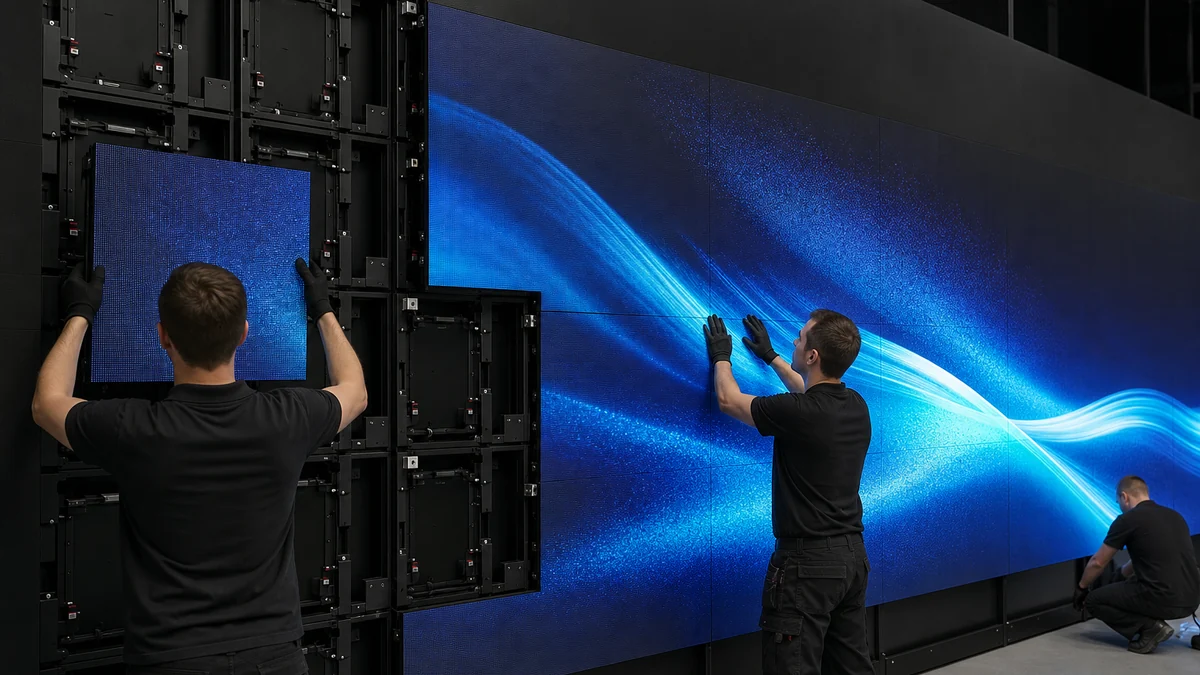
A high-quality COB module still requires a properly engineered cabinet.
LED chips and driver ICs generate heat during operation. If heat cannot be effectively transferred away, component temperatures may rise and accelerate aging.
Buyers should therefore examine cabinet materials, ventilation, power distribution, thermal paths, and maintenance access.
Magnesium or aluminum cabinet designs may be used in different product configurations to achieve a balance between weight, strength, and heat dissipation.
The important point is that thermal performance should be considered at the system level, not only at the LED chip level.
Manufacturing Quality and Long-Term Performance
Manufacturing quality has a direct impact on COB LED display reliability.
Buyers should ask how the manufacturer controls chip bonding, encapsulation, PCB assembly, calibration, aging tests, and final inspection.
Batch consistency is also important.
For a large project, hundreds of modules may be manufactured over several production cycles. If the optical characteristics of different batches vary significantly, the completed display may show visible differences.
A capable factory should have standardized production procedures and quality-control checkpoints throughout the manufacturing process.
How to Choose the Right COB LED Display Manufacturer
The manufacturer can have as much influence on the final product as the COB technology itself.

Distributors and system integrators should evaluate production capability, component sourcing, engineering support, quality control, customization capability, and after-sales service before selecting a supplier.
COB Packaging and Mass-Production Consistency
COB production requires precise control over multiple manufacturing processes.
LED chips must be positioned accurately on the PCB. Bonding must maintain electrical reliability. Encapsulation must provide consistent protection and optical performance.
Mass production makes these requirements even more challenging.
A manufacturer may produce one excellent COB module without having the process stability required for a large commercial project.
For B2B buyers, production consistency is therefore an important qualification criterion.
Before placing a large order, buyers can ask manufacturers about production capacity, sample-to-mass-production consistency, quality-control procedures, and testing standards.
Quality Control, Calibration, and Failure Rate
A reliable LED factory should test products at multiple stages instead of relying only on final inspection.
Module testing can identify electrical and visual defects before the products reach the assembly stage.
Aging tests can help identify early component failures. Brightness and color measurements can verify optical consistency. Calibration can then compensate for controlled differences between modules.
Dead-pixel and dead-lamp rates are also useful indicators of manufacturing quality.
From a factory perspective, controlling failure rates starts long before final testing. LED chip quality, soldering or bonding processes, PCB quality, driver IC performance, power supply stability, and thermal design all contribute to long-term reliability.
Calibration is equally important. For a large LED wall, even a small brightness or color difference between modules can become noticeable.

This is why professional LED manufacturers should treat COB quality as a complete production system rather than simply a packaging technology.
Frequently Asked Questions
What are the advantages of COB LED technology?
COB LED technology integrates LED chips directly onto the PCB and protects them with an encapsulation layer. Its major advantages include stronger surface protection, fine pixel pitch capability, high pixel density, good contrast, and suitability for premium indoor applications. However, actual performance depends on LED chip quality, driver ICs, PCB design, thermal management, calibration, and manufacturing quality.
Is COB better than SMD for LED displays?
COB is not universally better than SMD. COB is particularly suitable for fine-pitch indoor displays that require strong surface protection, close-viewing image quality, and premium visual performance. SMD remains a practical choice for many indoor, outdoor, rental, and advertising applications because of its mature manufacturing ecosystem and cost efficiency. The best choice depends on viewing distance, environment, performance requirements, maintenance expectations, and budget.
Conclusion
The growing focus on COB LED technology reflects the broader development of fine-pitch and high-performance LED displays in 2026. COB provides a highly integrated package structure, stronger surface protection, high pixel density, and strong potential for premium visual performance.
For corporate meeting rooms, control centers, broadcast studios, retail environments, education facilities, and other close-viewing applications, COB can provide an attractive alternative to conventional SMD displays.
However, packaging technology alone does not determine display quality. COB manufacturing consistency, LED chip selection, driver IC performance, thermal management, calibration, and factory quality control are equally important.
For distributors, integrators, and project buyers, the best approach is to evaluate the complete LED solution rather than simply asking whether COB is better than SMD.
NSELED combines LED display manufacturing capabilities with customized solutions for different project requirements. Contact NSELED to discuss your COB LED display project and find the right solution for your application.