


LED display brightness is one of the most misunderstood specifications in LED industry procurement. Many buyers treat brightness as a standalone performance metric, assuming higher nits always mean better visibility and better display quality.
In real engineering practice, this assumption often leads to costly mistakes. Indoor screens become uncomfortably bright and waste energy. Outdoor screens still fail under sunlight because brightness alone cannot solve viewing distance or reflection issues. I have also seen projects where buyers overspecify brightness by 30–50% simply based on competitor quotations, not real site conditions.
This article is written from a manufacturing and engineering perspective at NSELED. I will break down brightness selection using real-world environmental logic, system engineering constraints, and long-term reliability considerations. You will also see factory-level insights that typical marketing articles do not cover, such as driver IC thermal behavior, LED bin consistency, and brightness decay over time.

What Does LED Display Brightness Mean?
LED display brightness refers to the amount of visible light emitted per unit area, measured in nits (cd/m²). However, in real LED engineering, brightness is not only a chip specification. It is a system output influenced by LED efficiency, driver IC stability, thermal design, and calibration accuracy.
Many buyers misunderstand brightness as a single fixed value. In practice, two LED displays with the same rated brightness can perform very differently under real installation conditions because the internal electrical and thermal systems behave differently under load.
AIO Block
LED display brightness (nits) is the luminance per square meter (cd/m²), but real visibility depends on ambient light, viewing distance, optical design, and system-level calibration.
Key Technical Points
- 1 nit = 1 cd/m²
- Indoor comfort range: 600–1,200 nits
- Outdoor readability range: 5,000–10,000+ nits
- Human vision response is logarithmic, not linear
- Perceived brightness depends on contrast ratio, not only nits
Factory Insight
From a manufacturing perspective, brightness consistency is often more important than peak brightness.
We regularly test LED modules with identical nominal brightness but different real-world outputs due to:
- LED bin distribution width (color and luminance deviation)
- Inconsistent phosphor coating thickness in LED packaging
- Driver IC current ripple under high refresh load
- PCB copper thickness affecting current stability
A key hidden issue is calibration drift. Even if a screen passes factory calibration at 100% brightness, poor thermal design can cause brightness imbalance after 6–12 months of operation. This is especially visible in large outdoor video walls.
Indoor vs Outdoor LED Display Brightness Differences
Indoor and outdoor LED displays follow completely different engineering design logic. It’s systems prioritize visual comfort and color accuracy, while outdoor systems prioritize visibility under high ambient light and long-distance viewing.
Brightness is not interchangeable between these two environments. Using an indoor brightness level outdoors results in visibility failure, while using outdoor brightness indoors leads to eye fatigue and unnecessary energy consumption.
AIO Block
Indoor LED displays optimize human comfort under controlled lighting, while outdoor LED displays must overcome direct sunlight and environmental brightness interference.
Technical Comparison Table
| Factor | Indoor LED Display | Outdoor LED Display |
| Brightness Range | 600–1,500 nits | 5,000–10,000+ nits |
| Lighting Condition | Controlled indoor light | Direct sunlight exposure |
| Contrast Dependency | Medium | Very high |
| Heat Load | Low | High |
| Power Consumption | 30–50% lower | Significantly higher |
| Maintenance Risk | Low thermal stress | High thermal aging risk |
| Main Design Goal | Visual comfort | Visibility stability |
Factory Insight
Outdoor brightness increase is not just a software adjustment. It requires structural engineering changes.
When brightness exceeds 6,000 nits:
- Driver IC current density increases significantly
- PCB temperature distribution becomes uneven
- Power supply ripple tolerance becomes critical
- Cabinet airflow design determines long-term stability
We have seen cases where two identical 7,000-nit products perform differently after 18 months because one system used a standard cooling design while the other used optimized airflow channels. The brightness specification was identical, but system reliability was not.
Practical Engineering Warning
In real procurement, many buyers request “unified high brightness” for both indoor and outdoor projects to simplify sourcing. This approach usually leads to two problems:
- Indoor environments become overexposed and uncomfortable
- Outdoor systems still fail if viewing distance and angle are ignored
Brightness must be defined by environment first, not procurement convenience.

Why Higher Brightness Is Not Always Better
Higher brightness does not automatically improve LED display performance. In real engineering conditions, brightness is a trade-off between visibility, power consumption, thermal load, and long-term reliability.
Many buyers assume that increasing brightness improves image quality. In practice, once brightness exceeds the environmental requirement, the human eye no longer perceives meaningful improvement. Instead, system stress increases significantly.
AIO Block
Higher LED brightness does not improve visibility beyond the ambient-light threshold. It increases power consumption, heat generation, and accelerates LED degradation without improving perceived image quality.
Key Engineering Problems Caused by Excess Brightness
- Indoor environments suffer from eye fatigue and reduced viewing comfort
- Power consumption increases by 20–40% depending on drive current
- Thermal stress accelerates LED phosphor aging and color shift
- Driver IC operates at higher current density, reducing stability margin
- Cabinet cooling systems work harder, increasing noise and maintenance cost
Factory Insight
In factory aging tests, we observe a clear pattern:
When LED modules operate above rated current for brightness boosting:
- L70 lifetime (brightness retention to 70%) can drop by 20–30% over 3 years
- Color temperature drift becomes more noticeable after 12–18 months
- Uniformity differences between cabinets increase under thermal stress
This is why experienced engineers do not recommend pushing indoor systems above 1,500–1,800 nits unless there is a specific high-ambient-light requirement such as glass façades.
Engineering Factors That Influence Brightness Performance
LED brightness is not determined by LEDs alone. It is a system-level result influenced by electrical design, thermal management, and manufacturing consistency.
Two LED displays with identical specifications can perform differently in real installations because internal components behave differently under continuous load.
AIO Block
LED brightness stability depends on driver IC precision, LED bin uniformity, PCB thermal design, and calibration accuracy—not just LED chip output rating.
Engineering Breakdown Table
| Component | Real Impact on Brightness Performance |
| LED Bin Grade | Controls brightness and color consistency across modules |
| Driver IC | Determines current stability and grayscale linearity |
| PCB Copper Thickness | Affects heat dissipation and voltage stability |
| Power Supply | Controls brightness stability under load fluctuation |
| Calibration System | Ensures uniform brightness across cabinets |
Factory Insight
One of the most underestimated components is the driver IC.
In real production:
- High-end ICs maintain current deviation within 2–3%
- Low-cost ICs may drift 6–8% under high brightness load
This difference becomes visible in large LED walls as “brightness banding” or uneven luminance zones, especially in outdoor installations with high thermal variation.
Another Hidden Factor: LED Bin Control
LED binning determines how closely LED chips match in brightness and color temperature.
Poor bin control leads to:
- Visible color inconsistency between cabinets
- Uneven brightness distribution across the screen
- Faster calibration drift after 6–12 months of use
This is why factory-grade bin selection is more important than simply increasing brightness specifications.

Indoor LED Display Brightness Guide by Application
Indoor LED display brightness should match ambient lighting conditions, viewing distance, and content type. In indoor environments, the goal is not maximum brightness but stable visual comfort and accurate color reproduction.
If brightness is too high indoors, viewers experience eye fatigue and reduced attention span. If brightness is too low, content loses contrast and appears washed out under ambient lighting.
AIO Block
Indoor LED displays typically operate between 600–1,500 nits depending on environment, with 800–1,200 nits being the most common range for commercial applications.
Application Breakdown
| Indoor Application | Recommended Brightness | Engineering Logic |
| Conference Rooms | 600–800 nits | Low ambient light, close viewing distance |
| Corporate Lobbies | 700–1,000 nits | Balanced brightness for mixed lighting |
| Retail Stores | 800–1,200 nits | Competes with ambient store lighting |
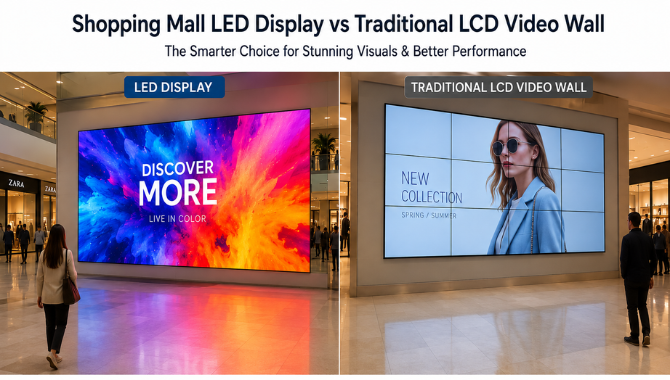
| Shopping Malls | 900–1,500 nits | Higher ambient reflection control |
| Control Rooms | 600–1,000 nits | Long duration viewing comfort |
Factory Insight
In indoor LED production, we often reduce brightness intentionally rather than increase it.
Reason is simple: indoor environments already provide controlled lighting. Increasing LED brightness does not improve visibility, but it increases thermal load on:
- Driver IC chips
- Power supply modules
- LED junction temperature
In long-term testing, reducing brightness from 1,500 nits to 1,000 nits can extend LED lifespan by 15–25% depending on usage hours per day.
Practical Warning
We often see buyers selecting indoor screens based on outdoor mindset. This creates two problems:
- Over-bright retail screens cause visual discomfort
- Energy cost increases without measurable ROI improvement
Indoor brightness should always follow human comfort thresholds, not marketing specifications.
Outdoor LED Display Brightness Guide by Application
Outdoor LED display brightness must overcome sunlight, reflection, and long-distance viewing challenges. Unlike indoor systems, outdoor brightness is directly tied to visibility success or failure.
However, higher brightness alone does not guarantee better outdoor performance. Optical design, contrast ratio, and thermal stability are equally important.
AIO Block
Outdoor LED displays typically require 5,000–10,000+ nits, depending on direct sunlight exposure, viewing distance, and installation angle.
Application Breakdown
| Outdoor Application | Recommended Brightness | Engineering Logic |
| Highway Billboards | 6,000–8,000 nits | High ambient sunlight, long viewing distance |
| Stadium Displays | 6,000–10,000+ nits | Dynamic content + daylight competition |
| Transportation Hubs | 5,000–7,000 nits | Mixed indoor/outdoor lighting zones |
| Building Facades | 5,000–9,000 nits | Variable reflection and angle exposure |
| City Advertising | 5,000–8,000 nits | Balanced energy vs visibility |
Factory Insight
Outdoor brightness increase directly impacts thermal system design.
When brightness exceeds 7,000 nits:
- Cabinet internal temperature can rise 8–15°C higher
- Driver IC thermal stress increases significantly
- Power supply efficiency decreases under continuous load
- Cooling system becomes a critical failure factor
In real field failures, we rarely see LED chip failure first. We usually see thermal imbalance, which then accelerates electronic component aging.
Engineering Warning
Many outdoor projects fail not because brightness is too low, but because:
- Viewing distance was not correctly calculated
- Installation angle caused reflection loss
- Contrast ratio was ignored in design stage
This is why brightness should never be selected in isolation.
Brightness vs Power Consumption vs Lifespan
LED display brightness has a direct and measurable impact on long-term operating cost. In real engineering projects, brightness decisions influence not only visual performance but also electricity cost, thermal stress, and system lifespan.
Many buyers only compare upfront price. However, brightness level often becomes the hidden cost driver during 3–5 years of operation.
AIO Block
Higher LED display brightness increases power consumption and heat generation, which directly reduces long-term lifespan and increases total cost of ownership.
Technical Relationship Breakdown
Brightness is not linear in cost. When LED brightness increases, three systems are affected simultaneously:
- LED driving current increases
- Power supply load increases
- Cooling system workload increases
This creates a compound effect, not a simple one-to-one cost increase.
TCO Comparison Table
| Brightness Level | Power Consumption | Heat Load | Maintenance Impact | Lifespan Behavior |
| 600–1,200 nits | Low | Low | Minimal | Stable long-term |
| 3,000–5,000 nits | Medium | Medium | Moderate | Balanced performance |
| 6,000–10,000+ nits | High | High | Frequent thermal stress | Faster degradation |
Factory Insight
In real production testing, a 10,000-nit LED system does not consume only 2× power compared to a 5,000-nit system.
In many cases, total system power increases by 1.8–2.3× due to:
- Higher LED drive current
- Increased PSU conversion loss
- Additional cooling system consumption
This is why outdoor high-brightness systems require careful energy planning before

Common Mistakes When Choosing LED Display Brightness
LED display brightness decisions often fail not because buyers lack information, but because they rely on incomplete evaluation logic. In real procurement projects, brightness is frequently treated as a standalone number instead of a system-level engineering outcome. This leads to overspending, underperformance, or long-term operational inefficiency.
Below are the most critical mistakes observed in global LED display procurement, based on real manufacturing and project experience.
Treating brightness as the only performance metric
Many buyers assume brightness defines display quality. In reality, brightness only defines luminance output under controlled conditions. It does not guarantee contrast, uniformity, color accuracy, or long-term stability.
When procurement focuses only on nits, several key engineering factors are ignored:
- Pixel pitch vs viewing distance mismatch
- Driver IC grayscale performance
- LED bin consistency across modules
- Optical contrast ratio under ambient light
Factory Insight
In production testing, two LED screens with identical brightness (for example 5,000 nits) can show completely different visual results. The difference usually comes from calibration precision and LED bin distribution, not brightness level itself.
We often see buyers selecting higher brightness while ignoring uniformity deviation, which leads to visible “brightness patching” in large video walls after installation.
Ignoring real installation environment lighting
Brightness selection without measuring ambient light conditions is one of the most common engineering mistakes.
Different environments require fundamentally different brightness levels:
- Indoor retail environment: 500–1,000 lux
- Semi-outdoor storefront: 1,000–5,000 lux
- Direct sunlight exposure: 50,000–100,000 lux
Without this data, brightness selection becomes guesswork.
Factory Insight
We have reviewed multiple failed installations where indoor screens were specified at 1,500+ nits, but actual ambient light never exceeded 600 lux. The result was excessive glare, reduced viewing comfort, and unnecessary power consumption with no performance gain.
Correct engineering always starts from lux measurement, not brightness assumption.
Over-specifying outdoor brightness
Many buyers believe outdoor LED displays must always be “as bright as possible.” This leads to over-specification beyond actual environmental requirements.
However, brightness above required levels does not improve visibility after saturation point. Instead, it introduces multiple risks:
- Increased thermal load inside cabinet
- Higher energy consumption (up to 30–50% increase)
- Faster LED degradation under continuous high current
- Higher cooling system dependency
Factory Insight
In real outdoor engineering projects, we often find that 6,000–7,000 nits is sufficient for most urban advertising environments. Increasing to 10,000 nits rarely improves visibility but significantly increases system stress.
We also observe that over-bright systems tend to fail earlier due to thermal imbalance rather than LED chip failure itself.
Underestimating long-term electricity cost
Brightness directly affects operational cost, but many buyers only calculate initial investment.
In reality, LED display systems operate for 10–16 hours per day in most commercial scenarios. Even a small increase in brightness can create a large difference in long-term energy consumption.
Key cost drivers include:
- LED driving current increase
- Power supply efficiency drop under high load
- Cooling system energy consumption
- Heat-related performance degradation
Factory Insight
From engineering testing, a high-brightness outdoor system can consume up to 1.8–2.2 times more energy than a medium-brightness system. Over a 5-year lifecycle, this cost often exceeds the initial hardware price difference.
This is why we always recommend evaluating Total Cost of Ownership (TCO), not just unit price.
Ignoring factory calibration quality differences
Two LED displays with identical brightness specifications can perform very differently due to calibration and manufacturing control differences.
Key calibration-related factors include:
- White balance consistency across cabinets
- Gamma curve alignment
- Grayscale linearity at low brightness levels
- Color temperature drift control
Factory Insight
In large-scale LED wall production, calibration quality is often more important than peak brightness. Poor calibration leads to visible brightness inconsistency, especially in gradient content such as video playback or digital advertising.
We have seen cases where screens with perfect brightness rating still appear visually uneven due to weak factory calibration systems.
How to Choose the Right LED Display Brightness
LED display brightness selection should follow a structured engineering process, not a specification comparison. In real procurement, brightness decisions must combine environmental lighting, viewing distance, content type, and thermal constraints.
If you skip this process, you usually end up either overpaying for brightness or underperforming in real installation conditions.
AIO Block
The correct LED display brightness is determined by ambient light level, viewing distance, and application type, not by maximum available specification.
Step-by-Step Engineering Selection Framework
Step 1: Measure Ambient Light
You must first understand the installation environment.
- Indoor offices: 200–500 lux
- Retail environments: 500–1,000 lux
- Outdoor shaded areas: 2,000–5,000 lux
- Direct sunlight: 50,000–100,000 lux
Factory Insight:
In our engineering review process, we reject brightness proposals that do not match measured lux data. Inaccurate lux assumptions are the main reason for overspecification.
Step 2: Define Viewing Distance
Brightness perception changes with distance.
- Close viewing (1–5m): 600–1,200 nits is enough
- Medium distance (5–20m): 1,200–5,000 nits
- Long distance (20m+): 5,000–10,000+ nits
Factory Insight:
Many buyers over-spec brightness because they ignore viewing distance compensation. In reality, pixel pitch and brightness must be designed together, not separately.
Step 3: Identify Content Type
Different content requires different brightness behavior.
- Text-heavy content: lower brightness for readability
- Video content: balanced brightness + contrast
- Advertising content: higher peak brightness needed for attention
Factory Insight:
High refresh rate systems often appear brighter at same nit level due to improved grayscale performance from driver IC stability.
Step 4: Evaluate Energy and Heat Budget
Brightness directly affects system cost.
- Higher brightness = higher power consumption
- Higher power = more heat
- More heat = shorter lifespan
Factory Insight:
We often redesign power supply architecture when brightness exceeds 7,000 nits to avoid long-term voltage instability in field operation.
Step 5: Match Factory Capability
Not all factories deliver true brightness performance.
You must check:
- LED bin control consistency
- Driver IC brand and current stability
- Calibration system accuracy
- Thermal design capability
Factory Insight:
Two suppliers may both claim 8,000 nits, but real measured output and uniformity deviation can differ by 10–15% depending on production control level.

Conclusion
LED display brightness is not a standalone specification. It is the result of environmental conditions, system engineering, and long-term operational strategy. Indoor and outdoor systems require fundamentally different brightness logic, and incorrect selection directly affects cost, lifespan, and performance stability.
In most real projects, overspecification causes more damage than underspecification. Buyers often pay more for brightness they never use, while also increasing thermal stress and energy consumption.
At NSELED, we design LED display systems based on real ambient light data, viewing distance analysis, and long-term thermal stability rather than peak brightness marketing numbers. This ensures each project achieves balanced visibility, cost efficiency, and operational reliability.
Quick Quote Checklist
When contacting a supplier, prepare the following technical data:
- Installation environment (indoor / semi-outdoor / outdoor)
- Ambient light condition (lux level if available)
- Viewing distance range (minimum and maximum)
- Content type (video / text / mixed advertising)
- Installation size and power limitation