


Introduction
Choosing the right church LED screen requires more than selecting a large display with impressive specifications. Churches need a visual system that supports worship, livestreaming, sermons, and long-term operation.
Many churches struggle with choosing the wrong pixel pitch, insufficient brightness, or unsuitable installation designs. A screen that looks excellent in a showroom may not perform well in a real sanctuary with stage lighting and cameras.
This guide helps church buyers evaluate LED technology, screen size, image quality, installation methods, cost factors, and manufacturer capabilities to make a practical investment decision.
What Is a Church LED Screen and Why Do Churches Need One?
A church LED screen is a direct-view digital display system designed for worship environments, allowing churches to present lyrics, sermons, videos, live camera feeds, and visual backgrounds with stable brightness and high image quality. Unlike projectors, LED displays create images directly through millions of LED pixels, which helps churches maintain clear visuals under different lighting conditions.
| Display Solution | Image Quality | Maintenance Method | Best Application |
|---|---|---|---|
| Church LED Screen | High brightness, stable colors, excellent large-format performance | Replaceable LED modules | Modern worship spaces, livestreaming, stage backgrounds |
| Projector System | Depends heavily on ambient light and projection surface | Lamp/light source and optical maintenance | Small churches with limited budgets |
| LCD Video Wall | Good image quality but limited seamless large-size scalability | Individual panel replacement | Control rooms, small display areas |
What Is a Church LED Screen?
A church LED screen uses thousands or millions of microscopic LED chips arranged on modules and cabinets to create a large digital canvas. Churches commonly install these displays behind worship stages, beside the main stage, or in lobby areas.
Unlike traditional displays, LED video walls do not require a projection distance. They generate light directly from the LED pixels, which allows them to maintain visibility even when churches use strong stage lighting.
A typical church LED display system includes:
- LED modules and cabinets
- Receiving cards and control systems
- Video processors
- Power supplies
- Structural mounting systems
- Content management equipment.
The final viewing experience depends not only on the LED panel itself but also on how these components work together.
For example, two churches may purchase the same P2.5 LED screen specification but receive different results. One screen may maintain uniform brightness after several years, while another may develop visible color differences. The difference usually comes from component selection, manufacturing control, and calibration processes.
Factory Perspective:
During LED display production, manufacturers must control several variables before a screen reaches the customer.
At NSELED’s manufacturing level, engineers pay attention to:
- LED chip consistency between batches
- Driver IC performance under continuous operation
- Module flatness after assembly
- Calibration accuracy before shipment.
These details directly influence whether a church sees a professional visual effect five years later or needs frequent adjustments.
Common Applications of LED Screens in Churches
Churches use LED screens for more than displaying lyrics. Modern worship environments increasingly combine LED displays with digital production systems to create immersive experiences.
Common applications include:
| Application | How Churches Use LED Screens |
|---|---|
| Worship stage background | Display worship visuals, videos, themes, and sermon graphics |
| Lyrics and scripture display | Improve audience engagement during worship |
| Live camera feed | Show pastors, performers, and close-up views |
| Livestream production | Provide professional backgrounds for online audiences |
| Church announcements | Display schedules, events, and community information |
| Lobby information displays | Guide visitors and communicate messages |
A church LED screen also improves consistency between physical and online worship experiences. Many churches now produce livestream content, which creates additional requirements for screen performance.
A display that works for human eyes may not always work well for cameras.
Camera systems can reveal:
- Flickering caused by low refresh rates
- Uneven brightness
- Color shifts
- Poor grayscale performance.
This is why churches should evaluate LED screens based on both audience viewing experience and camera performance.
Why Churches Are Upgrading From Projectors to LED Displays
Many churches originally selected projectors because they offered a lower initial investment. However, large worship spaces increasingly require stronger brightness, higher reliability, and better visual consistency.
LED displays solve several common projector limitations.
| Factor | LED Screen | Projector |
|---|---|---|
| Brightness stability | Maintains direct light output | Image quality decreases with ambient light |
| Large screen performance | Suitable for very large displays | Requires powerful projection equipment |
| Maintenance | Modular component replacement | Optical system and light source maintenance |
| Livestream compatibility | Better camera performance with proper refresh rate | More sensitive to lighting conditions |
| Lifespan | Often designed for long operating hours | Requires more frequent light-source maintenance |
According to the U.S. Department of Energy, LED technology generally provides significantly higher energy efficiency compared with traditional lighting technologies because LEDs convert electricity into light more effectively. This principle also contributes to the broader adoption of LED-based visual systems. U.S. Department of Energy LED Lighting Overview
However, churches should not assume that every LED screen automatically provides better results.
A poorly selected LED display can create new problems:
- Excessive brightness in a dark sanctuary
- Visible pixel structure at close viewing distances
- Difficult maintenance access
- Poor integration with existing AV systems.
Expert recommendation:
A church should not choose an LED screen simply because another church installed the same model. Every worship space has different viewing distances, lighting conditions, architecture, and content requirements.
For example:
- A small sanctuary with viewers sitting 3 meters away may require a fine-pitch LED display.
- A large auditorium with viewers 20 meters away may achieve excellent results with a larger pixel pitch at a lower cost.
Choosing the correct engineering solution matters more than choosing the most expensive specification.
How to Choose the Right Pixel Pitch for a Church LED Screen?
The best pixel pitch for a church LED screen depends mainly on viewing distance, screen size, and content requirements. Smaller pixel pitches create sharper images for close viewing, while larger pixel pitches provide better cost efficiency for larger worship spaces.
| Viewing Distance | Recommended Pixel Pitch |
|---|---|
| Less than 3 meters | P0.9–P1.5 |
| 3–6 meters | P1.5–P2.5 |
| 6–10 meters | P2.5–P3.9 |
| More than 10 meters | P3.9–P5+ |
Understanding Pixel Pitch and Image Resolution
Pixel pitch refers to the distance between the centers of two adjacent LED pixels, measured in millimeters.
For example:
- P1.5 means the distance between pixels is 1.5mm.
- P3.9 means the distance between pixels is 3.9mm.
A smaller pixel pitch creates higher pixel density, which improves image details when audiences sit close to the screen.
However, many buyers make one common mistake:
They believe the smallest pixel pitch always provides the best solution.
This approach often increases the budget without creating visible benefits.
For example, installing a P0.9 LED screen in a large church where viewers sit 25 meters away may provide limited visible improvement compared with a properly selected P2.5 or P3.9 solution.
The additional investment may not create meaningful value.
Recommended Pixel Pitch for Different Church Sizes
Church buyers should select pixel pitch according to the relationship between screen size and audience distance.
| Church Environment | Recommended Pixel Pitch | Reason |
|---|---|---|
| Small worship room | P1.2–P2 | Audience sits closer to screen |
| Medium sanctuary | P1.8–P2.5 | Balanced image quality and budget |
| Large auditorium | P2.5–P3.9 | Longer viewing distance reduces pixel visibility |
| Outdoor church display | P5–P10 | Requires brightness and durability |
Factory Perspective:
Pixel pitch alone does not determine real-world image quality.
During LED manufacturing, engineers also evaluate:
- LED bin consistency
- Driver IC quality
- PCB design
- Calibration accuracy.
A display with excellent pixel pitch but poor LED consistency can show uneven brightness between modules.
During mass production, factories use calibration systems to measure differences between individual modules. This process helps reduce visible seams after installation.
Why Choosing the Smallest Pixel Pitch Is Not Always the Best Decision
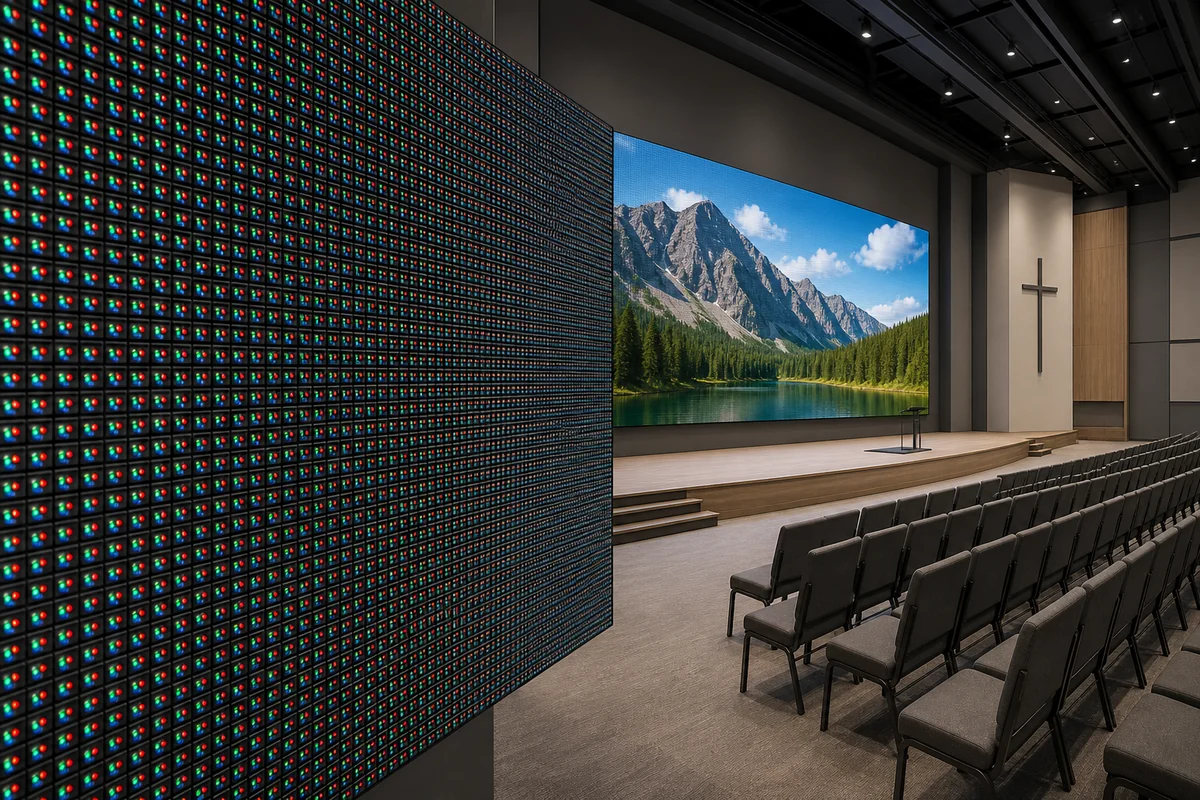
Many church buyers assume that a smaller pixel pitch automatically means a better LED screen. This assumption is incomplete because pixel pitch only represents pixel density, not the entire viewing experience.
A church should choose pixel pitch according to the relationship between audience distance, screen size, and content type.
For example, a P1.5 LED screen can provide excellent detail for a small worship room where viewers sit close to the stage. However, the same specification may become unnecessary for a large auditorium where most viewers sit more than 15 meters away.
The extra investment may increase the project budget without creating a noticeable improvement.
A practical selection approach considers:
• The closest audience viewing distance.• The average viewing distance.• The screen size requirement.• Whether the church uses professional livestream cameras.• The type of content displayed.
We do not recommend using a very fine pixel pitch simply because it looks more advanced. A P0.9 or P1.2 LED screen is not automatically the best choice for every church. The correct solution delivers the best visual value per dollar.
Factory Perspective: How LED Components Affect Real Image Quality
A church LED screen is not only a collection of pixels. The final performance depends on how thousands of components work together.
During manufacturing, LED factories evaluate several critical factors:
LED Chip Consistency
LED chips from different production batches may have small differences in brightness and color wavelength.
Manufacturers use LED binning processes to classify chips with similar optical characteristics. This process helps maintain consistent colors across thousands of pixels.
Poor chip consistency can create:
- Uneven brightness between modules
- Visible color differences
- More frequent calibration requirements.
Driver IC Performance
The driver IC controls how LED pixels receive electrical signals. It affects:
- Gray scale performance
- Refresh rate
- Brightness stability
- Heat generation.
A church that uses LED screens for livestreaming should pay special attention to driver IC performance because cameras capture issues that human eyes may ignore.
High-quality driver systems can provide smoother grayscale transitions during:
- Dark worship scenes
- Stage lighting changes
- Camera close-ups.
Calibration Process
Professional LED manufacturers calibrate modules before shipment.
The calibration process improves:
- Brightness uniformity
- Color consistency
- Module-to-module matching.
Without proper calibration, a large LED wall may show visible differences after installation.
How to Determine the Right Church LED Screen Size?
The ideal church LED screen size depends on stage dimensions, audience distance, viewing angles, and content requirements. A larger screen does not always create a better worship experience because excessive size can increase cost without improving visibility.
| Church Size | Typical LED Screen Size |
|---|---|
| Small church | 3–6㎡ |
| Medium church | 6–20㎡ |
| Large auditorium | 20㎡+ |
Measure Viewing Distance Before Choosing Screen Dimensions
The first step in selecting LED screen size is understanding how far the audience sits from the display.
A church should measure:
- The closest seating position
- The farthest seating position
- The average viewing distance
- The stage height
- The audience viewing angle.
A screen that looks impressive from the back of the church may appear uncomfortable for people sitting close to the stage.
For example:
A large LED wall installed too close to the audience may create visible pixel structure if the pixel pitch does not match the viewing distance.
A smaller but properly designed LED screen can provide a more natural visual experience.
Select Screen Width and Height Based on Stage Design
Church LED screens should support the stage instead of overwhelming it.
The design team should consider:
- Stage width
- Worship band placement
- Speaker position
- Lighting equipment
- Camera framing.
Common church LED configurations include:
| Configuration | Application |
|---|---|
| Center LED wall | Main worship background and video content |
| Center screen + side screens | Large churches requiring wider visual coverage |
| Ultra-wide LED wall | Modern worship stages with cinematic visuals |
| Ribbon LED screens | Supporting lyrics and additional information |
A church should also consider future expansion.
For example, a church may start with one central LED wall but later add:
- Side LED displays
- Lobby information screens
- Additional livestream production displays.
Planning expansion capability during the initial design can reduce future renovation costs.
Choose Between Standard 16:9 and Custom LED Configurations
The 16:9 format remains popular because most video content follows this ratio.
However, churches increasingly use custom LED layouts because worship environments have unique stage designs.
| Screen Format | Advantages | Suitable Application |
|---|---|---|
| 16:9 LED Wall | Easy content compatibility | Sermons, videos, livestream |
| Ultra-wide LED Screen | Creates immersive stage visuals | Modern worship environments |
| Multiple LED Panels | Flexible content management | Large churches and events |
A church should avoid designing the LED wall only around current content.
Modern worship production often includes:
- Live camera switching
- Motion graphics
- Interactive backgrounds
- Online streaming.
The screen design should support future content requirements.
Consider Audience Sightlines and Viewing Experience
A professional church LED installation considers every seat, not only the front row.
The design team should evaluate:
- Whether people at the side seats can see the full screen
- Whether stage equipment blocks visibility
- Whether lighting creates reflections
- Whether the screen height matches audience eye level.
Factory Perspective:
Manufacturers often receive projects where customers focus only on screen specifications but ignore installation geometry.
From a production perspective, cabinet alignment and installation accuracy directly influence the final experience.
Even a high-end LED panel can look poor if:
- Cabinets are not perfectly aligned
- Installation structures have movement
- Module gaps are inconsistent.
Professional factories check cabinet flatness during production because small mechanical errors can become obvious after assembling a large video wall.
How to Select Brightness and Refresh Rate for Church LED Displays?
Most indoor church LED screens require 600–1,500 nits brightness and at least a 3840Hz refresh rate to provide comfortable viewing, accurate colors, and stable livestream performance.
| Requirement | Recommended Specification |
|---|---|
| Dark sanctuary | 600–800 nits |
| General worship hall | 800–1,500 nits |
| Bright indoor environment | 1,500–3,000 nits |
| Livestream production | 3840Hz+ refresh rate |
| Professional broadcasting | 7680Hz refresh rate |
Choosing Brightness Based on Church Lighting Conditions
Brightness selection depends on the environment.
A common mistake is choosing the highest brightness available because buyers believe brighter means better.
However, excessive brightness can create problems:
- Audience discomfort
- Reduced contrast
- Unnatural stage appearance
- Higher energy consumption.
For most indoor churches, 800–1,500 nits provides a practical balance.
Outdoor church displays require much higher brightness because sunlight can significantly reduce image visibility.
Why Refresh Rate Matters for Worship Livestreaming

Refresh rate determines how frequently the LED display updates images per second.
A higher refresh rate helps reduce:
- Camera flickering
- Scanning lines
- Motion artifacts.
Churches with livestream production should prioritize refresh rate because online audiences view the worship experience through cameras.
A screen that looks acceptable in person may create visible issues in recorded video.
Recommended choices:
- 3840Hz: Suitable for most church applications.
- 7680Hz: Better for professional broadcast environments.
How Color Calibration Improves Worship Visuals
Churches often display:
- Skin tones
- Dark backgrounds
- Worship videos
- Color gradients.
These contents require accurate grayscale and color reproduction.
Poor calibration can create:
- Uneven colors
- Different shades between cabinets
- Inconsistent stage visuals.
A professional LED system maintains consistent image quality through factory calibration and regular maintenance.
Factory Perspective: Driver IC and Heat Management Impact Long-Term Stability
Many buyers compare church LED screens by visible specifications such as pixel pitch and brightness. However, long-term stability depends heavily on internal electronic design.
The driver IC controls how each LED pixel receives current signals. During long worship services, livestream production, and daily operation, the driver system continuously processes thousands of image updates every second.
A lower-quality driver solution may create problems such as:
- Increased heat generation
- Brightness inconsistency after long operation
- Color deviation between modules
- Reduced grayscale accuracy.
Professional LED manufacturers evaluate driver components because a church screen often operates for several hours every week.
Factory-level testing focuses on thermal performance, current stability, and image consistency instead of only measuring brightness at shipment.
Heat management also affects lifespan.
LED cabinets must manage heat through:
- Proper internal airflow design
- Efficient power distribution
- Suitable component placement
- Reliable cooling structures.
Excessive heat accelerates component aging. Over several years, poor thermal design can cause brightness decay and increased maintenance frequency.
For churches planning a long-term investment, the question should not only be:
“Is the LED screen bright enough today?”
The better question is:
“Will the LED screen maintain stable performance after thousands of operating hours?”
What Installation Method Is Best for a Church LED Screen?

The best church LED screen installation method depends on wall structure, stage design, maintenance requirements, and future upgrade plans. Wall-mounted, hanging, and ground-supported installations each serve different worship environments.
A church should evaluate installation before purchasing the LED display because the structure directly affects safety, maintenance efficiency, and overall appearance.
Wall-Mounted LED Screen Installation
Wall-mounted LED screens are common in indoor churches because they create a clean stage appearance.
Advantages include:
- Space-saving design
- Modern visual appearance
- Suitable for fixed worship stages
- Better integration with stage architecture.
Wall-mounted installations work well when:
- The church has limited stage depth
- The screen remains in one fixed location
- Front maintenance modules are available.
However, installers must check:
- Wall load capacity
- Ventilation space
- Cable management
- Maintenance accessibility.
A visually attractive installation can still create operational problems if technicians cannot access internal components easily.
Hanging LED Screens for Worship Stages
Hanging LED screens use suspended structures above or behind the stage.
This design is popular in:
- Large worship centers
- Concert-style churches
- Multi-purpose auditoriums.
Benefits include:
- Flexible stage design
- Better visibility from distant seats
- Easier integration with lighting systems.
However, suspended installations require careful engineering.
The installation team must consider:
- Structural safety
- Weight distribution
- Vibration control
- Professional rigging standards.
Factory Perspective:
LED manufacturers usually focus on the screen itself, but experienced suppliers also consider how the cabinet design supports installation conditions.
For hanging systems, cabinet weight, locking mechanism precision, and connection strength influence installation safety.
Ground-Supported LED Video Walls
Ground-supported LED walls use a base structure to support the display from the floor.
They are suitable for:
- Large churches
- Temporary worship events
- Flexible stage arrangements.
Advantages:
- Easier relocation
- Faster installation
- Suitable for rental-style applications.
Disadvantages:
- Requires additional stage space
- Needs careful leveling
- May affect audience sightlines.
Front Maintenance vs Rear Maintenance Design

Maintenance access is one of the most overlooked factors during church LED screen purchasing.
| Maintenance Type | Advantages | Suitable Application |
|---|---|---|
| Front Maintenance | Technicians can replace modules from the front | Wall-mounted indoor LED screens |
| Rear Maintenance | Provides easier internal access | Large fixed installations with backstage space |
A church should decide maintenance strategy before selecting cabinets.
A screen installed against a wall without front maintenance capability can create expensive service challenges later.
For example, replacing one failed module may require removing surrounding structures if technicians cannot access the screen from the front.
Factory Perspective: Why Cabinet Precision Determines Installation Quality
Large LED walls contain hundreds or thousands of modules.
Small manufacturing errors can become visible after installation.
Cabinet precision affects:
- Screen flatness
- Module alignment
- Seam consistency
- Long-term structural stability.
During production, factories control:
- CNC cabinet machining accuracy
- Module positioning tolerance
- Locking mechanism consistency.
A difference of less than one millimeter between cabinets may not appear significant individually, but a large LED wall can amplify these small errors.
A professional LED manufacturer focuses on mechanical accuracy because visual quality depends on both electronic performance and physical assembly.
How Much Does a Church LED Screen Cost?
The cost of a church LED screen depends on screen size, pixel pitch, LED components, installation method, control system, and customization requirements. A complete church LED display project can range from several thousand dollars for small installations to significantly higher budgets for large auditorium solutions.
| Cost Factor | Impact on Price |
|---|---|
| Screen size | Larger display area increases total investment |
| Pixel pitch | Smaller pixel pitch increases LED module cost |
| LED components | Higher-grade components improve stability |
| Installation structure | Custom structures increase engineering cost |
| Control system | Advanced processing improves image performance |
Main Factors Affecting Church LED Screen Price
Church LED screen pricing does not depend on one specification.
The main cost factors include:
Screen Size
A larger LED wall requires:
- More LED modules
- More cabinets
- More power supplies
- Larger control capacity.
However, bigger does not always mean better.
A properly designed smaller LED wall can outperform an oversized screen if it matches the viewing environment.
Pixel Pitch
Pixel pitch has a direct relationship with cost.
Smaller pixel pitch requires:
- Higher LED density
- More LED chips
- More precise manufacturing
- More advanced calibration.
For example:
A P1.5 LED screen usually costs more than a P3.9 screen of the same size because the pixel density is much higher.
However, churches should only invest in smaller pixel pitch when the audience can actually benefit from the additional resolution.
LED Components and Manufacturing Quality
The internal components influence both price and lifespan.
Important components include:
- LED chips
- Driver IC
- Power supply
- Receiving card
- Cabinet materials.
A low-cost screen may reduce expenses by using lower-grade components, but this can increase future maintenance costs.
Initial Investment vs Total Cost of Ownership
Professional buyers should evaluate total cost of ownership (TCO), not only the initial purchase price.
TCO includes:
- Purchase cost
- Installation cost
- Electricity consumption
- Maintenance frequency
- Spare parts availability
- Technical support.
A cheaper LED screen may create higher expenses if it requires frequent repairs or produces inconsistent image quality.
Why Low-Cost LED Screens May Create Higher Maintenance Costs
Some suppliers compete mainly through lower prices.
However, extremely low pricing may indicate compromises in:
- LED chip consistency
- Cabinet materials
- Quality testing
- Calibration processes.
For churches, reliability matters because worship events often follow fixed schedules.
A screen failure during a major service creates more than a technical problem. It affects the entire worship experience.
Expert recommendation:
Churches should compare suppliers based on manufacturing capability and long-term support, not only quotation numbers.
How to Integrate a Church LED Screen With AV Systems?
A church LED screen should integrate smoothly with media software, cameras, video processors, and livestream systems to deliver a consistent worship experience both inside the sanctuary and online.
Modern churches no longer use LED displays only for static lyrics or announcements. Many worship teams now combine LED screens with professional production workflows, including live cameras, motion graphics, sermon presentations, and online broadcasting.
A successful LED project requires technical compatibility between the display system and the church’s existing AV infrastructure.
LED Screen Compatibility With ProPresenter and Media Software
Many churches use presentation software to manage worship content, and the LED screen must receive signals correctly from these systems.
Common workflow components include:
- Presentation software
- Video processors
- Media servers
- Camera systems
- Audio-visual control systems.
For example, a worship team may display:
- Lyrics on the main LED wall
- Scripture passages on side screens
- Background videos during worship songs
- Live camera feeds during sermons.
The LED system should support different content formats without creating unnecessary workflow complexity.
| Content Type | Recommended LED Requirement |
|---|---|
| Lyrics and text | High contrast and accurate grayscale |
| Worship videos | Stable color reproduction and smooth motion |
| Camera feeds | High refresh rate and low latency |
| Motion backgrounds | Strong processing capability |
Factory Perspective:
A common mistake occurs when buyers evaluate only the LED cabinet but ignore the video processing system.
The LED display, receiving cards, and processor work together as one visual system.
A premium LED panel with an unsuitable processor may still produce:
- Incorrect scaling
- Color differences
- Delayed video response
- Poor image quality.
Experienced manufacturers evaluate the complete signal chain before recommending a solution.
Integration With Cameras and Live Streaming Systems
Church livestreaming creates additional technical requirements for LED displays.
A screen that looks acceptable to the audience may show problems through cameras.
Common camera-related issues include:
- Flickering
- Moiré patterns
- Uneven brightness
- Color inconsistency.
Churches should consider:
- High refresh rate
- Proper grayscale control
- Accurate color calibration
- Suitable brightness settings.
For most worship livestream applications:
- 3840Hz refresh rate provides reliable performance.
- 7680Hz refresh rate suits professional broadcast environments requiring more demanding camera conditions.
However, churches should avoid paying for specifications they do not need.
For example, a small church without livestream production may not need an ultra-high refresh rate system. The budget may create more value when invested in better installation design, spare modules, or content equipment.
Managing Worship Lyrics, Videos, and Background Content
A church LED screen needs to support different visual experiences.
A worship service may include:
- Text-based lyrics
- Sermon slides
- Worship videos
- Animated backgrounds
- Live camera images.
Each content type places different demands on the display.
For example:
Text requires:
- Sharp edges
- Good contrast
- Accurate grayscale.
Video content requires:
- Smooth motion
- Stable color
- Sufficient processing performance.
A church should define its content strategy before choosing LED specifications.
A display designed mainly for lyrics does not require the same performance level as a system used for cinematic worship backgrounds and livestream production.
Planning LED Systems for Future Expansion and Multi-Screen Systems
Churches should consider future growth before finalizing the first LED installation.
A flexible LED system can support future upgrades such as:
- Additional side screens
- Lobby displays
- Campus expansion
- Larger livestream environments.
Future planning should include:
• Spare signal channels.• Scalable control systems.• Compatible cabinet designs.• Maintenance planning.
Factory Perspective:
Manufacturers often see churches upgrade their LED systems several years after installation.
A well-designed project allows expansion without replacing the entire system.
For example, choosing a standardized cabinet size and compatible control architecture can reduce future upgrade costs.
How to Choose a Reliable Church LED Screen Manufacturer?
A reliable church LED screen manufacturer should provide more than LED products. The supplier should offer engineering consultation, customization capability, quality control, installation guidance, and long-term technical support.
Choosing the right manufacturer directly affects:
- Display reliability
- Installation quality
- Maintenance efficiency
- Long-term ownership cost.
Many buyers focus on price comparisons between suppliers. However, LED displays are complex electronic systems, and manufacturing capability often determines the final result.
Evaluate LED Display Manufacturing Capabilities
A professional LED manufacturer should demonstrate control over the entire production process.
Important evaluation points include:
| Evaluation Factor | What Buyers Should Check |
|---|---|
| Factory capability | Production equipment, assembly process, testing ability |
| Quality control | Aging tests, calibration procedures, inspection standards |
| Customization | Screen size, cabinet design, installation options |
| Technical support | Installation guidance and after-sales service |
A manufacturer with strong production capability can provide more accurate customization.
Church projects often require non-standard solutions because every worship space has different:
- Stage dimensions
- Architectural structures
- Viewing distances
- Content requirements.
Check LED Module Quality Control
LED modules directly influence daily viewing performance.
Buyers should ask suppliers about:
- LED chip sourcing
- Module testing procedures
- Brightness calibration
- Dead pixel control.
During mass production, manufacturers use quality inspection processes to identify abnormal modules before shipment.
These processes help reduce:
- Early failures
- Uneven brightness
- Color inconsistency.
Factory Perspective:
A mature LED factory does not only test whether a screen works after assembly.
Engineers also monitor production consistency.
For example, they check whether modules from different production batches maintain similar optical performance.
This approach helps churches maintain consistent image quality when replacing spare modules years later.
Review Testing and Calibration Process

Before shipment, professional LED manufacturers usually perform multiple testing stages.
Common tests include:
- Power-on aging tests
- Brightness measurement
- Color calibration
- Signal stability testing
- Module inspection.
Aging tests help identify early component failures before installation.
This step becomes especially important for churches because worship services usually follow fixed schedules, and unexpected screen failures can disrupt important events.
Confirm Warranty and Technical Support
A church LED project does not end after installation.
Long-term support affects the real value of the investment.
A reliable supplier should provide:
- Clear warranty terms
- Spare parts recommendations
- Remote technical assistance
- Installation guidance
- Maintenance instructions.
Church buyers should ask suppliers:
• How quickly can replacement modules be provided?• Who supports troubleshooting after installation?• Does the supplier understand worship and livestream environments?
Conclusion
Choosing the right church LED screen requires more than comparing screen size or product prices. Churches should evaluate pixel pitch, viewing distance, brightness, refresh rate, installation method, AV compatibility, and long-term maintenance requirements together. The best LED display solution is the one that matches the worship environment, audience experience, and future content needs.
Before making a final decision, church buyers should focus on engineering value rather than short-term cost savings. A properly designed LED system can improve worship presentations, livestream quality, and operational efficiency for many years. Next week, churches can take three practical steps: measure the viewing distance and stage area, define content and livestream requirements, and request a professional technical evaluation from an experienced LED display manufacturer.
If you are planning a church LED screen project, contact NSELED for a customized display solution based on your worship space, visual goals, and budget requirements. Our team provides professional guidance on pixel pitch selection, screen size planning, brightness configuration, installation design, and AV system integration to help churches build reliable and future-ready LED display systems. Contact us today to receive an engineering-based recommendation tailored to your church application.
Three Next-Week Action Steps
- Measure your worship space and audience viewing distance before comparing LED specifications.
- Define your content and livestream requirements to select the correct brightness, refresh rate, and processing system.
- Request an engineering-based recommendation from an experienced LED manufacturer instead of comparing prices only.
Frequently Asked Questions
- What pixel pitch is best for a church LED screen?
Choose pixel pitch from the closest viewing distance: fine pitches such as P1.2–P2 suit close seating, while P2.5–P3.9 often provides better value in larger sanctuaries. - How bright should an indoor church LED display be?
Most worship halls perform well around 800–1,500 nits, adjusted to ambient and stage lighting. Dark sanctuaries may need less brightness. - What refresh rate is recommended for church livestreaming?
A refresh rate of at least 3840Hz is a practical baseline for camera use and helps reduce visible flicker and scan lines. - Is front maintenance better than rear maintenance?
Front maintenance is ideal for wall-mounted screens with limited backstage space. Rear maintenance is convenient when a dedicated service corridor is available. - How long does a church LED screen last?
Service life depends on component quality, operating hours, heat management, calibration, and maintenance. Selecting a reliable manufacturer and keeping spare modules improves long-term operation.