


Introduction
Choosing the right LED display manufacturer requires more than comparing product prices and specifications.
Many buyers struggle to identify reliable suppliers because hundreds of companies offer similar LED screens with very different quality levels.
This guide explains how to evaluate manufacturers through factory capability, component quality, production processes, and long-term support, helping buyers make confident purchasing decisions.
Why Choosing the Right LED Display Manufacturer Matters for Your Project
Choosing the right LED display manufacturer helps buyers reduce quality risks, control long-term costs, and ensure successful project delivery.
| Key Evaluation Area | Why It Matters |
|---|---|
| Manufacturing Capability | Determines product consistency and supply stability |
| Product Quality | Affects lifespan and maintenance cost |
| Technical Expertise | Ensures suitable solutions for different applications |
| Service Capability | Supports installation and long-term operation |
Many buyers start the purchasing process by comparing quotations. However, price comparison alone creates a dangerous situation because LED displays contain dozens of components and manufacturing processes that directly influence performance.
A lower quotation may hide differences in LED chips, driver IC selection, PCB quality, calibration procedures, and aging tests. These differences often appear after months or years of operation, when replacement costs become much higher than the initial price difference.
For commercial LED projects, the manufacturer does not only supply a display. The manufacturer provides a complete technology solution that affects installation efficiency, maintenance frequency, and business results.
The Hidden Risks Behind Choosing the Wrong LED Display Supplier
Many LED display purchasing problems begin before the order is placed. Buyers often focus on visible factors such as screen size, pixel pitch, and price, while they overlook the supplier’s manufacturing capability.
A supplier may provide attractive product photos and competitive pricing, but the real question is whether the supplier can consistently produce the same quality in mass production.
A professional LED display manufacturer should control the complete production chain, including:
- Component selection.
- Module assembly.
- Cabinet production.
- Calibration process.
- Aging testing.
- Final quality inspection.
Without manufacturing control, suppliers may depend on different third-party factories for different orders. This situation creates inconsistent product quality because the supplier cannot fully control production standards.
Factory Perspective from NSELED:
During LED display production, consistency is often more challenging than creating one excellent sample. A factory must ensure that thousands of LED modules maintain similar brightness, color performance, and electrical stability.
For example, LED modules from different production batches may show slight brightness variations if calibration standards are not strict. Professional manufacturers use module-level calibration and aging procedures to reduce these differences before shipment.
This manufacturing discipline becomes especially important for large projects such as stadium displays, shopping mall video walls, transportation advertising screens, and command centers, where even small inconsistencies become visually obvious.
Why Manufacturer Selection Directly Affects Long-Term ROI
A professional LED display manufacturer directly influences the total cost of ownership (TCO), not only the initial purchasing cost.
Many buyers calculate investment based only on the quotation price:
Initial Price = Purchase Cost
However, experienced buyers evaluate:
Total Cost of Ownership = Purchase Cost + Maintenance Cost + Energy Cost + Replacement Cost
A slightly higher-quality LED display solution often reduces long-term expenses because it lowers failure rates and extends operating life.
| Cost Factor | Impact on Project ROI |
|---|---|
| Component Quality | Determines failure frequency |
| Power Efficiency | Influences long-term electricity costs |
| Thermal Design | Affects product stability |
| Maintenance Design | Determines service efficiency |
| Manufacturer Support | Reduces downtime risks |
For example, outdoor LED displays operate under challenging conditions. High temperature, humidity, dust, and direct sunlight continuously affect electronic components.
A manufacturer that understands outdoor engineering will consider:
- Waterproof cabinet design.
- Heat dissipation structure.
- Component protection.
- Brightness management.
- Long-term calibration.
A supplier that only focuses on selling a screen may not consider these factors deeply.
Factory Perspective from NSELED:
Professional manufacturers evaluate LED displays based on their expected operating environment. An outdoor billboard installed in the Middle East requires different thermal and protection strategies compared with an indoor retail display in Europe.
The same pixel pitch does not mean the same engineering solution.
A P4 outdoor LED display used under strong sunlight requires different brightness management and heat control compared with a P4 indoor screen. Selecting the wrong manufacturer often creates unnecessary energy consumption and maintenance problems.
The Difference Between Buying a Product and Choosing a Technology Partner
A reliable LED display manufacturer acts as a technology partner instead of simply shipping products.
The difference appears during every stage of a project:
| Purchasing Approach | Product Supplier | Technology Partner |
|---|---|---|
| Recommendation | Sells available models | Analyzes application requirements |
| Design | Provides standard products | Provides customized solutions |
| Installation | Limited guidance | Offers technical support |
| Maintenance | Reacts after problems occur | Helps prevent problems |
Professional buyers usually need more than hardware.
They need guidance on:
- Which pixel pitch matches viewing distance.
- How much brightness the environment requires.
- Which cabinet structure fits installation conditions.
- Which maintenance method reduces future costs.
For example, many buyers believe a smaller pixel pitch always means a better LED display. However, this assumption can increase unnecessary spending.
We do not recommend choosing a P1.5 LED display for a viewing distance of 15 meters because viewers cannot fully recognize the additional pixel density. The buyer pays more but receives limited visual improvement.
A professional manufacturer should recommend the most suitable solution, even when the recommended product is not the most expensive option.
Factory Perspective from NSELED:
Experienced LED manufacturers evaluate projects from an engineering perspective. Engineers consider viewing distance, content type, brightness environment, maintenance access, and operating hours before recommending a solution.
This approach helps buyers invest in the right technology instead of purchasing unnecessary specifications.
Verify Whether the LED Display Supplier Is a Real Manufacturer or a Trading Company
A direct LED display manufacturer provides better control over production quality, customization, technical support, and delivery compared with trading suppliers.
| Evaluation Factor | Direct Manufacturer | Trading Supplier |
|---|---|---|
| Production Control | Direct factory management | Depends on third parties |
| Customization | High flexibility | Limited options |
| Technical Support | Factory engineering team | Supplier-based support |
| Quality Control | Direct inspection | Indirect control |
The global LED display market includes manufacturers, distributors, and trading companies. Each business model can serve different purposes, but B2B buyers should understand the difference before making large purchases.
A direct manufacturer usually controls production decisions, while a trading company mainly manages communication and order coordination.
For large commercial projects, direct cooperation with a factory often provides stronger technical communication and better customization capability.
How to Identify a Real LED Display Factory
A real LED display factory should demonstrate more than a product catalog.
Buyers should evaluate whether the supplier has:
- Actual production facilities.
- Engineering teams.
- Quality control systems.
- Manufacturing equipment.
- Experience with international projects.
A professional factory should be able to explain:
- Where LED modules are assembled.
- How products are tested.
- How quality problems are handled.
- How customized projects are developed.
Factory verification methods include:
- Requesting factory videos.
- Reviewing production process information.
- Checking project references.
- Understanding manufacturing workflow.
Factory Perspective from NSELED:
A genuine manufacturer can explain technical details beyond product specifications.
For example, an experienced factory can discuss why different driver IC solutions affect refresh rate stability, or why certain LED modules require additional thermal considerations for outdoor applications.
This technical communication ability often separates manufacturers from simple resellers.
Verify Whether the LED Display Supplier Is a Real Manufacturer or a Trading Company
Why Production Capability Matters When Selecting a Manufacturer
Production capability determines whether an LED display manufacturer can deliver consistent quality, stable supply, and customized solutions for long-term cooperation.
A factory with strong production capability does not only assemble LED cabinets. It manages the complete manufacturing process, from incoming materials to final inspection.
For B2B buyers, production capability directly affects:
- Order consistency.
- Delivery reliability.
- Custom project flexibility.
- Long-term supplier cooperation.
A supplier may successfully complete one small order, but large commercial projects require stronger manufacturing systems.
For example, a buyer ordering hundreds of square meters of outdoor LED displays needs confidence that every cabinet will maintain similar brightness, color performance, and structural quality.
A professional manufacturer should have:
• Dedicated production areas for LED module assembly and cabinet integration.• Quality inspection procedures for incoming components.• Aging testing systems before shipment.• Engineering teams that solve technical problems.• Production planning systems for large-volume orders.
Factory Perspective from NSELED:
Mass production creates challenges that samples cannot reveal.
During production, small differences in soldering quality, component batches, or module assembly pressure can affect long-term reliability.
Professional factories control these variables through standardized production procedures. For example, LED modules require consistent mechanical assembly because uneven module installation can create visible gaps or brightness differences after installation.
A reliable manufacturer focuses on repeatability, not only creating one perfect sample.
What Buyers Should Verify Before Starting Cooperation
Before placing an order, buyers should evaluate whether the LED display manufacturer can support the complete project lifecycle.
A professional supplier evaluation should include:
| Verification Area | What Buyers Should Check |
|---|---|
| Factory Location | Confirm actual manufacturing facilities |
| Production Process | Understand assembly and testing procedures |
| Quality System | Review inspection and testing methods |
| Technical Team | Confirm engineering support capability |
| Previous Projects | Evaluate international application experience |
Many overseas buyers make decisions based only on online communication. However, professional procurement teams usually verify deeper information before selecting a supplier.
A reliable manufacturer should provide clear answers about:
- Product development process.
- Component sourcing standards.
- Quality inspection methods.
- Warranty procedures.
- Technical support.
Buyers should also pay attention to how suppliers answer technical questions.
A professional manufacturer usually discusses solutions based on application requirements.
A trading company often focuses more on product availability and price.
Factory Perspective from NSELED:
When buyers ask detailed questions about LED components, thermal design, or maintenance methods, experienced manufacturers can provide engineering-based answers.
For example, a professional factory can explain why an outdoor LED cabinet requires proper heat dissipation instead of simply increasing brightness. Higher brightness without thermal control can accelerate component aging and increase power consumption.
Understand LED Display Components Because Quality Starts Inside the Screen

LED display reliability depends on component quality and manufacturing processes rather than only visible specifications.
| Component | Key Performance Impact |
|---|---|
| LED Chip | Brightness consistency and lifespan |
| Driver IC | Refresh rate and display stability |
| PCB | Signal reliability and durability |
| Power Supply | Energy efficiency and operation stability |
| Receiving Card | Control system performance |
Many buyers compare LED displays by pixel pitch, brightness, and price. However, these specifications only describe surface-level performance.
The internal components determine whether the display can maintain stable operation after thousands of working hours.
An LED display is a complete electronic system. Each component influences the final result.
For example:
- LED chips affect color uniformity.
- Driver ICs influence grayscale performance.
- PCB design affects signal stability.
- Power supplies affect operational reliability.
- Receiving cards affect image processing.
A manufacturer that carefully selects and tests components can provide more predictable performance.
How LED Chips Affect Long-Term Display Performance
LED chips directly influence brightness stability, color consistency, and display lifespan.
Two LED displays may use the same pixel pitch but produce different long-term results because manufacturers may select different LED chip solutions.
Important factors include:
- Brightness decay rate.
- Color consistency.
- Batch stability.
- Thermal performance.
For outdoor LED displays, these differences become more visible because screens operate under stronger environmental stress.
Sunlight exposure, temperature changes, and long operating hours accelerate performance changes.
A professional manufacturer considers not only initial brightness but also long-term image quality.
Factory Perspective from NSELED:
Outdoor LED displays often require calibration management because LED brightness naturally decreases over time.
The challenge is not creating a bright screen on day one. The challenge is maintaining similar brightness and color performance after years of operation.
Manufacturers that control LED chip selection and module calibration can reduce color differences between modules during long-term use.
Why Driver IC Selection Influences LED Display Stability
Driver ICs control how LED pixels receive electrical signals. They influence refresh rate, grayscale performance, power efficiency, and heat generation.
For applications such as broadcast studios, virtual production, and high-speed camera environments, driver IC performance becomes especially important.
| Driver IC Level | Typical Application |
|---|---|
| Standard Driver IC | General commercial displays |
| High-performance Driver IC | Premium LED video walls |
| Advanced Driver IC | Broadcast and virtual production |
A higher refresh rate does not automatically guarantee better image quality.
The complete system must also include:
- Suitable receiving cards.
- Proper PCB design.
- Correct signal processing.
- Stable power management.
For example, a screen advertising a high refresh rate may still produce poor performance if the internal components cannot support stable operation.
Factory Perspective from NSELED:
During LED display manufacturing, engineers evaluate driver IC performance under continuous operation.
Different driver IC solutions create different heat characteristics. Higher-frequency operation can increase thermal load if the design does not optimize power efficiency.
Professional manufacturers consider electrical stability, heat management, and application requirements together instead of selecting components only by marketing specifications.
How Manufacturing Processes Control Dead Pixel Rate
Dead pixels are one of the most visible quality problems in LED displays.
A professional LED display manufacturer controls dead pixel rates through multiple production stages.
The process usually includes:
• Incoming component inspection.• LED module testing.• Aging operation.• Brightness calibration.• Final cabinet inspection.
The goal is to identify problems before products leave the factory.
A display with poor manufacturing control may appear normal during initial installation but develop more failures after continuous operation.
For large projects, even a small failure rate can create significant maintenance challenges.
For example, a 500-square-meter LED screen requires thousands of LED modules. A small difference in module reliability can affect maintenance frequency and operating costs.
Factory Perspective from NSELED:
Mass production quality depends on process control.
Professional factories do not rely only on visual inspection. They use repeated testing procedures to detect unstable modules, abnormal power consumption, and signal problems before shipment.
This approach reduces the possibility of customers receiving inconsistent products from different production batches.
Show the complete factory workflow:
- LED module assembly.
- Cabinet installation.
- Aging testing room.
- Brightness calibration.
- Final inspection before shipment.
SEO Alt Text:
“LED display manufacturer factory production line and aging testing process”
Evaluate LED Display Manufacturer’s Technical Capability and Customization Ability
A professional LED display manufacturer should provide customized solutions based on application requirements instead of offering only standard products.
| Application | Recommended LED Solution |
|---|---|
| Indoor Commercial Display | Fine Pixel Pitch LED |
| Outdoor Advertising | High Brightness LED |
| Stadium Projects | High Protection LED |
| Events | Rental LED Display |
| Glass Buildings | Transparent LED |
Choosing an LED display manufacturer requires more than checking whether a company sells different product models. A strong manufacturer should understand why different environments require different engineering solutions.
A retail store, stadium, control room, and outdoor advertising screen all have different requirements. They need different brightness levels, cabinet structures, protection ratings, maintenance methods, and installation designs.
A manufacturer with technical capability can analyze the application first and recommend the correct solution.
A manufacturer without engineering experience often provides standard products based only on available inventory.
Factory Perspective from NSELED:
Professional LED manufacturers evaluate projects through engineering parameters rather than product names.
For example, a customer may request a large outdoor LED screen with the highest brightness available. However, excessive brightness does not always create a better solution.
A screen installed in a shaded outdoor environment may not require 10,000 nits brightness. The extra brightness increases power consumption and heat generation without improving viewing experience.
A professional manufacturer helps customers balance performance, operating cost, and project requirements.
Why Product Range Reflects Manufacturer Expertise
A broad LED display product range often reflects a manufacturer’s ability to solve different application challenges.
However, product quantity alone does not define technical capability. Buyers should evaluate whether the manufacturer understands the engineering differences between applications.
Professional LED manufacturers usually support solutions such as:
| LED Display Type | Typical Application |
|---|---|
| Fine Pixel Pitch LED | Conference rooms, control centers, premium indoor spaces |
| Outdoor LED Display | Advertising, transportation, public information |
| Rental LED Display | Concerts, exhibitions, temporary events |
| Transparent LED Display | Glass buildings, retail windows |
| Flexible LED Display | Creative architectural installations |
Each product category requires different manufacturing knowledge.
For example:
- Fine pixel pitch LED requires precise module assembly and calibration.
- Outdoor LED requires waterproof structure and thermal management.
- Rental LED requires lightweight cabinets and fast installation.
- Transparent LED requires balancing transparency and brightness.
A manufacturer that only focuses on one standard product may struggle with customized projects.
Factory Perspective from NSELED:
Manufacturing different LED solutions requires different production experience.
A transparent LED display is not simply a traditional LED screen with fewer components. Engineers must balance light transmission, structural strength, brightness output, and installation requirements.
This difference explains why buyers should evaluate technical experience instead of only comparing product catalogs.
Why Customization Capability Matters for Complex Projects
Customization capability becomes important when projects involve special environments, unusual dimensions, or unique installation requirements.
Standard LED products work well for many applications, but some projects require engineering adjustments.
Common customization requirements include:
- Special cabinet dimensions.
- Curved LED structures.
- Creative shapes.
- Lightweight designs.
- Special mounting systems.
- Outdoor protection improvements.
For example, a shopping mall advertising screen may require a curved design to match architectural structures. A museum installation may require a special shape to integrate with the exhibition environment.
A manufacturer with strong engineering capability can adjust:
- Mechanical structure.
- Module arrangement.
- Installation method.
- Control system configuration.
Factory Perspective from NSELED:
Customization begins during engineering design, not after production starts.
Experienced manufacturers evaluate factors such as cabinet stress, module alignment, heat dissipation, and maintenance access before manufacturing.
A poorly designed custom LED display may look attractive initially but create installation difficulties or maintenance problems later.
Professional manufacturers design customized solutions with future operation in mind.
How Application Experience Improves Project Results
Application experience helps manufacturers recommend solutions that match real operating conditions.
A professional manufacturer considers:
- Viewing distance.
- Ambient brightness.
- Content type.
- Installation location.
- Maintenance requirements.
For example, many buyers believe smaller pixel pitch always creates a better display.
However, pixel pitch selection should match viewing distance.
We do not recommend using P2.5 LED displays for viewing distances beyond 20 meters because viewers cannot fully recognize the additional pixel density. The investment often creates unnecessary cost without visible improvement.
A suitable manufacturer focuses on practical viewing experience rather than selling higher-priced specifications.
The correct selection process considers:
| Project Factor | Impact on LED Selection |
|---|---|
| Viewing Distance | Determines suitable pixel pitch |
| Environment | Determines brightness and protection level |
| Content Type | Affects resolution requirements |
| Maintenance Access | Influences cabinet and module design |
Factory Perspective from NSELED:
Manufacturers with real project experience understand problems that specifications cannot show.
For example, an outdoor LED screen near the ocean faces salt corrosion risks. A standard outdoor cabinet may not provide enough protection without additional material considerations.
Engineering experience helps manufacturers identify these risks before installation.
Evaluate LED Display Quality Through Factory Testing and Certification Standards

Certifications prove compliance, while factory testing proves actual LED display reliability and manufacturing control.
| Quality Control Process | Purpose |
|---|---|
| Material Inspection | Ensure component quality |
| Aging Test | Detect early product failures |
| Brightness Calibration | Maintain display uniformity |
| Waterproof Testing | Verify outdoor durability |
| Final Inspection | Confirm shipment quality |
Many buyers check certifications first when evaluating LED display manufacturers. Certifications provide useful information, but they represent only one part of supplier evaluation.
A certificate confirms that a product meets certain standards. It does not automatically prove that every production batch maintains the same quality.
Professional manufacturers combine certifications with internal quality management systems.
Why Certifications Are Important but Not Enough
International buyers often check certifications such as:
- CE
- FCC
- RoHS
- EMC
- ISO9001
These certifications help buyers confirm that products follow recognized requirements.
For example:
- CE certification supports compliance with European market requirements.
- FCC certification relates to electromagnetic interference requirements in the United States.
- RoHS controls restrictions on hazardous substances.
However, certification alone cannot answer important questions:
- How does the factory control production consistency?
- How does the supplier test LED modules before shipment?
- How does the manufacturer reduce failure rates?
Factory Perspective from NSELED:
Professional manufacturers treat certifications as the foundation, not the final quality proof.
The real quality difference appears inside daily production management.
A factory with strict incoming inspection and aging procedures can identify component problems before products reach customers.
How Professional Factories Maintain Quality Consistency
Quality consistency requires systematic control throughout the production process.
A professional LED display manufacturer manages:
- Incoming material inspection.
- Module production.
- Electrical testing.
- Calibration.
- Aging testing.
- Final inspection.
Each stage prevents different types of problems.
| Production Stage | Potential Issue Controlled |
|---|---|
| Material Inspection | Unstable components |
| Module Assembly | Mechanical defects |
| Aging Test | Early electronic failures |
| Calibration | Brightness differences |
| Final Inspection | Shipment errors |
For large projects, consistency becomes more important because hundreds or thousands of modules must work together as one large display.
A small difference between modules can become visible when screens are installed side by side.
Factory Perspective from NSELED:
Professional factories pay close attention to batch consistency.
For example, outdoor LED displays require accurate brightness calibration because different module batches may develop visible color differences after long-term exposure.
Manufacturers that maintain calibration records and production data can better manage long-term screen performance.
Why Aging Tests Are Essential Before Shipment
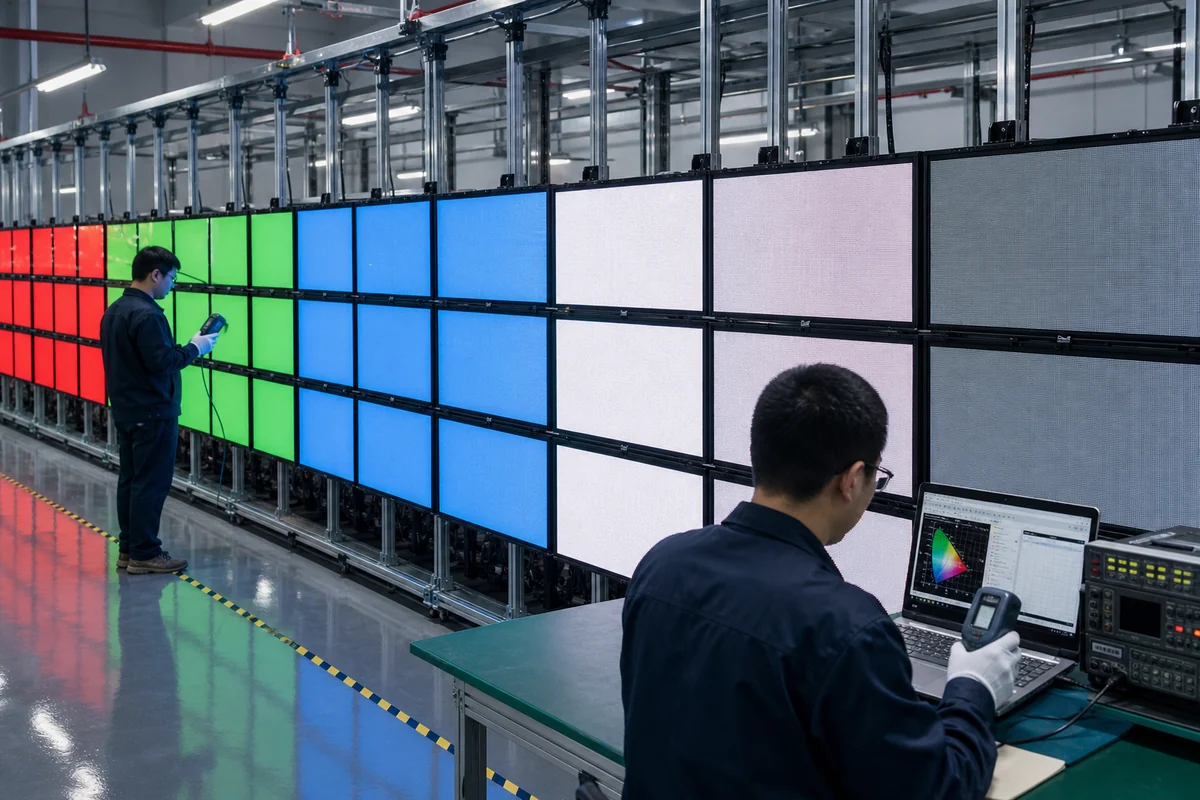
Aging testing helps manufacturers discover potential failures before products reach customers.
During aging tests, LED displays operate continuously under controlled conditions.
Manufacturers check:
- Pixel stability.
- Signal performance.
- Power system behavior.
- Brightness consistency.
- Temperature changes.
This process reduces the risk of early failures after installation.
A professional factory does not treat aging tests as a simple inspection step. It uses aging data to improve production quality.
Factory Perspective from NSELED:
Aging tests simulate real operating conditions.
LED displays used in commercial environments often operate for many hours every day. Testing products before shipment helps identify unstable components that may fail during customer operation.
This preventive approach reduces downtime and maintenance pressure for international buyers.
Do Not Choose an LED Display Manufacturer Based Only on Price
The cheapest LED display option may create higher long-term expenses because maintenance, energy consumption, and lifespan determine total ownership cost.
| Cost Factor | Long-Term Impact |
|---|---|
| Initial Price | Purchase investment |
| Component Quality | Failure rate |
| Energy Efficiency | Operating expenses |
| Maintenance | Service cost |
| Lifespan | Replacement frequency |
Price is an important factor in every LED display project, but experienced buyers understand that the lowest quotation does not always represent the best value.
LED displays are long-term investments. A screen installed in a shopping mall, stadium, transportation hub, or outdoor advertising location may operate for many years.
A small price difference during purchasing can become a much larger cost difference during operation.
For example, a lower-cost LED display may use lower-grade components or simplified manufacturing processes. The buyer may save money initially but spend more later on repairs, module replacement, and operational downtime.
Factory Perspective from NSELED:
Professional manufacturers analyze cost from the entire product lifecycle.
A display with better thermal management, stable components, and optimized power design may have a higher initial price but lower operating expenses over several years.
The purchasing decision should focus on value creation rather than only reducing the first payment.
Why LED Display Prices Differ Between Manufacturers
LED display prices vary because manufacturers make different decisions regarding components, engineering, production processes, and service capability.
Two LED screens with the same pixel pitch can have different prices because the internal design may differ significantly.
Important price factors include:
| Factor | Influence on Price |
|---|---|
| LED Chip Brand and Quality | Affects brightness consistency and lifespan |
| Driver IC Selection | Influences refresh rate and stability |
| Cabinet Material | Determines structural durability |
| Power Supply Quality | Affects reliability and energy efficiency |
| Production Control | Impacts failure rate |
For example, an outdoor P6 LED display requires more than LED modules and cabinets.
A professional outdoor solution must consider:
- Waterproof protection.
- Heat dissipation.
- Brightness management.
- Electrical safety.
- Long-term environmental resistance.
A supplier that reduces cost by simplifying these areas may provide a lower quotation but create future risks.
Factory Perspective from NSELED:
Manufacturing cost differences often come from details that buyers cannot see from product photos.
For example, two LED cabinets may look identical externally, but internal differences in PCB design, power distribution, and cooling structure can significantly affect long-term stability.
Experienced manufacturers explain these differences because they understand how production decisions influence future maintenance.
How to Compare LED Display Value Through Total Cost of Ownership
Professional buyers compare LED displays through total cost of ownership instead of only purchase price.
The calculation should include:
Total Cost of Ownership = Initial Investment + Operation Cost + Maintenance Cost + Replacement Cost
| Evaluation Item | Buyer Consideration |
|---|---|
| Purchase Cost | Initial budget |
| Power Consumption | Monthly operating expenses |
| Maintenance Frequency | Labor and replacement costs |
| Spare Parts Availability | Future service ability |
| Expected Lifespan | Investment return period |
Energy consumption is especially important for large LED projects.
A large outdoor advertising screen may operate continuously for many hours every day. A more efficient power system can reduce long-term electricity expenses.
Professional buyers also evaluate maintenance design.
For example, front-service LED modules may reduce maintenance time when the screen is installed against a wall.
A manufacturer that understands installation conditions can recommend better maintenance strategies.
Factory Perspective from NSELED:
Engineers evaluate maintenance during the design stage.
A low-cost display may create problems if technicians need to remove large sections of the screen to replace a single module.
Professional manufacturers consider accessibility, spare module planning, and maintenance efficiency before production.
Why Low-Cost Displays Often Increase Maintenance Risks
Low-cost LED displays often create problems when manufacturers reduce costs by sacrificing important engineering details.
Common risks include:
- Higher dead pixel rates.
- Uneven brightness.
- Shorter component lifespan.
- More frequent repairs.
- Limited technical support.
For B2B buyers, these problems can affect business operations.
A malfunctioning LED advertising screen may directly reduce advertising revenue. A damaged stadium display may affect event quality. A failed retail display may reduce customer engagement.
Therefore, buyers should evaluate supplier capability instead of only comparing quotations.
Evaluate International Support and After-Sales Capability
International buyers should choose LED display manufacturers that provide reliable technical support, warranty service, and long-term cooperation.
| Service Factor | Buyer Expectation |
|---|---|
| Technical Support | Remote troubleshooting and guidance |
| Warranty | Clear responsibility and coverage |
| Spare Parts | Long-term availability |
| Installation Support | Professional project assistance |
For overseas customers, product delivery is only one part of the project.
A professional LED display manufacturer should support customers before, during, and after installation.
International projects involve additional challenges:
- Different electrical standards.
- Different installation environments.
- Remote communication.
- Local technical requirements.
A manufacturer with international experience can help customers avoid common project problems.
Why Overseas Buyers Need More Than Product Delivery
Shipping an LED display to another country does not complete the supplier responsibility.
A reliable manufacturer should provide:
• Technical documentation.• Installation guidance.• Troubleshooting support.• Spare parts recommendations.• Warranty assistance.
For large projects, communication efficiency becomes extremely important.
A supplier that responds quickly and understands international project requirements can reduce installation delays.
Factory Perspective from NSELED:
International LED projects often involve different installation teams and local contractors.
Manufacturers need to provide clear technical information because small misunderstandings can create installation problems.
For example, incorrect cabinet installation methods can affect alignment, waterproof performance, and maintenance access.
How to Evaluate Warranty and Technical Support
Warranty terms should clearly explain:
- Warranty period.
- Covered components.
- Replacement process.
- Technical support method.
However, warranty length alone does not define service quality.
Buyers should also evaluate:
| Service Evaluation | Key Question |
|---|---|
| Response Time | How quickly can problems be handled? |
| Technical Team | Are engineers available? |
| Spare Parts | Are replacement components accessible? |
| Documentation | Are installation guides provided? |
A professional manufacturer builds support systems before problems happen.
Why International Project Experience Matters
Manufacturers with international project experience usually understand different market requirements.
For example:
- European projects may focus on certifications and energy efficiency.
- Outdoor projects in hot climates require stronger thermal solutions.
- Rental projects require fast installation and transportation efficiency.
A manufacturer familiar with global projects can provide more accurate recommendations.
Factory Perspective from NSELED:
International experience helps manufacturers identify risks before production.
A project specification may look complete on paper, but real installation conditions can create unexpected challenges.
Experienced manufacturers review installation location, climate conditions, and maintenance requirements before finalizing solutions.
Ask the Right Questions Before Choosing an LED Display Manufacturer
Asking the right questions helps buyers evaluate supplier capability and avoid purchasing risks.
| Question Category | Examples |
|---|---|
| Technical | Pixel pitch, brightness, refresh rate |
| Manufacturing | Factory capacity, testing process |
| Commercial | Lead time, warranty, support |
Many purchasing mistakes happen because buyers ask only for price quotations.
Professional procurement teams ask questions that reveal supplier capability.
The goal is not finding the cheapest supplier.
The goal is finding the manufacturer that can deliver stable performance throughout the project lifecycle.
Technical Questions Buyers Should Prepare
Buyers should ask:
• What pixel pitch does this application require?• What brightness level is suitable?• What refresh rate does the system support?• What components are used inside the display?• How does the manufacturer control calibration consistency?
These questions help buyers understand whether the supplier provides engineering-based solutions.
Manufacturing Questions Buyers Should Ask
Important manufacturing questions include:
• Do you own the factory?• What quality tests do you perform before shipment?• How do you control module consistency?• What is your production capacity?• Can you provide factory inspection information?
A professional manufacturer should answer these questions clearly.
Commercial Questions Buyers Should Confirm
Before cooperation, buyers should confirm:
- Production lead time.
- Warranty terms.
- Payment conditions.
- Shipping responsibilities.
- After-sales process.
Clear communication reduces future disputes..
Conclusion
Choosing the right LED display manufacturer requires more than comparing prices. Professional buyers should evaluate factory capability, component quality, engineering experience, testing procedures, and long-term service support before making decisions.
Next week, buyers can take three practical actions: first, audit potential suppliers by reviewing their manufacturing capability; second, prepare a complete technical requirement sheet before requesting quotations; third, compare suppliers based on total ownership value instead of initial purchase price.
NSELED helps global customers develop customized LED display solutions through engineering consultation, manufacturing expertise, and project support. If you need guidance on selecting the right LED display technology, application design, or customized solution, contact NSELED for a professional project evaluation and tailored LED display recommendation.
Frequently Asked Questions
How can I verify that an LED display supplier is a real manufacturer?
Ask for factory videos, production records, quality-control procedures, equipment lists, business documents, and a live video factory tour. For large projects, arrange an on-site or third-party inspection.
What certifications should an LED display manufacturer provide?
Certification requirements depend on the destination market and application. Common documents include CE, FCC, RoHS, ETL, and UL-related compliance, but buyers should also verify product testing and production consistency.
Why should buyers compare total cost of ownership instead of price?
Total cost includes purchasing, installation, energy, spare parts, maintenance, downtime, and replacement. A low initial quotation can become more expensive if component quality or support is weak.
How long should LED displays be aging-tested before shipment?
The appropriate procedure varies by product and manufacturer. Buyers should request the supplier’s documented aging-test duration, test patterns, inspection criteria, and final quality report.
What after-sales support should an international buyer expect?
Look for clear warranty terms, spare-module planning, remote technical assistance, installation documentation, troubleshooting response times, and reliable replacement-part availability.