


Shopping malls increasingly rely on LED display screens to attract visitors and boost retail engagement.
However, many mall developers and retail operators struggle to choose the right LED display solution. They must balance visual performance, installation conditions, operational costs, and advertising value. A poorly selected screen can reduce viewing impact, increase maintenance costs, and fail to deliver expected advertising returns.
This guide explains how to choose the best LED display screens for shopping malls. You will learn the key technical factors, optimal installation locations, and strategic considerations that help maximize long-term value.

Best Locations for LED Displays in Shopping Malls
The most effective LED displays appear in areas with high visitor traffic and strong visual exposure. Strategic placement ensures that the screen captures attention and delivers maximum advertising value.
Shopping malls typically contain several zones where digital displays perform especially well. These locations combine high foot traffic, natural viewing angles, and extended dwell time.
Retail developers often use a combination of display locations to create a network of digital advertising points throughout the mall.
Mall Entrances and Building Facades
Mall entrances represent the first visual contact between the shopping center and visitors. LED displays installed at entrances immediately capture attention and communicate promotions, events, and brand messages.
Entrance screens can also help shopping centers build a modern and high-tech brand image. Large digital facades often become architectural landmarks that attract visitors and encourage social media sharing.
In outdoor or semi-outdoor entrances, displays must handle stronger environmental conditions. Designers typically choose:
- Higher brightness levels
• Weather-resistant cabinets
• Protective coatings against humidity and dust
These entrance displays often function as large-format advertising platforms for global brands.
According to retail experience research summarized on Wikipedia regarding digital signage systems, high-visibility digital displays significantly increase advertising recall compared with static signage.
Because entrances attract every visitor entering the mall, they represent one of the most valuable locations for LED display installations.
Central Atriums and Event Areas
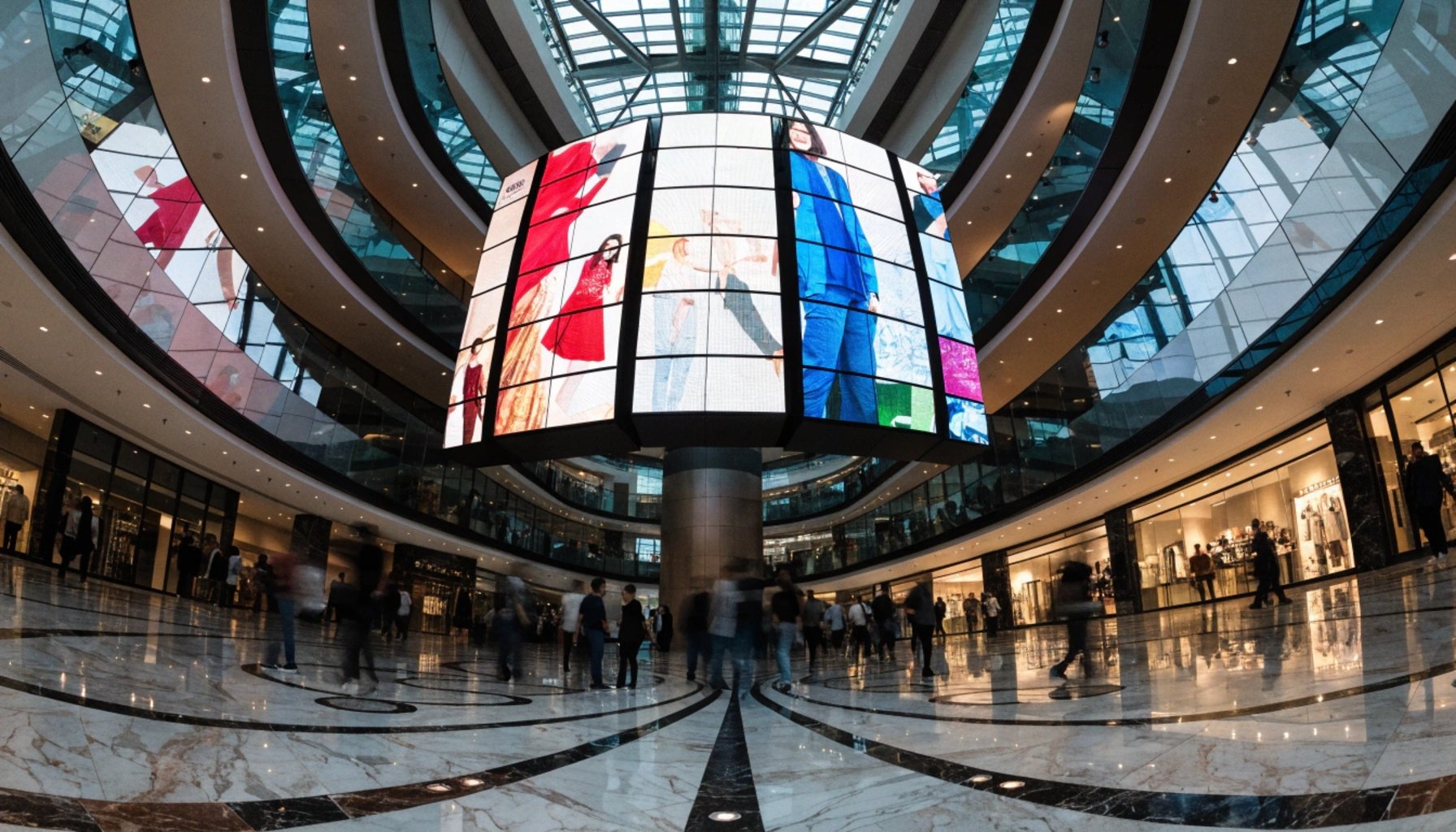
Central atriums are among the most powerful locations for large LED displays in shopping malls. These open spaces allow screens to reach visitors across multiple floors, making them ideal for brand campaigns, product launches, and large promotional events.
Most modern malls design atriums as visual centers of activity. People gather there for events, seasonal decorations, or entertainment programs. A large LED video wall in this area delivers strong visual impact and keeps visitors engaged.
Large atrium displays often serve several purposes:
- Brand advertising for global retail brands
• Live broadcasts of mall events
• Holiday campaigns and seasonal promotions
• Interactive entertainment or media experiences
Because these screens are usually very large, designers often install suspended LED displays or curved video walls. These structures allow viewers to see content clearly from multiple floors.
The table below shows typical atrium display configurations.
| Display Type | Typical Screen Size | Key Benefit |
| Large LED video wall | 50–200 m² | Maximum visual impact |
| Hanging LED cube | 20–80 m² | 360° visibility |
| Curved LED display | Custom size | Immersive design |
| LED ribbon display | Long horizontal structure | Continuous advertising space |
Atria displays require careful planning because of their structural complexity. Engineers must calculate weight distribution, power supply routes, and maintenance access points.
According to industry insights summarized on Wikipedia about digital signage networks, large-format displays placed in high-traffic environments significantly improve advertising reach and audience engagement.
For mall operators, a well-designed atrium LED display often becomes the centerpiece of the entire digital advertising strategy.
Corridors, Escalators, and Walkways
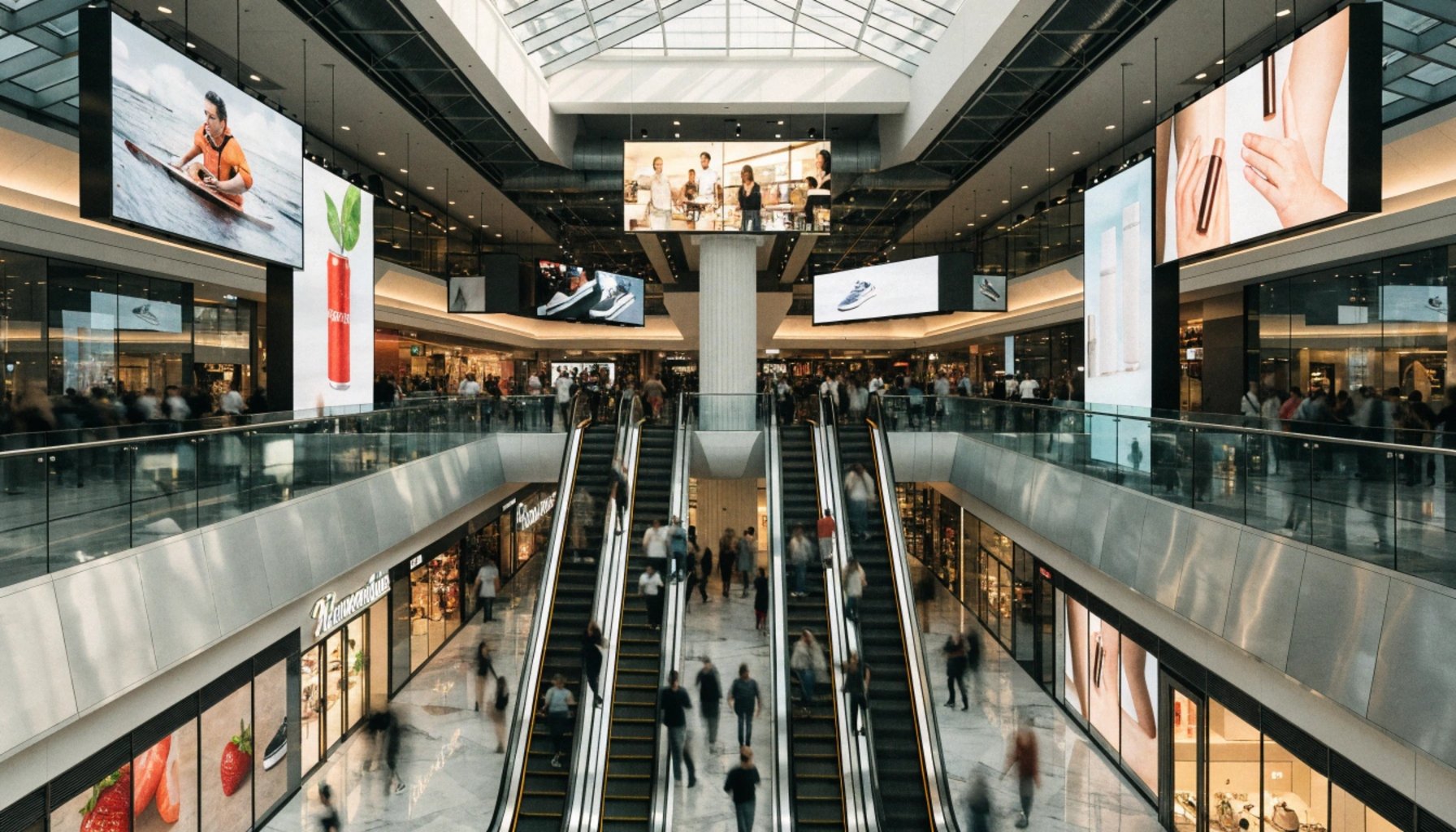
Corridors and escalator areas provide continuous exposure for digital advertising. Visitors pass through these spaces repeatedly as they move between stores, floors, and entertainment areas.
Unlike atriums, these areas focus on repetitive visibility rather than large-scale impact. Smaller LED displays placed along corridors ensure that shoppers encounter advertising content multiple times during their visit.
Common installation approaches include:
- Wall-mounted LED advertising screens
• Vertical displays beside escalators
• Narrow ribbon displays along ceilings or railings
• Column-mounted displays in walkways
Retail brands often prefer these locations for short promotional messages, such as discounts, flash sales, or limited-time campaigns.
The advantage of corridor displays lies in high frequency exposure. Even if visitors only glance at the screen for a few seconds, repeated exposure increases brand recall.
Marketing research summarized by the International Energy Agency regarding commercial visual environments highlights that repeated visual exposure improves information retention in retail spaces.
For shopping mall operators, the strategy is simple:
combine large statement displays with smaller corridor screens to create a complete digital advertising network.
Retail Storefronts and Window Displays
Retail storefront LED displays help brands attract attention and communicate promotions directly to shoppers. These screens transform ordinary shop windows into dynamic advertising spaces that update instantly.
Retail environments compete heavily for customer attention. Traditional printed posters cannot match the flexibility of digital displays. LED screens allow retailers to change promotions, product highlights, or seasonal campaigns in real time.
Storefront LED displays typically focus on high-resolution visuals because shoppers often stand very close to the screen. For this reason, smaller pixel pitches are usually preferred.
| Storefront Display Type | Recommended Pixel Pitch | Main Purpose |
| High-resolution LED poster | P1.9 – P2.5 | Product promotion |
| LED video wall behind glass | P2 – P3 | Brand storytelling |
| Transparent LED display | P3 – P4 | Window advertising without blocking view |
| Narrow vertical LED display | P2.5 – P3 | Entrance promotion |
Transparent LED displays have become especially popular in premium retail districts. These displays allow natural light to pass through while still showing digital content.
According to display technology explanations provided by Wikipedia, transparent LED technology uses spaced LED strips to maintain partial transparency while displaying images and videos.
For retailers, storefront LED displays offer three major advantages:
- Attract pedestrians walking past the store
• Deliver dynamic product advertising
• Maintain flexible promotional campaigns
As a result, many flagship retail stores now treat digital displays as part of their store design and branding strategy.
Food Courts and Entertainment Areas
Food courts and entertainment zones offer some of the longest visitor dwell times in shopping malls. People often sit, relax, and socialize in these areas, which creates an excellent opportunity for digital advertising.
Unlike corridor displays that deliver quick messages, food court screens can show longer video content, branded storytelling, or event promotions. Because audiences remain seated for longer periods, they have more time to watch full advertising campaigns.
Typical applications include:
- Restaurant promotions and menu displays
• Entertainment announcements and event schedules
• Brand advertising campaigns
• Live sports or entertainment broadcasts
These displays usually require larger screen sizes so that visitors can view them from multiple seating areas.
The table below outlines common food court display strategies.
| Display Position | Typical Screen Size | Primary Function |
| Central food court video wall | 30–120 m² | Brand advertising |
| LED menu displays | Small modular screens | Restaurant promotions |
| Suspended LED screens | Medium size | Entertainment broadcasts |
| Directional information screens | Small displays | Wayfinding and announcements |
Marketing experts widely recognize that longer dwell time increases advertising effectiveness. When shoppers sit down to eat or rest, they naturally pay more attention to surrounding visual media.
Therefore, food courts often generate strong advertising engagement and brand exposure.
Content Strategy: How Shopping Malls Maximize LED Display Impact
Shopping malls maximize the value of LED displays by combining strong content strategy with smart scheduling. A high-quality screen alone does not guarantee results. The real impact comes from delivering the right message at the right time to the right audience.
Many malls treat LED displays as part of a digital signage network that supports marketing, advertising, and visitor communication. With proper content planning, operators can increase brand visibility, promote events, and improve the overall shopping experience.
Retail studies summarized by Wikipedia explain that digital signage increases customer engagement because it delivers dynamic, frequently updated content compared with static advertising.
Below are several proven strategies shopping centers use to maximize LED display effectiveness.
Advertising Campaigns for Retail Brands
Retail advertising represents one of the primary revenue sources for shopping mall LED displays. Many malls lease advertising time to brands that want to promote new products or seasonal offers.
A well-designed advertising campaign should focus on clear messaging, strong visuals, and short attention spans. Shoppers often view the screen while walking, so the message must remain simple and visually striking.
Effective advertising content often includes:
- Short promotional videos (5–10 seconds)
• High-contrast product visuals
• Clear promotional messages or discounts
• Brand logos and recognizable imagery
Advertising networks inside malls usually rotate content throughout the day. This rotation ensures that multiple brands receive exposure while visitors see varied content.
The table below shows a typical advertising rotation strategy.
| Time Period | Advertising Focus | Example Campaign |
| Morning | Lifestyle brands | Coffee shops, fashion brands |
| Afternoon | Retail promotions | Clothing and electronics |
| Evening | Entertainment | Cinema and restaurants |
| Weekends | Major brand campaigns | Product launches |
By carefully scheduling advertising campaigns, mall operators can maximize advertising revenue while keeping content fresh and engaging.
Event Promotion and Seasonal Marketing
Shopping malls frequently host seasonal events, promotions, and entertainment programs. LED displays provide an ideal platform for promoting these activities.
For example, many malls organize events such as:
- Holiday celebrations
• Fashion shows
• Product launches
• Cultural festivals
• Live entertainment events
LED displays help announce these events throughout the shopping center. Large screens in atriums can show countdown timers, promotional videos, or live broadcasts.
Seasonal campaigns also play an important role in retail marketing. During major shopping periods such as Black Friday or holiday seasons, malls use LED displays to highlight promotions across multiple stores.
According to consumer retail statistics reported by the National Retail Federation, seasonal shopping events drive a large share of annual retail sales in many markets. Digital signage helps retailers capture customer attention during these critical periods.
Therefore, event promotion and seasonal marketing remain key strategies for maximizing the effectiveness of shopping mall LED displays.
Wayfinding and Information Displays
LED displays also help visitors navigate large shopping malls by providing wayfinding and information services. Modern malls often cover hundreds of thousands of square meters. Without clear guidance, visitors may struggle to locate stores, facilities, or event spaces.
Digital signage improves navigation by delivering real-time information across the mall. Instead of relying only on static maps, shopping centers can update directions, announcements, and schedules instantly.
Typical information displayed on LED wayfinding screens includes:
- Store directories and floor maps
• Event schedules and promotions
• Parking guidance and entrance information
• Emergency announcements or safety notices
Large shopping centers often place these displays at key decision points, such as elevator lobbies, escalator intersections, and main corridors.
The table below outlines common wayfinding display locations.
| Location | Information Displayed | Visitor Benefit |
| Mall entrances | Store directory and floor map | Helps visitors plan routes |
| Elevator and escalator areas | Floor navigation guidance | Reduces confusion |
| Parking entrances | Parking availability | Improves traffic flow |
| Information desks | Event and promotion details | Enhances customer service |
Digital navigation systems also integrate with centralized content management platforms. These systems allow mall operators to update information across multiple screens simultaneously.
Research referenced on Wikipedia regarding digital signage networks shows that interactive and dynamic displays improve visitor experience and information accessibility in public environments.
As shopping centers continue to grow in size and complexity, digital wayfinding systems are becoming an essential component of modern retail infrastructure.
Integrating LED Displays with Digital Signage Systems
A digital signage management system allows shopping malls to control multiple LED displays from a central platform. This integration simplifies content scheduling, system monitoring, and campaign management.
Without a centralized system, managing dozens of displays across a large mall would be extremely inefficient. Digital signage platforms allow operators to update content remotely and coordinate advertising campaigns across different locations.
Key capabilities of digital signage systems include:
- Remote content management
• Scheduled advertising playback
• Real-time system monitoring
• Emergency message broadcasting
• Data analytics for audience engagement
The table below summarizes the operational advantages of integrated digital signage systems.
| Feature | Operational Benefit | Example Application |
| Centralized control | Manage multiple screens easily | Mall-wide advertising campaigns |
| Content scheduling | Automate daily playback | Time-based promotions |
| Real-time updates | Instant information changes | Event announcements |
| Data analytics | Measure campaign performance | Advertising ROI tracking |
These systems also allow malls to connect LED displays with marketing campaigns, mobile applications, and customer data platforms.
According to industry insights discussed by the International Energy Agency regarding digital infrastructure in commercial buildings, smart digital systems improve operational efficiency and communication within public spaces.
For mall operators, the advantage is clear:
combining LED displays with digital signage systems transforms isolated screens into a powerful, coordinated communication network.

How to Choose a Reliable LED Display Manufacturer
Choosing a reliable LED display manufacturer is essential for the success of any shopping mall LED project. The manufacturer determines product quality, long-term stability, customization capability, and after-sales support.
Shopping mall LED displays often operate 12–16 hours per day for many years. Poor-quality components or unreliable suppliers can lead to frequent failures, expensive repairs, and operational disruptions.
Therefore, mall developers and system integrators should evaluate suppliers based on technical expertise, certifications, project experience, and support services.
According to industry information summarized on Wikipedia regarding LED display systems, manufacturing quality and component reliability play a critical role in the long-term performance of large-scale digital displays.
Below are several key factors buyers should consider when selecting a professional LED display manufacturer.
Product Quality and Certification
High-quality LED displays rely on certified components and strict manufacturing standards. Buyers should always verify whether the manufacturer complies with international safety and quality certifications.
Common certifications for LED display products include:
- CE certification for European market compliance
• RoHS compliance for restricted hazardous substances
• FCC certification for electromagnetic compatibility in the United States
These certifications help ensure that the LED display meets regulatory requirements and operates safely in commercial environments.
Custom Design Capabilities
Every shopping mall has unique architectural layouts and installation conditions. As a result, many projects require customized LED display solutions rather than standard products.
A capable manufacturer should offer flexible customization options, such as:
- Custom screen sizes and aspect ratios
• Curved or creative display structures
• Transparent LED displays for glass walls
• Specialized mounting systems for atriums or columns
Customization ensures that the LED display integrates naturally with the mall’s architecture, branding, and marketing strategy.
Retail environments increasingly prefer creative LED designs that transform digital displays into architectural features rather than simple advertising screens.
Global Project Experience
Manufacturers with international project experience usually provide more reliable solutions. Export-oriented suppliers understand the regulatory requirements, logistics processes, and technical standards of different markets.
Experienced manufacturers typically support projects in regions such as:
- North America
• Europe
• Australia
• Japan and Southeast Asia
These suppliers also understand different installation environments, electrical standards, and safety regulations.
Buyers should ask manufacturers to provide case studies, reference projects, and installation photos from previous international deployments.
A proven project portfolio often indicates stronger technical expertise and better reliability.
After-Sales Support and Technical Service
Strong after-sales support is one of the most important factors in LED display projects. Even high-quality screens require occasional maintenance or technical adjustments.
A professional manufacturer should provide services such as:
- Remote technical support
• Spare parts supply
• Installation guidance
• Software troubleshooting
• Maintenance training for operators
Conclusion
Choosing the right LED display screens for shopping malls requires careful planning and technical understanding. Mall developers must evaluate pixel pitch, brightness, viewing angles, installation structure, and long-term operating costs before making a final decision.
A well-designed LED display network can transform a shopping center into a dynamic digital environment. Strategically placed screens increase visitor engagement, improve brand visibility, and create new advertising revenue opportunities for retailers and mall operators.
If you are planning a retail LED display project, partnering with a reliable manufacturer is essential. NSELED provides customized LED display solutions for shopping malls worldwide. Contact our team to explore the right LED display solution for your project.
FAQs
What pixel pitch is best for shopping mall LED displays?
P2.5–P4 is the most common pixel pitch range for indoor shopping malls. The final choice depends on the viewing distance and screen size.
How bright should an indoor LED display be for a shopping mall?
Most indoor mall LED displays use 800–1200 nits brightness to remain clear under indoor lighting conditions.
How much does a shopping mall LED display cost?
Costs vary based on pixel pitch, screen size, and installation complexity, ranging from small commercial displays to large customized video walls.