


Introduction
Indoor LED screens have become one of the most effective digital display solutions for businesses that need high-impact visual communication. From retail stores and shopping malls to corporate offices, entertainment venues, and control centers, companies increasingly use LED displays to create immersive experiences and deliver dynamic content.
Unlike traditional LCD video walls, indoor LED displays provide a seamless viewing experience without visible bezels. They offer higher brightness, better scalability, and more flexible installation options for large-format visual applications. As display technology continues to improve, fine pixel pitch LED screens have also made LED solutions suitable for close-viewing environments such as meeting rooms, studios, and premium retail spaces.
The growing adoption of indoor LED screens has also increased demand for reliable LED display manufacturers. However, choosing the right supplier is not always easy. The market includes professional LED manufacturers, distributors, system integrators, and trading companies with different capabilities. A supplier with strong marketing materials does not always mean it has advanced manufacturing experience or reliable product quality.
For businesses planning an indoor LED display project, selecting the right manufacturer directly affects image performance, installation efficiency, maintenance costs, and long-term return on investment.
Why Choosing the Right Indoor LED Screen Manufacturer Matters
Choosing an indoor LED screen manufacturer is not only about comparing product prices. A professional manufacturer should provide consistent quality, technical expertise, customization capability, and reliable after-sales support throughout the entire project lifecycle.
Many buyers focus only on specifications such as pixel pitch, brightness, and screen size. However, the long-term performance of an LED display depends on many deeper factors, including LED component quality, production control, module consistency, calibration accuracy, and thermal management.
From a manufacturer’s perspective, a reliable indoor LED display requires strict quality control at every production stage. For example, LED modules must go through brightness and color calibration to ensure uniform visual performance across the entire screen. During mass production, controlling dead pixel rates and maintaining module consistency are also critical factors that influence product reliability after installation.
A professional LED display manufacturer should also understand different application requirements. A conference room LED wall, a retail advertising display, and a control room screen may require completely different solutions in terms of pixel pitch, refresh rate, brightness, and installation structure.
Therefore, working with an experienced manufacturer helps buyers avoid common problems such as inconsistent brightness, difficult maintenance, poor technical support, and unexpected replacement costs.
What You Will Learn from This Guide
This guide provides a comprehensive overview of the top indoor LED screen manufacturers in the US market and explains how buyers can evaluate LED display suppliers before making a purchasing decision.
You will learn:
- How to identify reliable indoor LED screen manufacturers
- What factors should be considered when comparing LED display companies
- How manufacturing capability affects product quality
- The differences between US-based suppliers and Chinese LED display factories
- What influences indoor LED screen pricing
- How to select the right LED display solution for different applications
Instead of only listing company names, this article focuses on the key factors that help businesses choose a long-term LED display partner.
How We Selected the Top Indoor LED Screen Manufacturers in the US
A reliable manufacturer ranking should not be based only on company size or online visibility. Professional LED display buyers usually evaluate suppliers based on technical capability, production experience, project performance, and service quality.
The following criteria are used to evaluate indoor LED screen manufacturers.
Manufacturing Capability and Industry Experience
Manufacturing capability is one of the most important factors when selecting an indoor LED screen supplier.
A professional LED display manufacturer should have:
- Dedicated production facilities
- Experienced engineering teams
- Advanced testing equipment
- Stable supply chains
- Quality control systems
Manufacturers with strong production capabilities can better control product consistency, delivery schedules, and customization requirements.
For large commercial projects, production experience becomes especially important. A supplier that has completed hundreds of LED display installations usually understands potential challenges related to cabinet structure, installation environments, signal systems, and maintenance requirements.
Experienced manufacturers also have better control over production details, including LED module assembly, driving system integration, and aging testing.
Product Quality and LED Display Technology

Technology capability directly affects the performance and lifespan of an indoor LED screen.
When evaluating manufacturers, buyers should consider:
- Pixel pitch options
- LED chip quality
- Driving IC performance
- Refresh rate capability
- Color consistency
- Energy efficiency
- Heat dissipation design
For example, fine pixel pitch LED displays require higher manufacturing accuracy because smaller pixels create stricter requirements for module consistency and calibration.
A professional factory does not simply assemble LED cabinets. It manages the complete production process to ensure stable performance.
The choice of driving IC is also important. Different IC solutions can influence refresh rate, power efficiency, and heat generation during long-term operation. Manufacturers with deeper technical experience can select suitable components based on application requirements instead of using standard configurations for every project.
Project Experience and Market Reputation
A manufacturer’s previous projects provide valuable information about its practical capabilities.
Buyers should review:
- Completed indoor LED projects
- Industries served
- Installation environments
- Customer feedback
- International project experience
Different applications create different technical challenges.
For example:
- Retail environments require excellent visual impact and creative designs
- Corporate meeting rooms require high resolution and reliability
- Control rooms require continuous operation and stable performance
- Entertainment venues require high refresh rates and strong visual effects
A manufacturer with diverse project experience is usually better prepared to recommend suitable solutions.
Customization, OEM, and Engineering Support
Many commercial LED display projects require customized solutions rather than standard products.
A capable manufacturer should support:
- Custom cabinet sizes
- Special-shaped LED displays
- Curved LED walls
- Customized mounting structures
- OEM branding services
- System integration support
Customization capability is especially important for distributors, AV integrators, and engineering contractors who need flexible solutions for different customers.
A strong OEM/ODM partner can help businesses expand their product offerings while reducing development costs.
After-Sales Service and Customer Support
LED displays are long-term investments, so after-sales support plays an important role in supplier selection.
Reliable manufacturers should provide:
- Technical consultation
- Installation guidance
- Spare parts support
- Remote troubleshooting
- Warranty services
- Maintenance recommendations
A high-quality LED screen should not only perform well after installation but also remain stable throughout years of operation.
Manufacturers that provide strong technical support help customers reduce downtime and maintenance expenses.
What Is an Indoor LED Screen Manufacturer?
Indoor LED Screen Manufacturer vs LED Display Supplier vs Distributor
When researching indoor LED screen solutions, many buyers use the terms “manufacturer,” “supplier,” and “distributor” interchangeably. However, these three types of companies usually play different roles in the LED display industry.
An indoor LED screen manufacturer is a company that designs, produces, tests, and supplies LED display products directly. Professional manufacturers usually control important production processes, including LED module assembly, cabinet manufacturing, quality inspection, calibration, and product testing.
A LED display supplier may provide complete solutions but may not always own production facilities. Some suppliers cooperate with factories and focus more on sales, project management, and installation services.
A distributor mainly purchases products from manufacturers and resells them to customers. Distributors often provide local support, inventory management, and installation services, but they may have limited control over product design and manufacturing quality.
For commercial buyers, understanding this difference is important because the supply chain structure can affect:
- Product pricing
- Customization flexibility
- Technical support
- Delivery time
- Long-term maintenance
For example, a company looking for a standard indoor LED wall for a small retail store may work well with a local distributor. However, large-scale projects, international sourcing, and customized LED solutions often require direct cooperation with an experienced manufacturer.
From a factory perspective, direct cooperation with manufacturers allows buyers to communicate technical requirements more efficiently. Engineers can adjust product configurations based on application needs, including pixel pitch, brightness level, cabinet design, and installation environment.
How Professional LED Display Manufacturers Control Product Quality
The quality of an indoor LED screen depends on much more than the final appearance of the product. A reliable manufacturer needs to control every stage of production to ensure stable performance after installation.
Professional LED display factories usually implement quality control procedures throughout the manufacturing process.
LED Component Selection
LED components directly influence image quality, brightness stability, and product lifespan.
Manufacturers need to evaluate:
- LED chip performance
- Light efficiency
- Color consistency
- Reliability under continuous operation
High-quality LED components help reduce brightness differences between pixels and improve long-term visual consistency.
Module Assembly and Production Control
LED modules are the basic building blocks of an LED display.
During production, manufacturers need to control:
- PCB quality
- Soldering accuracy
- Component placement
- Module flatness
- Electrical performance
Small production errors can become visible problems when thousands of modules are combined into a large LED wall.
For example, inconsistent module brightness can create visible color differences across the screen. Professional factories use calibration systems to balance brightness and color performance before shipment.
Brightness and Color Calibration
Calibration is one of the most important processes affecting LED display quality.
A large indoor LED screen contains thousands or even millions of individual LED pixels. Without proper calibration, slight differences between LED modules may create uneven images.
Professional manufacturers use calibration technology to optimize:
- Brightness uniformity
- Color accuracy
- Grayscale performance
This process helps maintain consistent image quality after installation.
Aging Testing and Reliability Inspection
Before delivery, reliable manufacturers perform aging tests to identify potential problems.
Typical testing procedures include:
- Long-term operation testing
- Power stability testing
- Signal performance testing
- Pixel inspection
- Temperature monitoring
Aging testing helps manufacturers detect defective components before products reach customers.
From manufacturing experience, controlling dead pixel rates during mass production is one of the key indicators of factory quality management. A manufacturer with strict testing procedures can significantly reduce maintenance issues after installation.
Key Manufacturing Processes Behind Reliable Indoor LED Screens
Understanding the manufacturing process helps buyers evaluate whether an LED company has real production capability.
A professional indoor LED screen typically goes through several major stages.
LED Module Manufacturing
The first stage involves producing LED modules.
This includes:
- LED lamp mounting
- PCB assembly
- Component installation
- Electrical testing
The module determines the basic performance of the entire display.
Cabinet Assembly
LED modules are installed into cabinets to create complete display units.
Manufacturers need to ensure:
- Cabinet precision
- Flatness between modules
- Structural stability
- Easy maintenance design
For indoor applications, cabinet design directly affects installation efficiency and future serviceability.
Control System Integration
An LED display requires a complete control system to process and transmit images.
Manufacturers evaluate:
- Receiving cards
- Sending systems
- Refresh rate
- Signal compatibility
Different applications may require different control solutions.
For example:
- Corporate meeting rooms may prioritize high resolution and smooth image quality
- Entertainment venues may require higher refresh rates for camera recording
- Control rooms may require stable 24/7 operation
Final Quality Inspection
Before shipment, manufacturers conduct final inspections, including:
- Appearance checking
- Brightness testing
- Color testing
- Functional testing
- Packaging inspection
A professional factory does not only focus on producing products quickly. It focuses on delivering reliable LED display solutions that can operate consistently for years.
Comparison of Top Indoor LED Screen Manufacturers in the US
Before selecting an indoor LED screen manufacturer, buyers should compare companies based on product capability, application experience, customization ability, and service support.
A ranking list alone cannot fully explain which supplier is suitable for a specific project. Different manufacturers may focus on different market segments.
Comparison Based on Product Categories
Indoor LED screen manufacturers usually offer different product categories depending on their technical strengths and target customers.
Common product categories include:
Fine Pixel Pitch LED Displays
Fine pixel pitch LED displays are designed for close viewing environments.
Typical applications include:
- Conference rooms
- Broadcast studios
- Control centers
- Premium retail spaces
These displays require advanced manufacturing accuracy because smaller pixel spacing increases requirements for:
- LED consistency
- Calibration precision
- Manufacturing tolerance control
Commercial Indoor LED Walls
Commercial LED walls are widely used in:
- Shopping malls
- Retail stores
- Corporate spaces
- Public facilities
Manufacturers need to balance:
- Visual performance
- Reliability
- Installation convenience
- Cost efficiency
Rental Indoor LED Displays
Rental LED displays are designed for frequent installation and transportation.
Important features include:
- Lightweight cabinets
- Fast installation design
- High durability
- High refresh rate
Event companies usually prioritize flexibility and reliability.
Custom LED Display Solutions
Some manufacturers specialize in creative LED applications, including:
- Curved LED screens
- Irregular shapes
- Interactive displays
- Special installation structures
These solutions require stronger engineering capabilities.
Comparison Based on Target Applications
Different customers have different requirements when choosing indoor LED display manufacturers.
Retail and Brand Applications
Retail customers usually focus on:
- Bright image quality
- Attractive visual effects
- Custom design capability
Manufacturers with commercial display experience are often better suited for these projects.
Corporate and Enterprise Applications
Corporate buyers usually require:
- Fine pixel pitch
- Professional appearance
- Stable operation
- Easy maintenance
Meeting rooms and conference centers often require high-resolution LED solutions.
Entertainment and Event Applications
Entertainment customers usually prioritize:
- High refresh rate
- Strong visual impact
- Reliable performance during continuous operation
Manufacturers with rental LED experience often have advantages in this market.
Engineering and System Integration Projects
System integrators need manufacturers that can provide:
- Technical documentation
- Engineering support
- Customized solutions
- Long-term cooperation
Manufacturing flexibility becomes a key evaluation factor.
Comparison Based on Customization and OEM Capability
For distributors and international partners, OEM capability can create significant business value.
A strong OEM manufacturer can provide:
- Customized product branding
- Product specification adjustments
- Packaging customization
- Engineering cooperation
This capability allows partners to develop unique solutions instead of selling identical products available from multiple suppliers.
Comparison Based on Customer Support and Service
Service capability is another important factor when comparing manufacturers.
Professional suppliers should provide:
- Pre-sales technical consultation
- Installation guidance
- Remote support
- Spare parts availability
- Maintenance assistance
For global customers, especially international distributors, reliable communication and technical support can significantly improve project success.
US Indoor LED Screen Manufacturers vs Chinese LED Display Factories
When selecting an indoor LED screen supplier, many international buyers compare US-based LED companies with Chinese LED display manufacturers. Both supply models have their own advantages, and the right choice depends on project size, technical requirements, budget, and service expectations.
A professional purchasing decision should not focus only on supplier location. Buyers should evaluate manufacturing capability, product quality, customization options, communication efficiency, and long-term support.
Advantages of Working with US-Based LED Display Companies
US-based LED display companies often provide advantages related to local service and project management.
Local Communication and Project Coordination
Working with a US supplier can simplify communication because customers are usually in the same time zone and share similar business processes.
This can be beneficial for:
- Local businesses
- Retail projects
- Government projects
- Customers requiring onsite coordination
Local suppliers may also have stronger relationships with regional installers and service teams.
Faster Onsite Support
For projects that require immediate technical assistance, local suppliers may provide faster onsite services.
This advantage is particularly valuable for:
- Large venues
- Live events
- Corporate facilities
- Mission-critical applications
However, buyers should confirm whether the company provides actual technical teams or works through third-party installers.
Easier Project Management
Some customers prefer working with a local supplier because they can handle:
- Site surveys
- Installation coordination
- Local regulations
- Project documentation
For companies without internal technical teams, a full-service local provider can reduce project complexity.
Advantages of Direct Factory Purchasing from China
China has become one of the world’s largest LED display manufacturing centers, with extensive production capacity and supply chain advantages.
Many global LED display brands and distributors work directly with Chinese manufacturers because of their manufacturing expertise and cost advantages.
More Competitive Manufacturing Costs
Direct factory purchasing can reduce costs because buyers work closer to the production source.
Chinese LED manufacturers typically benefit from:
- Mature supply chains
- Large-scale component purchasing
- Efficient production systems
- Extensive manufacturing experience
For large commercial projects, direct sourcing can significantly improve cost efficiency.
Strong OEM and ODM Capability
One major advantage of Chinese LED display factories is customization flexibility.
Experienced manufacturers can provide:
- Customized cabinet designs
- Private label production
- Special pixel pitch solutions
- Creative LED displays
- Project-based engineering support
This is especially valuable for:
- LED distributors
- AV integrators
- Brand owners
- System integration companies
Wider Product Selection
Chinese LED manufacturers usually offer a broader product range, including:
- Fine pixel pitch LED displays
- Indoor LED video walls
- Outdoor LED displays
- Rental LED screens
- Transparent LED displays
- Flexible LED solutions
- Custom creative LED products
This allows buyers to work with one manufacturing partner for multiple applications.
Which Supply Model Is Better for Different Buyers?
The best sourcing model depends on the buyer’s business model and project requirements.
Small Local Projects
For small projects that require quick installation and local support, a US-based supplier or integrator may be suitable.
Examples:
- Small retail displays
- Local business installations
- Short-term projects
Large Commercial Projects
For large LED wall projects, direct cooperation with experienced manufacturers may provide advantages in:
- Cost control
- Product customization
- Technical communication
- Production management
Examples:
- Shopping malls
- Airports
- Large entertainment venues
- Corporate headquarters
LED Distributors and System Integrators
Distributors usually benefit from working with manufacturers that provide:
- OEM services
- Stable supply
- Competitive pricing
- Product customization
- Technical training
A strong factory partnership can help distributors build long-term market advantages.
How Much Does an Indoor LED Screen Cost?
The cost of an indoor LED screen depends on multiple factors, including screen size, pixel pitch, LED components, cabinet design, installation requirements, and customization level.
Unlike traditional displays with fixed prices, LED screens are usually customized according to project requirements.
A small indoor LED wall for a conference room may have a completely different cost structure compared with a large commercial LED installation in a shopping mall or entertainment venue.
Average Price Range of Indoor LED Displays
Indoor LED display prices can vary significantly depending on specifications.
Generally, the main cost factors include:
- Display area
- Pixel pitch
- LED technology
- Control system
- Installation requirements
- Additional customization
Fine pixel pitch LED displays usually cost more because they require:
- Higher-density LED components
- More precise manufacturing
- Advanced calibration technology
For example, a P0.9 or P1.2 LED display designed for close viewing requires more advanced production control compared with a larger-pitch commercial display.
Main Factors Affecting Indoor LED Screen Pricing
Screen Size
Larger displays require more:
- LED modules
- Cabinets
- Power supplies
- Control equipment
Therefore, total project cost increases with display area.
However, larger projects may achieve better unit pricing because of production efficiency.
Pixel Pitch
Pixel pitch is one of the most important factors affecting price.
Smaller pixel pitch means:
- More LED pixels per square meter
- Higher resolution
- More advanced manufacturing requirements
Common indoor pixel pitches include:
- P0.9
- P1.2
- P1.5
- P1.8
- P2.5
- P3
The correct choice depends on:
- Viewing distance
- Content requirements
- Application environment
How LED Components Affect Long-Term Performance
The quality of internal components influences not only initial cost but also long-term operating expenses.
Important components include:
- LED chips
- Driving ICs
- PCB boards
- Power supplies
For example, efficient driving ICs can help reduce heat generation and improve energy efficiency during continuous operation.
High-quality LED components also improve:
- Brightness stability
- Color consistency
- Display lifespan
From a manufacturing perspective, component selection is one of the key differences between budget LED screens and professional commercial-grade solutions.
Installation and Maintenance Costs to Consider
The purchase price is only part of the total investment.
Buyers should also consider:
- Installation structure
- Labor cost
- Control system setup
- Spare parts
- Future maintenance
A well-designed LED display with front maintenance capability may reduce future service costs, especially in locations where rear access is difficult.
Professional manufacturers usually consider maintenance requirements during the design stage instead of treating maintenance as an afterthought.
Common Applications of Indoor LED Screens
Indoor LED displays are widely used across different industries because they provide seamless large-format visual experiences.
Retail Stores and Shopping Malls
Retail businesses use indoor LED screens to:
- Promote products
- Display advertisements
- Create immersive shopping experiences
- Strengthen brand communication
Compared with traditional printed advertising, LED displays allow businesses to update content instantly and create dynamic visual effects.
Retail applications usually focus on:
- High image quality
- Bright colors
- Reliable daily operation
- Attractive design
Corporate Meeting Rooms and Conference Centers
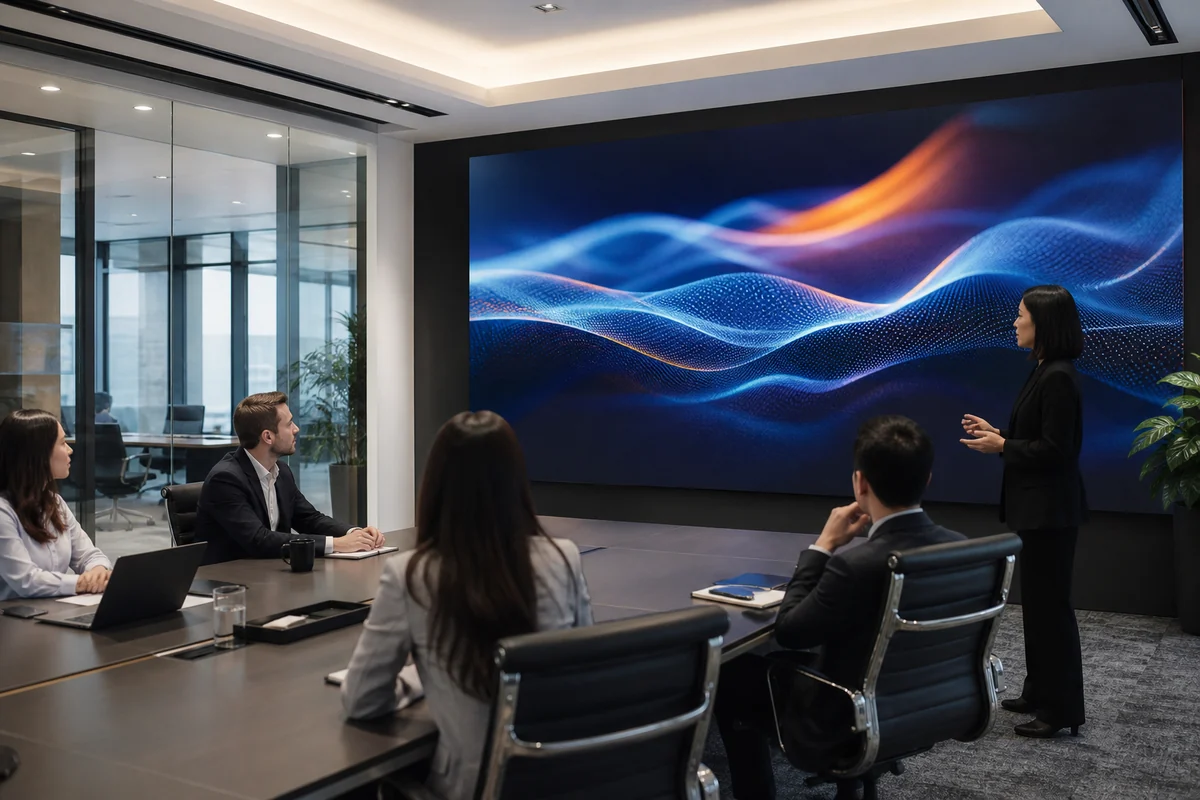
Corporate environments increasingly use fine pixel pitch LED displays instead of traditional projection systems.
Advantages include:
- Seamless images
- Better brightness
- Professional appearance
- Lower maintenance requirements
Typical applications include:
- Executive meeting rooms
- Video conference rooms
- Training centers
- Presentation spaces
Control Rooms and Command Centers

Control rooms require displays that can operate continuously with high reliability.
Important requirements include:
- Fine pixel pitch
- Stable operation
- Accurate image reproduction
- Long lifespan
Applications include:
- Security monitoring centers
- Transportation control rooms
- Energy management centers
Entertainment Venues and Events
Entertainment industries use indoor LED screens for:
- Concert stages
- Theaters
- Casinos
- Event spaces
These applications usually require:
- High refresh rate
- Excellent visual performance
- Fast installation capability
Exhibition and Trade Show Displays
Trade shows require flexible display solutions that attract visitor attention.
Indoor LED screens help exhibitors create:
- Large visual backgrounds
- Interactive experiences
- Premium brand presentations
Rental-friendly LED designs are especially popular because they allow quick setup and transportation.
FAQ
How long does an indoor LED screen last?
A high-quality indoor LED screen typically has a lifespan of around 80,000 to 100,000 hours under proper operating conditions. However, actual lifespan depends on several factors, including LED component quality, operating temperature, brightness settings, and maintenance.
Professional manufacturers improve lifespan through component selection, thermal design, aging testing, and strict quality control during production.
What is the best pixel pitch for an indoor LED display?
The best pixel pitch depends on viewing distance and application requirements.
For example:
- P0.9-P1.5: Premium conference rooms, control centers, broadcast environments
- P1.5-P2.5: Retail stores, corporate spaces, commercial applications
- P2.5-P4: Large indoor venues with longer viewing distances
Buyers should select pixel pitch based on how close viewers will stand rather than simply choosing the highest resolution option.
What should buyers verify before choosing an indoor LED screen manufacturer?
Verify production capability, project references, component specifications, calibration and aging-test procedures, engineering support, warranty terms, and spare-part availability.
Is a US supplier or a direct LED factory better?
A US supplier may provide faster local coordination and onsite support, while a direct factory may offer stronger customization and manufacturing cost control. The best model depends on project scale and service needs.
What affects the price of an indoor LED screen?
Display area, pixel pitch, LED chips, driver ICs, cabinets, control equipment, installation structure, calibration, shipping, maintenance access, and after-sales service all influence total cost.
Conclusion
Choosing the right indoor LED screen manufacturer requires more than comparing product prices or brand names. For US buyers, local suppliers can provide advantages in communication and onsite service, while experienced Chinese LED display manufacturers can offer strong production capabilities, competitive pricing, and flexible OEM/ODM solutions.
As a professional LED display manufacturer, NSELED provides customized indoor LED display solutions, OEM/ODM services, engineering support, and global project cooperation for distributors, integrators, and commercial customers worldwide. By working with an experienced manufacturing partner, buyers can achieve better product reliability, cost efficiency, and long-term value.