


IPS vs Full HD LED display differences confuse many buyers, especially in commercial screen projects.
Some compare them like two competing screen types, but they are not the same thing. One describes panel technology. The other describes resolution. When decision makers mix the two, they risk choosing the wrong display for brightness, durability, and long-term cost. That mistake hits budgets and project results fast.
Screen technology terms grew faster than buying guides evolved. The display market reached USD 167+ billion in 2024 and keeps expanding across retail, DOOH, and enterprise deployments (Statista, 2024). Despite this growth, mainstream content still explains monitors, not commercial LED walls. B2B buyers need answers that match real deployment environments, not laptop screen comparisons.
This guide gives you the distinctions that matter for projects, teams, and long-run operations. You will learn where each technology works, where it fails, and what actually impacts performance, cost, and reliability. You will get direct, practical criteria to make confident display decisions without guesswork.

Understanding the Basics
IPS is a panel technology, Full HD is a resolution – Not the same category
IPS and Full HD describe different parts of a display, which means they cannot be compared as competing screen types. IPS refers to how liquid crystals align inside an LCD panel, directly impacting color stability and viewing angles, while Full HD only refers to a 1920×1080 pixel resolution. Resolution controls clarity at a given distance, but panel technology determines how accurate, consistent, and readable that clarity actually looks in real use.
A Full HD screen can use IPS, VA, or TN panel technology, just as an IPS panel can exist in 1080p, 2K, or 4K.Comparing IPS to Full HD is similar to comparing a camera lens type to image file size, because one affects how an image is produced and the other only affects how much detail is stored. Commercial display projects fail when buyers treat these two factors as direct alternatives, instead of evaluating both separately based on environment and usage.
IPS vs LED vs LCD vs Full HD – What you’re actually comparing
LCD is a display foundation that requires a light source, LED describes either the backlight behind an LCD panel or direct self-emitting LED modules, IPS is a specific LCD panel technology, and Full HD is strictly a resolution standard. Most large commercial LED displays do not use IPS panels because they are not designed for high-brightness public environments, long viewing distances, or ultra-large scaling.
Typical IPS monitors operate at 300 to 600 nits, which works in indoor personal viewing, but commercial LED screens often exceed 5,000 to 10,000 nits to remain clear under daylight conditions. This brightness gap shows why IPS cannot replace commercial LED in outdoor advertising, storefront displays, stadium screens, or public video walls.
Real-world examples to help buyers understand quickly
A control room display works well with IPS because operators sit close, lighting is controlled, and color precision matters more than raw brightness or physical scale. A mall advertising wall, an event background screen, or a roadside digital billboard requires high brightness, long-distance clarity, and modular scalability, which IPS panels cannot deliver at meaningful commercial sizes.
IPS optimizes pixel-level accuracy for nearby viewers, while direct LED display systems optimize brightness and visibility for large audiences at distance. These technologies solve different problems, and choosing correctly depends on viewing distance, ambient light, screen size, and operating conditions, not resolution labels alone.

How IPS and Full HD LED Displays Work
How IPS panel technology delivers visuals
IPS panels generate images through a liquid-crystal layer that shifts horizontally to control light passing from an LED backlight. This structure reduces color distortion when viewed from angles, which is why IPS monitors feel more visually consistent than older LCD panels. Each pixel does not emit its own light, so brightness depends entirely on the strength and uniformity of the backlight behind the panel.
IPS was designed for close-range individual viewing, where color stability matters more than extreme brightness. The technology performs well in office lighting, editing workflows, and enclosed indoor spaces, but it struggles to maintain image punch under intense ambient light. Because of the way crystals align, IPS also tends to prioritize color over ultra-fast response or high brightness output.
The visual strength of IPS comes from panel uniformity, not luminance output. That means image quality holds up when the viewer shifts left or right, but it does not scale well when the environment demands long-distance visibility. This technical foundation explains why IPS feels excellent up close but becomes impractical when scaled into large public installations.
What Full HD LED display really refers to (1920×1080 + LED light source)
Full HD LED simply means a display uses 1920×1080 pixels and relies on LED illumination, either as a backlight or as part of an LED module system. It does not indicate color accuracy, brightness capacity, weather resistance, longevity, or viewing angle performance. Two Full HD LED screens can look completely different because resolution does not control panel quality or light output.
Resolution affects how detailed an image looks at a specific viewing distance, but real-world clarity depends more on contrast, brightness, pixel pitch, calibration, and driver performance. A 1080p LED display in a high-brightness commercial setting can look sharper than a 4K low-brightness screen if the audience is far away and the environment is bright. For business deployments, resolution is only one variable, and rarely the deciding one.
In LED signage, the “Full HD” label also becomes situational because many large LED walls do not rely on fixed 1080p glass panels. They reach 1080p equivalent resolution by combining modular LED tiles to match pixel density across physical dimensions. This difference in construction is why commercial LED screens scale in size while IPS panels remain size-limited.
Commercial LED displays vs IPS desktop/monitor panels – key differences in architecture
| Factor | Commercial LED Display | IPS Desktop/Monitor Panel |
| Light Source | Self-emitting LED modules, no backlight | LED backlight shines through LCD layer |
| Typical Brightness | 2,000–10,000+ nits for public visibility | 300–600 nits for indoor close viewing |
| Viewing Distance | 5m–100m depending on pixel pitch | 0.3m–2m ideal personal viewing |
| Scalability | Modular, builds to very large video walls | Fixed panel size, not modular |
| Environment | Indoor/Outdoor, daylight readable, weather-resistant options | Indoor controlled lighting only |
| Operation Time | Built for 16/7–24/7 long-run commercial use | Designed mainly for personal daily sessions |
| Primary Strength | Mass visibility and long-distance clarity | Color consistency and close-range accuracy |

Head-to-Head Comparison That Matters for Buyers
Color performance & calibration accuracy
IPS panels maintain color stability at close range because the liquid crystal layer controls how light passes through each pixel.Commercial LED achieves color consistency through module-level calibration and LED driver control, which is more effective when the screen scales to large sizes.
Brightness & outdoor readability
IPS screens are designed for indoor brightness, typically 300–600 nits, and wash out quickly in strong ambient light.Commercial LED displays operate at 2,000–10,000+ nits, making content readable through glass, under sun, and in high-glare environments.
Viewing angle & audience experience
IPS maintains color accuracy when a single viewer shifts position at close distance.Commercial LED uses wide-angle LED diodes to maintain visibility for crowds, ensuring minimal color loss even when viewed far off-center.
Refresh rate & motion performance
IPS delivers smooth motion for desktop and general video content, but it is not optimized for camera capture.Commercial LED supports ultra-high refresh rates (3,840Hz+), preventing flicker and scan lines when filmed or broadcast live.
Lifespan & maintenance needs
IPS monitors are fixed units, and component failure often means full replacement.Commercial LED displays are modular, allowing technicians to replace individual parts and extend operational lifespan.
Energy consumption & long-term operating cost
IPS runs at a relatively fixed power level regardless of ambient conditions.Commercial LED systems adjust brightness automatically based on environment and content, reducing power draw during low-light hours.
Quick Comparison Table
| Feature | IPS Panel Display | Commercial LED Display |
| Color Handling | Close-range color stability | Calibrated color uniformity at scale |
| Brightness | 300–600 nits | 2,000–10,000+ nits |
| Best Viewing Range | 0.3–2m | 5–100m+ depending on pixel pitch |
| Camera Performance | Standard motion support | 3,840Hz+ flicker-free on camera |
| Maintenance | Sealed unit replacement | Modular part-level servicing |
| Best Fit | Personal/small room displays | Public, retail, outdoor, large venues |

Commercial Display Scenarios: Which Is Better for Your Project?
Shopping malls & retail stores
Retail displays must fight ambient light from shop entrances, glass reflections, and long viewing distances.Commercial LED outperforms IPS here because it delivers much higher brightness and better visibility for passing audiences.
Control rooms & data visualization
Control room operators sit close and view detailed data for long hours in a low-light environment.IPS monitors perform well due to stable color accuracy, reduced light bleed, and comfortable close-range clarity.
Outdoor advertising & DOOH screens
Outdoor screens must remain readable under direct sun, rain, dust, and long operation hours.Commercial LED is the only viable option because IPS panels cannot hit the brightness, durability, or environmental resistance required.
Conference rooms & corporate displays
For small meeting rooms, IPS screens deliver sharp text and stable visuals for seated participants.For boardrooms and auditoriums with larger viewing distances, LED walls scale better and maintain visibility for the entire audience.
Events, rental & staging screens
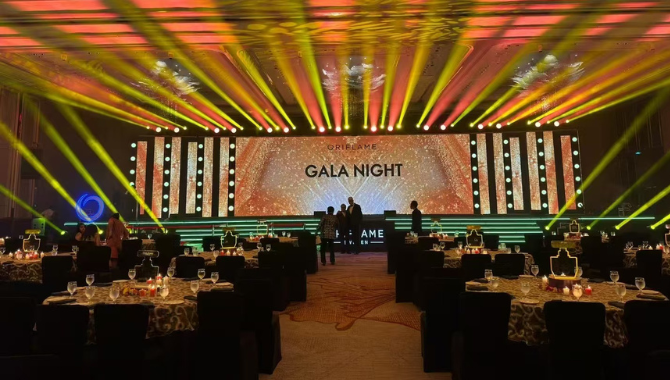
Event production demands high refresh rates, modular build, fast installation, and camera-safe visuals.Commercial LED dominates this category because IPS cannot scale, disassemble, or perform reliably for live production environments.
Scenario-Based Recommendation Matrix
| Scenario | Recommended Display | Why It Works Best |
| Shopping Mall & Retail | Commercial LED | Higher brightness and long-distance visibility |
| Control Room | IPS Panel | Close-range clarity and color stability |
| Outdoor Advertising | Commercial LED | Daylight readability and weather resistance |
| Corporate Meeting Room | IPS (small) / LED (large) | Depends on room size and viewing distance |
| Events & Staging | Commercial LED | High refresh, modular build, camera-safe |

Common Myths & Mistakes Buyers Make
“IPS is always better than LED” – why this is misleading
IPS is often labeled as the superior choice because reviews focus on personal monitors, not commercial displays.The assumption breaks when the screen must perform under sunlight, long distance, or large scale, where IPS brightness and size limits become blockers.IPS is better for close-range color precision, not better for visibility at scale or public display performance.
“Full HD means high quality” – resolution is not everything
Full HD only confirms pixel quantity, not brightness, contrast, color calibration, or real-world visibility.A 1080p LED screen in high brightness can look clearer than a 4K IPS panel viewed from 10 meters away.Sharpness depends on viewing distance, pixel pitch, and luminance, not resolution labels alone.
Why commercial LED screens outperform IPS monitors in public display
Commercial LED emits light directly from each module, enabling extreme brightness and long-range visibility.IPS relies on a backlight behind a crystal layer, which limits luminance and struggles in high ambient light.This architectural difference makes LED suitable for public environments, while IPS remains a close-range display technology.
The biggest purchasing risks when confusing panel type and resolution
Buyers who treat IPS and Full HD as interchangeable metrics often select screens that fail their real environment needs.Common consequences include unreadable screens, unexpected power consumption, limited scalability, and early replacements.Correct decisions start by separating resolution goals from deployment environment requirements.
Conclusion
IPS and Full HD solve different display questions, not the same one. IPS defines how a screen controls color and viewing angles at close distance, while Full HD defines pixel count without guaranteeing visibility, brightness, or performance.For personal or control room viewing, IPS works well. For retail, public media, outdoor ads, live events, and large spaces, commercial LED is the practical and scalable choice.
Screen success is never about resolution alone. It comes from matching brightness, distance, environment, serviceability, and operating hours to real project requirements. At NSELED, we design commercial LED display solutions that prioritize stability, visibility, and long-term value—especially for brands and businesses operating in retail, DOOH, events, and high-usage public environments.The best display is not the one with the highest spec, but the one that stays visible, reliable, and cost-efficient in real operating conditions.