


Introduction
LED wall tiles give businesses a modular way to build high-impact digital walls.Yet choosing the right tile requires more than comparing pixel pitch or cabinet price.
Many buyers see similar product photos and specifications, but the real differences often appear after installation. Cabinet tolerance, LED consistency, driver IC selection, heat management, and service access can affect image uniformity, maintenance time, and long-term project cost.
This guide explains how LED wall tiles work, which configurations exist, and how buyers can evaluate them before requesting a quotation.
What Are LED Wall Tiles?
LED wall tiles are modular direct-view LED display units that combine LED modules, driver electronics, power components, data connections, and a supporting cabinet or frame to create a larger video wall. Unlike LCD displays, an LED wall does not need a separate backlight. Each pixel produces light directly through LED components.
The term “tile” can describe different physical designs across manufacturers, so buyers should not treat it as a universal cabinet standard. One supplier may use a compact rigid cabinet, while another may offer curved or flexible modules. The mechanical design matters because it determines how easily the display can form flat walls, corners, curves, or custom architectural shapes.
IEC published the 2026 edition of IEC 62031, which covers safety requirements for LED modules and includes electrical, thermal, mechanical, and photobiological safety considerations. However, this standard addresses LED modules generally and should not be treated as a complete specification for a finished LED video wall.
How LED Wall Tiles Work
An LED wall tile receives video data from a controller or processor and distributes that information through receiving cards and driver circuits to individual LED pixels. The power supply converts the incoming electrical power into the voltage required by the display electronics.
A typical system includes:
| Component | Main Function | What Buyers Should Check |
|---|---|---|
| LED Module | Creates the visible image | Pixel pitch and consistency |
| Driver IC | Controls LED current | Grayscale, stability and thermal behavior |
| Receiving Card | Processes display data | Compatibility and capacity |
| Power Supply | Provides operating power | Efficiency and load margin |
| Cabinet/Frame | Supports modules | Flatness, tolerance and weight |
| Control System | Sends video content | Resolution and signal compatibility |
The factory perspective becomes important when buyers compare otherwise similar specifications. A quoted refresh rate does not tell you how the entire display behaves under sustained operation. At the factory, engineers need to consider the relationship between driver IC current, PCB design, power loading, thermal conditions, and module layout.
For example, two displays can both claim a high refresh rate while using different electronic architectures. The buyer should therefore request the actual component configuration and test conditions rather than comparing one number on a quotation sheet.
LED Wall Tiles vs Traditional LED Cabinets
LED wall tiles and conventional LED cabinets both build large direct-view LED displays, but they serve different design priorities. Traditional cabinets usually work best for standardized rectangular screens, while LED wall tiles become more valuable when a project requires modular geometry, creative framing, or architectural integration.
| Factor | LED Wall Tiles | Traditional LED Cabinets |
|---|---|---|
| Standard Rectangular Wall | Suitable | Excellent |
| Curved Configuration | Strong on suitable models | Model-dependent |
| Custom Geometry | Strong | More limited |
| Architectural Integration | Strong | Moderate to strong |
| Maintenance | Depends on design | Depends on design |
| Cabinet Standardization | Model-dependent | Usually stronger |
| Creative Installation | Strong | Model-dependent |
Buyers should avoid assuming that a “tile” automatically means a better product. The correct question is whether the tile architecture solves a specific project problem. If the project only requires a large flat screen, a conventional cabinet may provide a simpler and more economical solution.
From a manufacturing perspective, the biggest difference often appears in mechanical tolerance. A large LED wall can expose small dimensional errors across many cabinets. If each cabinet deviates slightly, the accumulated error can create visible gaps, steps, or uneven seams.
Common Applications of LED Wall Tiles
LED wall tiles work particularly well in environments where the display must combine visual performance with flexible physical design. Common applications include retail stores, museums, corporate spaces, entertainment venues, exhibitions, hospitality environments, and immersive installations.
Retail projects may use LED wall tiles to create branded visual walls without relying on a conventional rectangular screen. Museums and galleries often need fine pixel pitches because visitors can stand close to the display. Stage and entertainment projects may prioritize refresh rate, lightweight construction, rapid setup, and creative geometry.
The application should determine the specification rather than the other way around:
- Retail: balance pixel pitch, brightness, viewing distance, and cabinet design
- Museums and galleries: prioritize fine detail, color consistency, and close-view image quality
- Stage and entertainment: evaluate refresh rate, camera performance, weight, and installation speed
- Corporate environments: focus on image quality, clean integration, serviceability, and long operating hours
- Exhibitions: consider modularity, transportation, setup time, and repeated installation
Factory insight: NSELED would not recommend selecting a tile solely because its cabinet looks thinner or more flexible. A thinner structure can reduce weight, but engineers still need enough mechanical rigidity to maintain module alignment during transportation and installation. For a B2B buyer, the better specification is the one that reduces project risk, not simply the one that looks more impressive on a product sheet.
Types of LED Wall Tiles
LED wall tiles generally fall into flat, curved, corner, flexible, creative, and fine-pitch configurations. Each configuration solves a different installation or viewing requirement, so buyers should first define the physical geometry and viewing environment before selecting a model.
| Type | Main Feature | Typical Application |
|---|---|---|
| Flat | Standard wall installation | Retail, corporate |
| Curved | Concave or convex design | Stage, immersive spaces |
| Corner | 90° or custom corners | Retail, architecture |
| Flexible | Irregular shapes | Creative installations |
| Fine-Pitch | High pixel density | Museums, premium interiors |
The category names alone do not guarantee a specific performance level. A flexible LED tile can solve a difficult shape problem, but it may introduce different structural and maintenance considerations than a rigid cabinet. Similarly, a fine-pitch product can deliver more pixels per area but may increase component density, production cost, and the need for careful thermal and calibration control.
Flat LED Wall Tiles
Flat LED wall tiles provide the most straightforward configuration for standard rectangular displays. They typically offer simpler structural planning and are suitable for retail walls, corporate installations, showrooms, exhibitions, and other commercial environments.
For buyers, flat construction offers another advantage: it makes cabinet alignment easier to inspect during installation. A well-controlled cabinet should maintain consistent module positioning across the full wall.
Factory perspective: During production, cabinet flatness and assembly tolerance deserve attention because small mechanical deviations can become visible when hundreds of modules form one continuous image. A factory should inspect these tolerances before shipment rather than leaving alignment problems entirely to the installation team.
Curved LED Wall Tiles
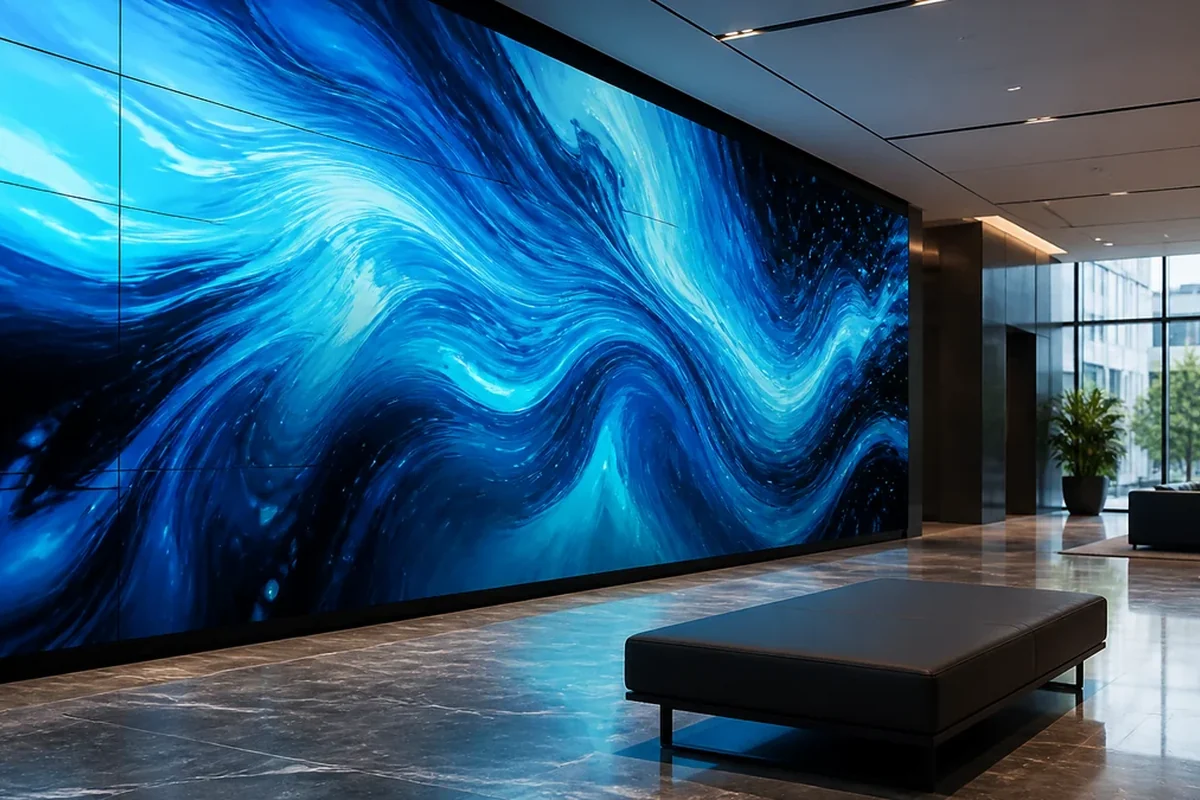
Curved LED wall tiles allow a display to follow concave or convex architectural surfaces and create more immersive viewing environments. They suit stage backgrounds, experiential spaces, retail features, and creative installations where a flat screen cannot reproduce the intended geometry.
The key purchasing parameter is not simply “curved.” Buyers should specify the required curve radius, whether the curve is concave or convex, the total screen dimensions, and the acceptable transition between adjacent cabinets.
We do not recommend choosing a curved LED wall simply because it creates a more distinctive appearance. If the project has no architectural or viewing requirement for curvature, the additional mechanical complexity may provide little practical value.
Corner and Creative LED Wall Tiles
Corner and creative LED wall tiles help designers build displays around architectural edges, columns, corners, or irregular surfaces. These configurations can create a continuous visual experience where a conventional flat cabinet would leave visible breaks.
The engineering challenge lies in maintaining pixel alignment across different surfaces. A 90-degree corner may look simple in a drawing, but the cabinet dimensions, module positioning, connector placement, and installation tolerance all influence the final seam.
Flexible LED Wall Tiles
Flexible LED wall tiles are designed for installations where rigid cabinets cannot follow the required shape. They can support selected curved or irregular configurations and give designers more freedom in creative LED architecture.
However, flexibility should not become the only purchasing criterion. Buyers should ask how the product maintains its shape, how installers support the modules, how technicians replace damaged sections, and how the manufacturer controls pixel alignment after repeated handling.
Factory perspective: A flexible display needs mechanical planning before electrical testing. If the module bends differently from one installation section to another, calibration alone cannot correct every visual inconsistency. The factory must control both electrical uniformity and mechanical positioning.
How to Choose the Right LED Wall Tile Pixel Pitch
The right LED wall tile pixel pitch depends on viewing distance, screen size, content detail, camera requirements, and budget. A smaller pixel pitch creates higher pixel density, but it does not automatically create a better viewing experience for every installation.
Pixel pitch measures the distance between the centers of two adjacent LED pixels. A P1.5 display places pixels much closer together than a P3.9 display. Therefore, P1.5 can reproduce finer details at close viewing distances, while P3.9 can provide an appropriate image at a greater distance without forcing the buyer to pay for unnecessary pixel density.
| Pixel Pitch | Typical Use | Purchasing Consideration |
|---|---|---|
| P0.9–P1.2 | Premium close-view applications | High pixel density and higher cost |
| P1.5–P1.8 | Museums, corporate, retail | Strong close-view performance |
| P2.5–P2.9 | Commercial and indoor applications | Balanced cost and resolution |
| P3.9 | Stage and larger viewing distances | Suitable for longer viewing distances |
| P4.8+ | Large-format applications | More economical for distant viewers |
These ranges provide a starting point rather than a universal rule. The final choice should come from the actual viewing environment, not from the smallest pixel pitch available.
Pixel Pitch and Viewing Distance
Viewing distance provides one of the most useful starting points for selecting pixel pitch. A viewer standing two meters from a P1.5 display can perceive much more detail than the same viewer would see on a P4.8 display.
However, buyers should not rely on one universal mathematical formula. Human visual acuity, content type, screen size, camera distance, and ambient lighting also influence the practical result.
For a museum where visitors may stand directly in front of the wall, a fine-pitch product can make sense. For a large stage where the audience sits many meters away, a much finer pitch may add cost without producing a meaningful improvement from the audience’s position.
Factory perspective: We recommend that buyers send the manufacturer three pieces of information before receiving a final pixel-pitch recommendation: the closest viewing distance, the farthest important viewing distance, and the intended content type. This information gives the factory a much better basis for selecting the LED configuration.
Pixel Pitch and Image Quality
Pixel pitch affects image detail, but image quality depends on more than pixel density. LED package consistency, driver IC performance, grayscale processing, calibration, brightness uniformity, and video processing can all affect what the viewer sees.
A fine-pitch display with inconsistent LED bins can still show visible color differences between modules. A larger-pitch display with good calibration can produce a more uniform image from its intended viewing distance.
For B2B buyers, this distinction matters because suppliers often highlight pixel pitch first. A quotation that says “P1.5” tells you very little about the complete image system. You should also request the LED package specification, refresh rate, calibration process, receiving card, controller compatibility, and module consistency requirements.
Pixel Pitch and Project Cost
Smaller pixel pitch generally increases LED wall cost because the same area contains more pixels and requires greater component density. The price difference can become significant as the screen area grows.
For example, choosing a premium fine-pitch product for a large retail wall may increase the initial quotation substantially even when customers cannot distinguish the additional resolution from their normal viewing position.
A better purchasing process compares at least two suitable pitches against the same screen dimensions. Then the buyer can evaluate image quality, price, power requirements, and expected viewing conditions together.
Factory Perspective: Why Smaller Pixel Pitch Is Not Always Better
We do not recommend using the smallest available pixel pitch simply because the budget allows it. If the audience stands far enough away, the additional pixel density may deliver little visible benefit while increasing procurement and maintenance costs.
A factory also has to manage tighter component density and calibration requirements as pixel pitch becomes smaller. More pixels per square meter mean more electronic components and more opportunities for manufacturing variation.
The smarter question is not, “What is the highest resolution I can buy?” It is, “What is the lowest pixel pitch that gives my audience the image quality the project actually requires?”
Key LED Wall Tile Specifications Buyers Should Compare
Buyers should compare pixel pitch, brightness, refresh rate, cabinet weight, power consumption, viewing angle, serviceability, and component quality as one complete LED wall system. A single impressive specification cannot guarantee project performance.
| Specification | Why It Matters |
|---|---|
| Pixel Pitch | Image resolution |
| Brightness | Visibility |
| Refresh Rate | Camera performance |
| Cabinet Weight | Installation requirements |
| Power Consumption | Electrical planning |
| Viewing Angle | Audience coverage |
| Serviceability | Maintenance |
| LED Package & Driver IC | Reliability and image quality |
A professional RFQ should therefore include more than screen size and pixel pitch. The buyer should ask the supplier to define the test conditions behind each major specification.
Brightness
Brightness determines how clearly an LED wall remains visible under the actual ambient lighting conditions. Indoor applications generally require much less brightness than direct-sunlight outdoor installations, so buyers should avoid paying for excessive brightness when the environment does not require it.
For indoor commercial spaces, excessive brightness can also create an uncomfortable viewing experience. The correct target should balance visibility, image quality, and operating conditions.
Factory perspective: During production and calibration, brightness uniformity matters alongside the maximum brightness number. A display that reaches a high peak value but shows noticeable differences between modules can create a poor visual result.
Refresh Rate
Refresh rate matters most when cameras will capture the LED wall or when the content contains fast movement. A specification such as 3840 Hz or 7680 Hz should therefore be evaluated according to the application rather than treated as a universal quality ranking.
For ordinary commercial viewing, 3840 Hz can meet many requirements. Virtual production, broadcast environments, and demanding camera applications may justify higher refresh rates after the complete processing chain has been tested.
Buyers should also verify the controller, receiving card, camera shutter settings, and signal path. A high refresh-rate claim from the LED module does not automatically mean the complete display system will deliver identical camera performance.
Cabinet Weight
Cabinet weight directly affects transportation, installation structure, handling, and labor requirements. Lightweight construction can become particularly valuable for temporary events, suspended installations, or buildings with strict structural limitations.
However, buyers should not minimize weight at any cost. The cabinet still needs enough rigidity to maintain module alignment during transportation and installation.
Factory insight: We inspect mechanical assembly because a lightweight cabinet with poor rigidity can create more installation problems than it solves. A small structural deviation can become visible when multiple cabinets form one continuous wall.
Power Consumption
Buyers should distinguish maximum power consumption from typical operating power. Maximum power helps engineers plan electrical capacity, while typical operating power provides a more realistic indication of day-to-day energy use.
The actual figure depends on brightness, content, LED package, driving method, power supply, and operating conditions. Therefore, suppliers should provide the measurement conditions rather than quoting one number without context.
A useful RFQ should request:
- Maximum power per square meter
- Typical operating power per square meter
- Input voltage
- Power supply efficiency
- Test brightness
- Test content or operating condition
Viewing Angle and Serviceability
Viewing angle determines how consistently audiences can see the image from positions away from the screen center, while serviceability determines how easily technicians can replace components.
Front-service designs can simplify maintenance when the rear of the display has limited access. Rear-service designs can provide advantages in installations where technicians have permanent access behind the wall.
The correct choice depends on the building structure, installation depth, and maintenance plan.
Factory perspective: Serviceability should be considered before cabinet production, not after installation. A project that requires wall removal just to replace a power supply can create unnecessary downtime and labor costs.
LED Wall Tile Design: Flat, Curved and Custom Configurations
Cabinet geometry determines whether an LED wall can achieve flat, curved, corner, or custom-shaped configurations while maintaining alignment and visual consistency. Buyers should define the intended geometry before requesting a final quotation because mechanical design can significantly affect manufacturing and installation costs.
Concave and Convex LED Wall Tiles
Concave and convex LED wall tiles allow designers to build displays around curved architectural or creative structures. The manufacturer needs the target radius and curve direction to select the correct cabinet or module configuration.
The curve should also match the installation structure. If the supporting frame does not reproduce the designed radius accurately, the LED cabinets may not align as intended.
Factory perspective: Curve radius tolerance matters because small deviations can accumulate across a large curved wall. We recommend confirming the mechanical drawing and radius tolerance before production rather than trying to correct the geometry during installation.
Corner LED Wall Tiles
Corner LED wall tiles allow the display to continue across architectural edges without leaving a conventional cabinet boundary at the corner. They can work particularly well for retail displays, branded environments, showrooms, and architectural installations.
Buyers should check the corner angle, pixel continuity, cabinet dimensions, module access, and cable routing. A corner design should support both visual continuity and practical maintenance.
Custom-Shaped LED Wall Tiles
Custom-shaped LED wall tiles can support creative installations that cannot use standard rectangular cabinets. Designers can combine different modules or cabinet geometries to create specific visual forms.
However, customization usually affects tooling, production time, spare-parts planning, and replacement procedures. Buyers should therefore distinguish between a custom appearance and a fully custom electronic architecture.
We recommend using standard electronic modules wherever possible and customizing the mechanical structure around them. This approach can simplify future maintenance and spare-parts management.
Cabinet Tolerance and Seam Consistency
Cabinet tolerance directly affects the visual quality of a large LED wall. Even when every individual module meets its electrical specifications, mechanical misalignment can produce uneven seams or visible steps.
A manufacturer should control cabinet dimensions, module positioning, connector fit, frame flatness, and assembly consistency during production.
This is an important difference between a product specification and a manufacturing process. The specification tells you what the factory promises; production control determines whether hundreds of cabinets actually behave consistently together.
How Much Do LED Wall Tiles Cost?
LED wall tile pricing depends on pixel pitch, screen area, LED package, cabinet design, customization, control systems, installation requirements, and order quantity. Buyers should compare the complete project cost instead of using a single price-per-square-meter figure.
| Cost Factor | Impact on Price | Why It Changes Cost |
|---|---|---|
| Pixel Pitch | High | More pixels and components per area |
| Screen Size | High | More modules, cabinets and electronics |
| LED Package | Medium–High | Affects density and image performance |
| Cabinet Design | Medium–High | Standard and custom structures differ |
| Customization | Medium–High | Requires engineering and production changes |
| Control System | Medium | Depends on resolution and signal needs |
| Installation | Medium–High | Structure, labor and site conditions |
A supplier quote should also separate the display itself from supporting costs. A low LED wall tile price can become an expensive project when the quotation excludes processors, mounting structures, spare modules, shipping, installation, commissioning, or electrical work.
LED Wall Tile Price Per Square Meter
Price per square meter provides a useful starting point, but it should never become the only purchasing metric. Two LED wall tiles with the same screen area can have very different prices because they may use different pixel pitches, LED packages, cabinet structures, driver ICs, power supplies, and control systems.
For example, a 20 m² P1.5 installation contains far more pixels than a 20 m² P3.9 installation. The factory must place and control more LED components within the same physical area. That difference affects module cost, assembly, testing, calibration, and replacement inventory.
Buyers should request a quotation that clearly identifies:
- Price per square meter
- Total display area
- Pixel pitch
- Cabinet dimensions
- LED package
- Driver IC
- Receiving card
- Power supply
- Controller or processor
- Mounting structure
- Spare parts
- Packaging and shipping
- Installation and commissioning
Factory perspective: We recommend asking for the bill of materials behind a major price difference. A supplier may reduce the quotation by changing a component that does not appear in the headline specification. The buyer needs to know what changed before comparing the two offers.
Factors That Affect LED Wall Tile Cost
Pixel pitch usually creates one of the largest price differences because a smaller pitch requires substantially higher pixel density. However, the manufacturing cost also depends on the mechanical structure and electronic configuration.
A curved or custom-shaped LED wall can require additional engineering even when the LED modules themselves remain similar. The manufacturer may need to modify cabinet frames, connectors, mounting points, cable paths, and production fixtures.
Screen size also affects more than the number of cabinets. Larger projects require more receiving cards, power distribution, spare modules, signal management, structural planning, and factory testing.
The control system creates another variable. A small commercial display may need a relatively simple controller, while a large high-resolution wall can require greater processing capacity and more signal outputs. For example, NovaStar publishes controller specifications that define loading capacity and input/output configurations for its different control products.
The practical rule is simple: compare complete configurations, not isolated unit prices.
Standard vs Custom LED Wall Tile Pricing
Standard LED wall tiles normally cost less to engineer and manufacture than highly customized configurations. Standard modules, cabinets, connectors, and replacement parts already have established production processes.
Custom designs can still make commercial sense when the physical environment requires them. A retail brand may need a corner display, while a museum may require a specific wall shape. In these cases, customization can solve an installation problem that standard cabinets cannot address.
However, buyers should ask whether the supplier can maintain common internal components. A custom cabinet does not need to mean a completely unique electronic system.
Keeping the LED module, driver architecture, power supply, and receiving system as standardized as possible can simplify future maintenance. The factory can then customize the mechanical frame around proven components.
Initial Price vs Total Cost of Ownership
The cheapest quotation does not necessarily produce the lowest five-year project cost. Buyers should consider energy use, spare parts, maintenance labor, replacement modules, installation difficulty, downtime, and future compatibility.
A display that requires rear access may work well in a dedicated technical room but create a major maintenance problem when installed directly against an architectural wall. Similarly, a very lightweight cabinet may reduce structural costs, but poor mechanical rigidity could increase alignment work during installation.
IEC 62031:2026 provides safety requirements for LED modules and covers electrical, thermal, mechanical, and photobiological safety. It does not define the complete performance specification of an LED video wall, so buyers still need project-specific requirements for image quality, reliability, serviceability, and system performance.
Factory perspective: When we evaluate project cost, we look beyond the factory quotation. We consider how the cabinet will be transported, installed, serviced, calibrated, and replaced. Those decisions can influence the customer’s actual cost far more than a small difference in the initial unit price.
Factory Perspective: Where Low-Cost LED Displays Usually Cut Costs
A very low quotation usually deserves a component-level comparison before a buyer accepts it. Cost reductions can come from different LED packages, driver ICs, power supplies, cabinet materials, simplified calibration, fewer spare parts, or less extensive factory testing.
The buyer should not assume that every low-cost supplier cuts quality. Instead, the buyer should identify exactly where the price difference comes from.
Ask the supplier:
- Which LED package does the quotation use?
- Which driver IC does the module use?
- What power supply model and capacity does the cabinet use?
- Does the factory perform aging tests before shipment?
- Does the price include calibration?
- How many spare modules and power supplies are included?
- What changes if the buyer requests a different component?
This comparison turns price negotiation into technical procurement rather than a race toward the lowest number.
LED Wall Tiles vs Traditional LED Video Walls
LED wall tiles are particularly suitable when a project requires creative geometry, modularity, or architectural integration, while traditional LED cabinets often provide a simpler solution for standard rectangular video walls.
| Factor | LED Wall Tiles | Traditional LED Video Walls |
|---|---|---|
| Creative Shapes | High | Medium |
| Curved Designs | High on suitable models | Model-dependent |
| Standard Rectangular Screen | High | High |
| Architectural Integration | High | Medium–High |
| Installation | Project-dependent | Generally simpler |
| Customization | High | Medium |
| Replacement Strategy | Model-dependent | Usually standardized |
| Large Standard Screen | Suitable | Strong choice |
The comparison does not mean one technology is universally better. The project geometry should determine the product architecture. A standard rectangular advertising screen does not automatically need a creative tile system.
LED Wall Tiles vs LED Video Walls
LED wall tiles and conventional LED video walls use the same basic direct-view LED principle, but their mechanical designs can target different installation requirements. Traditional cabinets often prioritize standardized dimensions, fast assembly, and repeatable deployment.
LED wall tiles can provide more options when designers need corners, curves, irregular forms, or architectural integration. That flexibility can come with additional engineering requirements.
For a B2B buyer, the correct comparison should include:
- Cabinet dimensions
- Weight
- Pixel pitch
- Curve capability
- Maintenance method
- Structural requirements
- Spare-part availability
- Installation time
- Total project cost
Factory perspective: We would choose the conventional cabinet when the project only needs a flat rectangular wall and the cabinet already meets the required specifications. We would choose a creative tile configuration when the physical design creates a clear business or architectural benefit.
LED Wall Tiles vs LCD Video Walls
LED wall tiles can create larger seamless displays without the physical bezel lines associated with multi-panel LCD video walls. They also allow manufacturers to build very large display surfaces and selected creative configurations.
LCD systems can still make sense for smaller close-view applications where a fixed display format, controlled brightness, or conventional indoor installation suits the project.
The buyer should compare the technologies based on the actual environment rather than screen technology alone.
| Factor | LED Wall Tiles | LCD Video Wall |
|---|---|---|
| Large Screen Size | Strong | More panel-dependent |
| Visible Bezels | No traditional panel bezel | Present |
| Creative Geometry | Strong | Limited |
| Brightness Options | Wide range | Model-dependent |
| Close Viewing | Depends on pixel pitch | Strong |
| Maintenance | Module/component based | Panel based |
| Custom Shapes | Stronger | Limited |
When Should You Choose LED Wall Tiles?
Choose LED wall tiles when the project needs modular design, creative geometry, architectural integration, or a large continuous visual surface. A traditional LED cabinet can remain the better choice when the project only requires a standard rectangular screen.
Before choosing, ask five practical questions:
- Does the wall require a curve or corner?
- Will viewers stand close to the display?
- Does the installation have strict weight limitations?
- Can technicians access the screen from the front or rear?
- Will the display need to integrate with a special architectural structure?
If most answers point toward standard construction, a conventional LED video wall may offer a simpler procurement path.
Best Applications for LED Wall Tiles
LED wall tiles are commonly used where high-impact visuals, modular installation, creative geometry, or architectural integration are required. The best product configuration changes according to the audience distance, content type, ambient light, installation structure, and maintenance requirements.
LED Wall Tiles for Retail
Retail projects can use LED wall tiles to turn ordinary walls, corners, and branded spaces into dynamic visual surfaces. Buyers should prioritize pixel pitch based on customer viewing distance and consider brightness carefully for storefronts exposed to strong ambient light.
For a retail wall behind a checkout counter, the viewing distance may differ substantially from a large storefront installation. The buyer should therefore avoid applying one pixel pitch across every retail project.
Factory insight: Retail displays often run for long daily periods, so we recommend evaluating thermal behavior and power consumption together with image quality. A lower purchase price has limited value if the display creates excessive heat or requires difficult maintenance in a busy store.
LED Wall Tiles for Museums and Galleries
Museums and galleries often need fine-pitch LED wall tiles because visitors can view the content from close distances. Color consistency, grayscale performance, low visual artifacts, and calibration become especially important when the display presents artwork or detailed digital content.
The installation should also respect the surrounding architecture. A custom frame can help integrate the screen into an exhibition wall without making the display look like a separate piece of equipment.
LED Wall Tiles for Stage and Entertainment

Stage applications often prioritize refresh rate, camera performance, weight, installation speed, and creative geometry. A screen that looks excellent to the audience can still create problems for cameras if the complete LED and processing chain does not meet the production requirements.
The buyer should test the display with the actual camera system whenever possible.
LED Wall Tiles for Corporate Spaces
Corporate environments usually prioritize clean design, close-view image quality, serviceability, and long operating periods. A fine-pitch LED wall can create a high-resolution visual surface in reception areas, meeting spaces, executive rooms, and brand experience centers.
The installation structure should also account for future service access. A visually clean wall can become difficult to maintain if designers completely block the technical space behind it.
LED Wall Tiles for Exhibitions and Events
Exhibitions and events benefit from modular LED wall tiles when teams need fast setup, transportation flexibility, or creative display shapes. Weight and cabinet handling become more important when technicians repeatedly assemble and dismantle the system.
The buyer should also ask about spare modules and replacement procedures before the first event. For rental or repeated-use projects, serviceability can matter more than a small difference in the initial purchase price.
How to Choose an LED Wall Tile Manufacturer
A reliable LED wall tile manufacturer should demonstrate production capability, component traceability, quality control, calibration procedures, testing, customization capability, spare-parts support, and technical assistance. Buyers should evaluate these factors before comparing the final quotation because the factory’s manufacturing process directly affects the consistency and maintainability of the finished display.
A supplier can provide an attractive specification sheet without having strong control over mass production. For a B2B project, you need to know whether the factory can reproduce the same electrical and mechanical performance across the entire order. The real test of a manufacturer is not whether one sample works well, but whether hundreds of cabinets can maintain consistent performance after production, calibration, packaging, transportation, and installation.
Production Capability
A capable manufacturer should control the major stages that influence LED wall tile performance, including module assembly, cabinet assembly, electrical testing, aging, calibration, and final inspection. Buyers should ask which processes the factory performs internally and which components or services it outsources.
This distinction matters when a project requires customization. A manufacturer that controls mechanical design and production can respond more directly when the buyer needs a special cabinet dimension, corner structure, curved configuration, or installation method.
Factory perspective: We recommend asking for production photos, sample testing records, and a clear explanation of the production workflow instead of relying only on factory size or marketing claims. A smaller but well-controlled production line can sometimes provide better project consistency than a large factory with weak process control.
LED and Driver IC Quality
LED package and driver IC selection affect image consistency, grayscale performance, refresh behavior, thermal performance, and long-term stability. Buyers should request the actual component models or approved component range rather than accepting a general statement such as “high-quality LED chips.”
Driver ICs control the current supplied to LED pixels. Their behavior under operating load can affect heat generation and display stability. LED package consistency also affects color and brightness matching across modules.
However, buyers should avoid treating one brand name as a guarantee of quality. The complete combination of LED package, PCB design, driver IC, power supply, calibration, and thermal management determines the final display behavior.
Quality Control and Aging Tests

A proper factory quality-control process should test LED wall tiles before shipment instead of relying only on visual inspection at the end of production. Electrical tests, module checks, cabinet inspection, signal testing, and aging procedures can identify problems before the products reach the installation site.
Aging tests are particularly useful because they allow the factory to operate the display under controlled conditions before shipping. This process can expose unstable power supplies, connection problems, abnormal modules, or other early-stage failures.
Factory insight: Mass production requires process control rather than random inspection alone. A factory can reduce shipment risk by checking modules during production, testing assembled cabinets, recording abnormal units, and verifying the final calibrated image before packing.
Calibration and Module Consistency
Calibration helps compensate for brightness and color differences between LED modules so that a large wall appears visually uniform. This process becomes increasingly important as the display area grows because small differences become easier to notice across a continuous image.
Buyers should ask whether calibration occurs before shipment and whether the factory maintains calibration data for replacement modules. This question becomes important for long-term maintenance.
If a replacement module has noticeably different brightness or color from the surrounding modules, the technician may need to recalibrate the affected area. A strong spare-parts strategy therefore includes compatibility and calibration, not simply keeping extra modules in a warehouse.
Factory perspective: We treat calibration as part of production quality rather than a cosmetic final step. The factory needs to control LED binning, module consistency, cabinet assembly, and calibration together. Otherwise, calibration may compensate for variations that should have been controlled earlier in production.
Warranty and Spare Parts
A B2B buyer should evaluate warranty coverage together with spare-parts availability and technical support. A warranty has limited practical value if replacement modules or power supplies take weeks to arrive during an active commercial project.
For larger installations, buyers should establish a spare-parts plan before shipment. The required quantity depends on project size, operating environment, accessibility, and the manufacturer’s recommended maintenance strategy.
A useful procurement discussion should clarify:
- Warranty duration and coverage
- Replacement component availability
- Spare module compatibility
- Power supply replacement
- Receiving card replacement
- Technical response process
- Calibration support
- Long-term component availability
Factory Perspective: What Buyers Should Check Before Bulk Ordering
Before placing a bulk order, buyers should verify the sample, production process, components, testing procedures, and after-sales plan rather than relying on the quotation alone.
We recommend this practical sequence:
- Confirm the technical specification. Check pixel pitch, brightness, refresh rate, cabinet size, weight, power, LED package, driver IC, and service method
- Request a physical sample. Inspect image uniformity, cabinet assembly, connectors, service access, and mechanical tolerances
- Test the sample in the real environment. Use the intended content and, when relevant, the actual camera system
- Confirm production controls. Ask how the factory handles aging, calibration, module inspection, and final testing
- Confirm the spare-parts strategy. Establish which components will remain available and how technicians will replace and recalibrate them
We do not recommend approving a large LED wall tile order from a quotation sheet alone. A sample may reveal mechanical or visual issues that specifications cannot show.
For a customized project, buyers can also ask the manufacturer to review the screen dimensions, viewing distance, installation geometry, and service requirements before finalizing the configuration. This approach can prevent an expensive specification mistake before production starts.
Conclusion
The right LED wall tiles are not simply the ones with the smallest pixel pitch or lowest initial price. Buyers should match pixel pitch, cabinet geometry, brightness, refresh rate, component configuration, serviceability, and installation requirements with the actual project environment. A complete comparison helps prevent unnecessary spending and reduces long-term maintenance risks.
Before placing an order, take three practical steps next week: confirm the viewing distance and screen geometry, request a complete technical quotation, and test a physical sample under real operating conditions. Also compare the LED package, driver IC, power consumption, calibration process, cabinet tolerance, spare-parts plan, and total cost of ownership instead of comparing price per square meter alone.
If you need help selecting the right LED Wall Tiles for a flat, curved, corner, flexible, retail, museum, stage, or custom installation, Contact Us at NSELED for a project-specific solution. Our team can help you evaluate pixel pitch, cabinet structure, component configuration, maintenance access, and cost based on your actual project requirements rather than simply recommending a standard product.