


Introduction
Modular screen walls combine multiple LED modules or cabinets into one large, seamless digital display.
Many buyers choose modular LED walls because they need flexible screen dimensions, easier maintenance, or a display that can adapt to different commercial spaces. However, module quality, pixel pitch, cabinet design, calibration, and serviceability can affect the final result far more than the basic screen size.
This guide explains how modular screen walls work, where they fit best, what they cost, and how buyers can evaluate manufacturers before placing a B2B order.

What Is a Modular Screen Wall?
A modular screen wall is a large LED display assembled from smaller LED modules or cabinets that work together as one visual surface. Its main advantage is that buyers can build, maintain, and expand the display in manageable sections rather than treating the entire wall as one unit.
Modular Screen Wall Definition
A modular screen wall uses multiple independent display units to create a larger LED screen. Each unit contains LEDs, driver ICs, circuit boards, connectors, and related electronics. Larger cabinets then combine these modules into a complete display system.
This structure gives LED displays an important practical advantage. If one module develops a fault, technicians can usually replace the affected section instead of removing the entire screen.
For B2B buyers, however, “modular” should not automatically mean “easy to maintain.” The module structure, cabinet access, spare-part availability, and component consistency all determine how practical maintenance becomes.
A modular wall also differs from a conventional tiled LCD video wall. LCD systems use separate rectangular panels with visible bezels between them. LED modules can form a continuous image surface without traditional LCD bezels.
How a Modular LED Screen Wall Works
A modular LED wall receives video signals through a controller and distributes the image data to individual receiving cards and LED modules. Each module drives a specific group of pixels, while the complete system synchronizes those modules to produce one image.
The basic signal path looks like this:
Video source → LED processor → Sending system → Receiving cards → LED modules → LED pixels
The cabinet provides the mechanical structure and usually contains power distribution, data connections, receiving electronics, and several LED modules.
Manufacturing quality becomes important at this point. Two modules can have identical dimensions but produce noticeably different colors if their LED characteristics, calibration data, or production consistency differ.
Modular LED Screen vs Traditional Video Wall
The main difference is how the display creates its image and how technicians maintain it. A modular LED wall uses LED modules and cabinets, while a traditional LCD video wall combines multiple flat-panel displays.
| Feature | Modular LED Screen Wall | LCD Video Wall |
| Image surface | Nearly seamless | Visible bezels |
| Screen size | Highly scalable | Limited by panel dimensions |
| Brightness | Suitable for bright environments with proper configuration | Generally lower |
| Maintenance | Module or cabinet replacement | Panel replacement |
| Shape customization | High | Limited |
| Large-format applications | Excellent | Suitable for smaller viewing areas |
For large commercial installations, LED usually makes more sense when buyers need a very large, seamless image surface or a custom screen shape.
Types of Modular Screen Walls
Modular LED walls can serve fixed installations, rental applications, indoor spaces, outdoor environments, and creative architectural projects. The right type depends on how frequently the screen moves, where technicians access it, and what viewing conditions the project creates.
Fixed and Rental Modular LED Screen Walls
Fixed modular LED walls use cabinets designed for permanent installation. They often prioritize structural stability, long service life, front or rear maintenance, and integration with the building.
Rental LED walls need a different design. Rental cabinets usually prioritize fast assembly, lighter weight, stacking or hanging options, and repeated transportation. Their mechanical connections must tolerate frequent installation and dismantling.
A corporate headquarters may therefore need a different modular cabinet from an event production company, even when both projects use the same pixel pitch.
Indoor and Outdoor Modular LED Walls
Indoor modular LED walls usually use lower brightness levels and finer pixel pitches because viewers often stand relatively close to the display.
Outdoor LED walls require stronger environmental protection, higher brightness, and mechanical designs that can handle changing weather conditions. Buyers should evaluate the complete cabinet and module construction instead of judging outdoor suitability from one specification.
The IP rating also needs careful interpretation. IEC 60529 defines the IP Code for classifying protection provided by electrical equipment enclosures against ingress.
Fine-Pitch and Creative Modular LED Walls
Fine-pitch modular LED walls use smaller pixel spacing for close viewing. They suit boardrooms, premium retail spaces, broadcast environments, museums, and other applications where viewers can see the screen from a short distance.
Creative modular walls take customization further. Manufacturers can design curved, angled, or specially shaped structures when the project requires something beyond a conventional rectangle.
However, creative shape should never replace optical planning. A curved screen still needs suitable pixel pitch, viewing angles, calibration, and content design.
Key Benefits of Modular Screen Walls
Modular screen walls give buyers more control over screen size, maintenance, configuration, and future expansion. The strongest benefit appears when the project needs a display that can evolve rather than remain fixed.
Flexible Screen Size and Custom Design
A modular system allows manufacturers to combine cabinets into different screen dimensions. This approach works well when a wall does not match standard television or LCD panel proportions.
For example, a project can use a wide-format LED wall for a lobby or a tall configuration for a retail installation. Manufacturers can also build creative structures when the architecture requires a non-standard shape.
The modular architecture lets the screen size follow the project instead of forcing the project to follow a fixed panel size.
Easy Installation, Maintenance, and Expansion
Modular cabinets simplify transportation and installation because installers can assemble the screen section by section. Technicians can also access individual modules or cabinets during maintenance.
The practical benefit depends heavily on the cabinet design. A front-maintenance LED wall can reduce service requirements when the rear of the screen has little or no access.
Expansion also becomes easier when the manufacturer maintains compatible cabinets, modules, power supplies, and receiving components.
Seamless Visual Performance
LED modules can create a continuous display surface without the prominent bezels found between LCD video wall panels.
However, a seamless physical structure does not automatically guarantee seamless image quality. Color calibration and module consistency determine whether adjacent sections actually look uniform.
This issue becomes more visible on large walls because small differences can repeat across hundreds of modules.
Key Specifications of Modular LED Screen Walls
Buyers should select modular LED walls according to viewing distance, environment, image requirements, cabinet design, and maintenance access rather than choosing the highest specification available.
Pixel Pitch and Viewing Distance
Pixel pitch measures the distance between corresponding points of adjacent pixels. Smaller pixel pitch generally provides higher pixel density and supports closer viewing.
For example, a P1.5 display contains much smaller pixel spacing than a P4 display. However, smaller pitch also increases LED component density and usually raises system cost.
A practical selection process should consider:
- Viewing distance
- Screen dimensions
- Content type
- Required image detail
- Camera usage
- Project budget
A buyer should not automatically choose the smallest available pitch. If viewers remain far from the screen, an unnecessarily fine pitch can increase the budget without delivering a meaningful visual benefit.
Brightness, Resolution, and Refresh Rate
Brightness must match the environment. Indoor displays normally need less brightness than outdoor screens exposed to direct sunlight.
Resolution depends on both pixel pitch and physical screen size. A large screen with a coarse pitch can still display a sharp image at an appropriate distance, while a small screen with a fine pitch can provide high pixel density at close range.
Refresh rate also matters when cameras record the LED wall. A display intended for broadcast or live-event production needs careful evaluation of refresh behavior, camera frame rates, shutter settings, and processor compatibility.
Cabinet Design, IP Rating, and Maintenance Method
Cabinet construction affects installation speed, mechanical stability, weight, heat management, and maintenance.
Buyers should also confirm whether the product supports front maintenance, rear maintenance, or both. Front access can become particularly valuable when the display sits directly against a wall.
For outdoor applications, buyers should request the exact IP rating and understand what the rating covers. IEC 60529 provides the international framework for IP enclosure classifications rather than using vague terms such as “waterproof.”
Modular Screen Wall Applications
Modular LED walls work across commercial, corporate, entertainment, retail, and outdoor environments because manufacturers can adapt the display size and configuration to the project.
Corporate, Commercial, and Control Room Applications
Corporate offices use modular LED walls in reception areas, boardrooms, presentation rooms, and executive spaces. Control rooms use large LED walls when operators need to monitor multiple information sources on one visual surface.
For these environments, buyers should prioritize pixel pitch, viewing distance, image uniformity, low-noise operation, and maintenance access.
A fine-pitch wall can provide a better experience for close viewing, while a larger-pitch product may provide better value in a control room where operators sit farther away.
Stage, Events, Entertainment, and Sports
Rental modular LED walls support concerts, conferences, exhibitions, theaters, sports events, and other temporary installations.
Rental buyers should focus on cabinet weight, fast locking systems, stacking or hanging options, corner protection, spare parts, and repeated assembly durability.
A rental company should not evaluate a cabinet only by its appearance. Mechanical reliability directly affects installation time and operational risk.
Retail and Outdoor Advertising
Retailers use modular LED walls for promotional content, brand storytelling, window displays, and immersive experiences. Outdoor advertising applications need higher brightness and stronger environmental protection.
Outdoor projects also require careful consideration of viewing distance. A large roadside display does not normally need the same fine pixel pitch as a close-viewing retail wall.
How Much Does a Modular Screen Wall Cost?
The cost of a modular screen wall depends on screen area, pixel pitch, LED components, cabinet construction, control equipment, installation conditions, and maintenance requirements. A single price per square meter cannot accurately represent every project.
Main Factors Affecting Modular LED Wall Price
Pixel pitch usually has a major effect on cost because a finer pitch requires more pixels across the same physical area.
Other important factors include:
- LED package and component grade
- Cabinet material and design
- Receiving and control systems
- Brightness requirements
- Front or rear maintenance
- Indoor or outdoor protection
- Structural requirements
- Quantity and customization
A P1.5 fine-pitch wall and a P5 outdoor advertising wall can have completely different cost structures even when their physical areas are identical.
Equipment, Installation, and Control System Costs
The LED cabinets represent only part of the project cost. Buyers may also need processors, sending equipment, signal distribution, power distribution, mounting structures, cables, installation labor, and commissioning.
Complex installations can require additional structural engineering. Outdoor projects may also require stronger mounting systems and environmental protection.
Therefore, buyers should compare complete project quotations rather than comparing only the LED price per square meter.
Why Modular LED Wall Quotes Differ
Two manufacturers can quote different prices for products that appear similar on a specification sheet.
The difference can come from LED package quality, IC selection, power supply efficiency, PCB design, cabinet materials, calibration standards, testing procedures, warranty terms, and spare-part policies.
A lower quotation can therefore reduce the initial purchase price while increasing maintenance or replacement costs later.
How to Get an Accurate Project Quote
A manufacturer needs several project details before preparing a meaningful quotation:
- Screen width and height
- Indoor or outdoor installation
- Minimum and average viewing distance
- Required pixel pitch
- Front or rear maintenance requirements
- Installation method
- Content and camera requirements
- Required warranty and spare parts
A project drawing or installation photo can improve quotation accuracy further.
Installation and Maintenance of Modular Screen Walls
A modular LED wall requires correct mechanical assembly, electrical connection, signal configuration, calibration, and maintenance planning. Good installation protects the investment, but good maintenance protects long-term image consistency.
Basic Installation Process
A typical installation includes site inspection, structural preparation, cabinet assembly, power and signal connection, controller configuration, testing, calibration, and final commissioning.
Installers should verify cabinet alignment before calibration. Even small mechanical inconsistencies can become visible across a large display.
The installation team should also check ventilation, power distribution, grounding, cable routing, and service access before completing the project.
Module Replacement and Troubleshooting
Modular construction simplifies fault isolation. If one module shows abnormal pixels, color differences, or signal problems, technicians can test the affected section without dismantling the entire wall.
However, replacement modules should match the original configuration. A replacement module with different LED characteristics can create visible color or brightness differences even when its pixel pitch is identical.
This is why B2B buyers should plan spare modules during the original purchase.

Preventive Maintenance for Long-Term Reliability
Preventive maintenance can include visual inspection, connection checks, cleaning, temperature monitoring, calibration verification, and replacement of aging components when necessary.
Outdoor displays require additional inspection because dust, moisture, temperature changes, and sunlight place greater stress on the system.
Manufacturers should also provide maintenance documentation so local technicians can identify common faults without waiting for remote support.
Modular Screen Wall vs Other Display Solutions
The best display technology depends on the screen size, viewing distance, environment, content, and maintenance requirements. No single technology fits every project.
Modular LED Wall vs LCD Video Wall
LCD video walls can work well for control rooms and smaller viewing environments where bezel width remains acceptable.
Modular LED walls become more attractive when the project requires a large seamless image, high brightness, custom dimensions, or unusual shapes.
Modular LED Wall vs Projector
Projectors depend on reflected light and require suitable projection distance and ambient-light control. LED walls generate their own light and can maintain a bright image in environments where projection becomes difficult.
A projector can still make sense when the installation requires a very large image at relatively low initial equipment cost and the environment supports projection.
Modular LED Wall vs Traditional LED Display
The terms often overlap because many modern LED displays already use modular construction. The practical difference usually comes from how manufacturers design the modules, cabinets, maintenance system, and mechanical configuration.
For buyers, the important question is not whether a screen uses modules, but whether the modular architecture matches the project’s installation, maintenance, and expansion requirements.
How to Choose a Modular Screen Wall Manufacturer
Manufacturer selection affects not only initial product quality but also spare-part availability, calibration consistency, technical support, and long-term maintenance.
Manufacturing Capability and Product Quality
A serious LED display manufacturer should provide clear information about LED components, PCB design, driving ICs, power systems, cabinet construction, testing, and quality control.
Buyers should also ask whether the supplier actually manufactures the core display components or mainly resells finished products.
For large B2B projects, production capacity and quality consistency matter because every cabinet must perform as part of one large display.
Module Consistency, Calibration, and Reliability
Module consistency becomes especially important on large LED walls. Manufacturing variations can create differences in brightness, white balance, and color reproduction.
A professional production process should include module testing, calibration, aging procedures, and final display inspection.
Buyers should ask how the manufacturer handles calibration data and how it manages replacement modules after delivery.
OEM and ODM Customization
Different projects can require different cabinet dimensions, mounting methods, colors, maintenance access, brightness levels, or pixel pitches.
OEM and ODM capability allows a manufacturer to adapt the product instead of forcing the project into a standard configuration.
For distributors and system integrators, this capability can also support branded products and application-specific solutions.
Warranty, Spare Parts, and After-Sales Support
A warranty only has practical value when the supplier can provide replacement components and technical support.
Buyers should confirm:
- Warranty period and coverage
- Spare module availability
- Power supply replacement policy
- Remote technical support
- Firmware and control-system support
- Local installation or engineering assistance
For a commercial LED wall, after-sales support should be evaluated as part of the product, not as an optional service.
Factory Insights: What Affects Modular LED Wall Quality?
The visible screen represents the final result of many manufacturing decisions. Module quality, component matching, calibration, thermal design, and production control all influence long-term performance.
Why Module Consistency Matters
A single LED module can look excellent during inspection and still create problems when combined with hundreds of other modules.
Manufacturers need to control component variation across production batches. They also need consistent calibration data so adjacent modules reproduce similar colors and brightness.
This becomes especially important when a buyer orders additional cabinets months or years after the original project.
How LED Packaging and Driving ICs Affect Performance
LED packaging affects optical consistency, reliability, and long-term color behavior. Driving ICs control how the LEDs receive electrical signals and can influence grayscale performance, refresh behavior, and thermal conditions.
Manufacturers therefore need to evaluate the complete electrical and optical system rather than selecting components only according to brand names.
A component specification sheet cannot replace system-level testing.
For demanding applications, buyers should ask manufacturers about component sourcing, batch consistency, burn-in procedures, and production testing.
How Calibration and Quality Control Reduce Display Differences
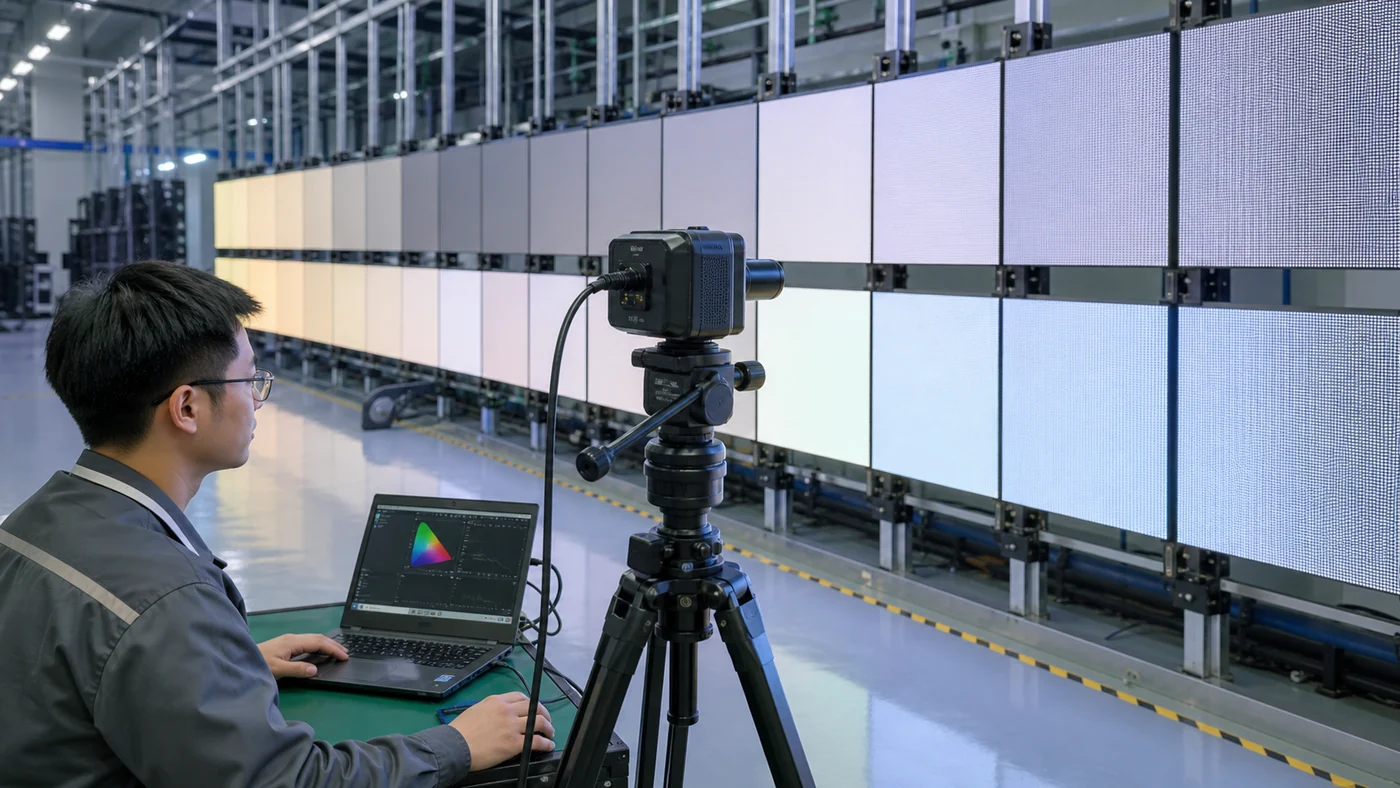
Calibration compensates for differences between LED pixels and modules. Manufacturers can measure brightness and color characteristics and use calibration data to improve uniformity across the finished wall.
Quality control should begin before final assembly. Production teams can inspect PCB assemblies, soldering, LED placement, module operation, cabinet connections, and complete-screen performance.
This layered approach reduces the chance that a small manufacturing variation becomes a visible problem across a large installation.
FAQs About Modular Screen Walls
What Is the Difference Between a Modular LED Wall and a Regular LED Screen?
A modular LED wall uses smaller modules or cabinets that combine into one larger display. This structure simplifies transportation, installation, maintenance, and customization. However, product quality still depends on module consistency, calibration, cabinet design, and replacement-part compatibility.
Are Modular LED Screen Walls Easy to Maintain?
Yes, modular LED walls can simplify maintenance because technicians can isolate and replace individual modules or cabinets instead of replacing the complete display. Front-maintenance designs can further reduce service requirements when the screen has limited rear access.
Conclusion
Modular screen walls give B2B buyers a scalable way to build large, seamless LED displays for corporate, commercial, entertainment, retail, sports, and outdoor applications. The best choice depends on pixel pitch, viewing distance, brightness, cabinet design, maintenance access, and project conditions rather than screen size alone.
Before ordering, buyers should evaluate module consistency, calibration, component quality, production testing, spare parts, warranty, and technical support. If you are planning a modular LED screen wall project, contact NSELED for a project-specific solution, including pixel pitch selection, cabinet configuration, OEM/ODM customization, engineering support, and a detailed quotation based on your installation requirements.