


Introduction
Choosing an outdoor LED screen manufacturer affects image quality, operating cost, maintenance, and project risk.
Many buyers compare suppliers by pixel pitch and price per square meter. That approach misses the factors that often create problems after installation, including component selection, thermal design, calibration, testing, and spare-parts support.
This guide explains how to evaluate an outdoor LED screen factory, compare technical specifications, control costs, and verify suppliers before placing a B2B order.
What Is an Outdoor LED Screen Manufacturer?
An outdoor LED screen manufacturer designs, assembles, tests, and supports LED display systems for outdoor environments, rather than simply reselling finished products. A capable manufacturer should control key production stages and explain how components, testing, calibration, and quality inspection affect the final display.
For a B2B buyer, the important question is not simply whether a company calls itself a manufacturer. The better question is: how much of the product and engineering process does the supplier actually control?
Manufacturer vs. Supplier vs. Trading Company
A supplier may offer a broad catalog without owning the production process. A trading company may coordinate an order between the buyer and a third-party factory. A direct manufacturer normally has stronger control over production, engineering changes, component selection, and quality inspection.
That difference becomes important when a project requires custom cabinet dimensions, unusual installation conditions, specific brightness, front maintenance, or a particular control configuration.
| Evaluation Factor | Direct Manufacturer | Trading Company | Distributor |
|---|---|---|---|
| Production control | Direct | Depends on factory | Limited |
| Engineering support | Usually direct | Depends on supplier | Usually limited |
| Custom cabinet design | Stronger | Factory-dependent | Limited |
| BOM visibility | Higher | Indirect | Variable |
| Production schedule | Factory-controlled | Supplier-dependent | Stock-dependent |
| OEM/ODM capability | Common | Factory-dependent | Limited |
| Spare-part source | Direct | Depends on factory | Usually indirect |
Factory Perspective: When a customer requests a cabinet change, the real advantage of a manufacturer is not the ability to change the drawing. It is the ability to evaluate how that change affects module layout, power distribution, receiving cards, heat dissipation, structural strength, and maintenance access before production starts.
What a Direct LED Screen Factory Should Be Able to Provide
A serious outdoor LED display factory should provide more than a product datasheet. Buyers should expect technical documentation, component information, production details, testing procedures, warranty terms, and a clear process for handling spare parts.
For a project buyer, ask the manufacturer to clarify:
- LED package specification and consistency requirements
- Driver IC specification
- Power supply configuration
- Cabinet dimensions and material
- Brightness and refresh rate
- IP protection design
- Control system
- Calibration process
- Aging-test procedure
- Warranty and spare-parts policy
The supplier should also explain which specifications remain fixed across production batches. This point matters for distributors and brand owners because inconsistent components can create visible differences between replacement cabinets and the original installation.
Why Manufacturing Capability Matters More Than Product Catalog Size
A large product catalog does not necessarily demonstrate manufacturing capability. Outdoor LED screens often share similar basic architecture, but the engineering requirements change significantly between a digital billboard, stadium perimeter display, retail façade, and rental screen.
Buyers should judge a manufacturer by its ability to configure the display around the project, not by the number of models listed on its website.
For example, a billboard may prioritize brightness, thermal management, serviceability, and long operating hours. A rental display may prioritize low weight, fast installation, and mechanical protection. Treating both products as identical because they use the same pixel pitch can lead to an unsuitable specification.
What International B2B Buyers Should Verify Before Contacting a Manufacturer
Before requesting a quotation, buyers should prepare basic project information and decide which supplier capabilities matter most. This makes quotation comparison much more accurate.
Check whether the manufacturer can provide:
- Export experience for your destination market
- Relevant product certifications and documentation
- Technical drawings and datasheets
- Sample or cabinet-level evaluation
- Production and aging-test evidence
- Spare modules and critical components
- Warranty terms
- Remote technical support
- Custom engineering
- Clear production lead times
A useful rule is simple: if a manufacturer cannot explain how it controls a specification, buyers should not assume that the specification guarantees performance.
How to Evaluate an Outdoor LED Screen Manufacturer
A reliable evaluation should focus on production control, component traceability, testing, customization capability, and long-term support—not simply factory size or marketing claims.
A buyer should evaluate the supplier in the same way they evaluate the LED display itself. Start with production capability, then examine components, QC, calibration, documentation, and after-sales support.
Production Capacity and Manufacturing Process

Production capacity matters when an order contains hundreds or thousands of LED cabinets. The key issue is not only how many cabinets a factory can assemble. The factory must maintain consistent specifications across the entire production batch.
A manufacturer should have a defined process covering component receiving, PCB/module assembly, cabinet assembly, electrical testing, aging, calibration, final inspection, and packaging.
For large B2B orders, ask how the factory handles batch consistency. A supplier may produce one excellent sample and still struggle to maintain the same optical and electrical performance across a large shipment.
Factory Perspective: In mass production, process consistency often matters more than a single sample. Incoming component inspection and batch-level calibration help reduce variation before the cabinets reach final inspection.
Component Supply Chain and BOM Transparency
The BOM determines much of an outdoor LED screen’s actual performance. Two displays can share the same P5 pixel pitch while using different LED packages, driver ICs, power supplies, PCB designs, and cabinet structures.
Buyers should therefore request the major component configuration instead of comparing only model names.
| Component | What Buyers Should Verify | Why It Matters |
|---|---|---|
| LED package | Package specification and consistency | Color and long-term optical stability |
| Driver IC | Model and operating characteristics | Refresh, grayscale, heat |
| Power supply | Brand, rating, loading | Electrical stability |
| Receiving card | Controller compatibility | Signal processing |
| PCB/module | Design and protection | Reliability |
| Cabinet | Material and structure | Weight, sealing, heat management |
Factory Perspective: Driver IC selection can affect thermal behavior under high-refresh operation. A manufacturer should consider the IC, scan mode, refresh requirement, power architecture, and cabinet heat path together rather than treating the refresh-rate number as an isolated specification.
Quality Control From LED Module to Finished Cabinet
Quality control should occur at multiple stages. A final visual inspection alone cannot detect every problem created during earlier assembly.
A practical QC structure includes:
- Incoming component inspection
- PCB and module inspection
- Electrical testing
- Cabinet assembly inspection
- Brightness and color consistency checks
- Signal testing
- Aging testing
- Final appearance inspection
- Packaging inspection
Dead-pixel control also starts before final assembly. Manufacturers can reduce failure risk by controlling LED package quality, soldering processes, electrical testing, and aging procedures rather than relying only on final inspection.
Calibration and Aging Testing
Calibration corrects differences in brightness and color among LED pixels or modules. Aging testing helps expose early component or assembly failures before shipment.
For a B2B buyer, the important question is not whether a factory says it performs calibration. Ask when calibration occurs, what equipment the factory uses, and whether the final display receives a complete system-level check.
A replacement module can also introduce visible differences if the original installation used inconsistent LED packages or calibration records. That issue becomes more noticeable on large displays where viewers can compare adjacent modules.
Factory Perspective: Maintaining calibration data and component consistency makes future maintenance easier. A replacement module should match the optical behavior of the installed screen as closely as possible.
Certifications, Warranty, and Documentation
Certifications help buyers verify compliance, but certification alone does not prove long-term product quality. The exact certification requirements depend on the destination market, electrical system, installation environment, and project scope.
Buyers should request the relevant documentation rather than accepting a generic statement such as “CE certified” or “FCC compliant.”
Also review:
- Product datasheet
- Electrical specifications
- Installation drawings
- Test reports
- Applicable conformity documents
- Warranty terms
- Spare-parts policy
- Technical support process
Factory Perspective: Documentation becomes especially valuable when a distributor sells the same LED display under its own brand. Consistent technical records allow the distributor to manage future replacements without guessing which configuration the original order used.
Production Capacity vs. Actual Project Requirements
A factory does not need to be the largest manufacturer to handle every project. Buyers should match production capability to the actual order.
For example, a distributor may need repeat shipments of the same cabinet configuration over several years. In that case, stable component sourcing and configuration control may matter more than a factory’s maximum monthly output.
The right manufacturer is the one that can maintain your required specification, quantity, delivery schedule, and support level consistently.
Conclusion: Manufacturer evaluation should focus on production control, component traceability, testing procedures, customization capability, and long-term support rather than factory size or marketing claims alone.
| Factory Check | What Buyers Should Verify |
|---|---|
| Production | SMT, assembly, aging test, calibration |
| Components | LED package, driver IC, power supply |
| QC | Incoming, process, finished-product inspection |
| Testing | Aging, brightness, color, signal stability |
| Documentation | Datasheet, test reports, certificates |
| Support | Warranty, spare modules, technical service |
Factory Perspective: A manufacturer should be able to explain where major components enter the production process and which tests they pass before shipment.
Outdoor LED Screen Specifications That Actually Matter
The most important outdoor LED screen specifications are pixel pitch, brightness, refresh rate, environmental protection, power consumption, thermal design, and cabinet configuration because each one affects a different part of the project.
Buyers should not select the highest number in every specification. The correct configuration depends on viewing distance, sunlight, content type, operating hours, maintenance access, and available electrical capacity.
Pixel Pitch and Viewing Distance
Pixel pitch describes the distance between the centers of adjacent LED pixels. A smaller pitch places more pixels into the same area and can provide higher image detail.
However, a smaller pixel pitch does not automatically produce better project value. If viewers stand far away, the additional pixel density may provide little practical benefit while increasing the purchase price.
Brightness and Direct Sunlight Performance
Outdoor LED displays need sufficient brightness to maintain visibility under ambient daylight. Many outdoor products use brightness levels around 5,000–10,000+ nits, but the correct target depends on the installation environment.
A screen facing direct sunlight requires a different configuration from one installed under a building overhang. The manufacturer should evaluate sunlight exposure rather than simply recommend the highest brightness available.
Refresh Rate and Camera Compatibility
Refresh rate affects how smoothly an LED display handles motion and how it appears on camera. 3,840Hz is suitable for many commercial applications, while demanding broadcast or virtual-production environments may require higher refresh performance.
Buyers should consider the actual camera equipment, shutter settings, shooting distance, and content requirements before paying for an unnecessarily high specification.
IP Rating and Outdoor Environmental Protection
An IP rating describes protection against solid particles and water under defined test conditions. IP65 is commonly used for outdoor LED display configurations, but buyers should not treat the rating as a complete durability specification.
Cabinet sealing, drainage, coatings, thermal management, connectors, and installation quality also influence long-term outdoor performance.
Contrast Ratio and Grayscale
Contrast affects the difference between dark and bright areas. Grayscale performance affects how smoothly the display reproduces tonal transitions.
For outdoor advertising, buyers should evaluate these specifications together with brightness and content type. A high-brightness display still needs appropriate image processing to reproduce advertising content clearly.
Power Consumption and Heat Dissipation
Manufacturers often publish maximum power consumption, but the actual operating load can vary with content, brightness settings, and display configuration.
Buyers should request both maximum and typical operating power when calculating electrical infrastructure and operating costs.
Thermal management also matters because electronic components operate under temperature stress. Cabinet ventilation, heat paths, power supply placement, and environmental temperature all influence operating stability.
Cabinet Size, Weight, and Maintenance Method
Cabinet design affects installation labor, structural requirements, transportation, and maintenance.
A front-maintenance cabinet can simplify service when technicians cannot access the rear of the display. A larger cabinet can reduce the number of seams and installation points, but it may increase weight and handling requirements.
Conclusion: Outdoor LED screen specifications should be selected according to viewing distance, sunlight exposure, content type, environmental conditions, maintenance access, and power availability.
| Specification | Typical Consideration | Project Impact |
|---|---|---|
| Pixel Pitch | P2.5–P10+ | Viewing distance and resolution |
| Brightness | Approx. 5,000–10,000+ nits | Sunlight visibility |
| Refresh Rate | 3,840Hz / 7,680Hz | Camera and motion performance |
| Protection | IP65 or project-specific | Rain and dust resistance |
| Power | Maximum vs. average | Electrical and operating cost |
| Cabinet | Fixed/rental/custom | Installation and maintenance |
Factory Perspective: A higher specification is not automatically better. The correct specification reduces unnecessary hardware cost while meeting the actual operating environment.
[Suggested Image Placeholder]Recommended visual: Outdoor LED screen installed under direct sunlight, showing viewing distance and image visibility.Suggested Alt Text: Outdoor LED screen brightness and viewing distance in direct sunlight
How to Choose the Right Pixel Pitch for an Outdoor LED Screen
Choose outdoor LED screen pixel pitch according to the minimum viewing distance, screen dimensions, content requirements, and budget—not simply by choosing the smallest available pitch.
Pixel pitch directly affects pixel density, image detail, viewing distance, and cost. For B2B projects, the correct choice starts with the audience position. A billboard viewed from 50 meters does not need the same pixel density as a retail façade viewed from 8 meters.
A practical approach uses viewing distance as the first filter, then checks screen size and content. If most viewers remain far from the screen, paying for an extremely fine pixel pitch can add cost without creating a meaningful visual improvement.
Pixel Pitch vs. Viewing Distance
Pixel pitch represents the distance between the centers of adjacent LED pixels. A smaller pitch places more pixels into each square meter, which increases image density.
For example, a P4 display contains substantially more pixels per square meter than a P8 display. However, viewers must be close enough to resolve that additional detail. Otherwise, the extra pixel density has limited practical value.
The viewing environment also matters. Drivers passing an outdoor billboard may see the display for only a few seconds. A pedestrian standing near a commercial building has much more time to notice fine image details.
Factory Perspective: When we recommend pixel pitch for a project, we should consider the minimum viewing distance rather than the average distance alone. The closest realistic viewer often determines whether a display appears appropriately detailed.
P2.5–P4 for Close-Viewing Outdoor Applications
P2.5–P4 configurations suit applications where viewers can approach the display relatively closely. These applications can include premium commercial façades, architectural installations, transportation areas, and outdoor spaces where people may stand near the screen.
However, do not automatically choose P2.5 simply because it provides higher resolution. The additional LED count increases material cost, power requirements, calibration workload, and the number of electronic components per square meter.
For a screen viewed primarily from a long distance, a coarser pitch can provide a better cost-to-performance ratio.
P4–P6 for Commercial Advertising
P4–P6 often provides a practical balance for commercial outdoor advertising where viewers may experience the display from moderate distances.
Retail buildings, roadside advertising, commercial plazas, and some DOOH applications can use this range depending on screen size and viewing conditions.
The buyer should also evaluate content. Detailed product images, text, and fine graphics benefit more from higher pixel density than simple logos or large-format video.
P6–P10+ for Large Billboards and Long-Distance Viewing
Larger pixel pitches can work well for billboards and other displays viewed from longer distances. Large screens can compensate for lower pixel density because viewers naturally perceive the image from farther away.
We do not recommend using a very fine pixel pitch for every large billboard simply to create a premium specification. If the closest practical viewing distance remains far away, the additional pixel density may provide limited commercial value.
A lower-cost P6, P8, or P10 configuration can sometimes deliver the required visual performance while reducing the initial investment.
Why Screen Size Should Be Considered Together With Pixel Pitch
Pixel pitch alone does not determine image resolution. Screen dimensions determine the total number of pixels available to reproduce content.
Consider two outdoor LED displays using P6:
- A 6 m × 3 m screen contains fewer total pixels than a 12 m × 6 m screen
- Both use the same pixel pitch
- The larger screen therefore provides substantially more total image information
This distinction matters when buyers compare quotations. Never compare pixel pitch without checking the physical screen dimensions and total pixel resolution.
How Pixel Pitch Changes Project Cost
A smaller pixel pitch requires more LED pixels and usually more electronic components per square meter. The manufacturer must also manage greater pixel density during module production, calibration, testing, and maintenance.
| Pixel Pitch | Typical Application | Relative Resolution | Cost Direction |
|---|---|---|---|
| P2.5–P3.9 | Premium commercial | High | Higher |
| P4–P5 | Retail / advertising | Medium-high | Medium-high |
| P6–P8 | Outdoor billboard | Medium | Medium |
| P8–P10+ | Large-format advertising | Lower | Lower |
Factory Perspective: Reducing pixel pitch increases LED quantity per square meter, which affects module cost, driver IC quantity, power design, calibration workload, and replacement-part requirements.
Conclusion: Choose pixel pitch based on the minimum viewing distance, screen dimensions, content requirements, and budget rather than selecting the smallest available pixel pitch.
| Pixel Pitch | Typical Application | Relative Resolution | Cost Direction |
|---|---|---|---|
| P2.5–P3.9 | Premium commercial | High | Higher |
| P4–P5 | Retail / advertising | Medium-high | Medium-high |
| P6–P8 | Outdoor billboard | Medium | Medium |
| P8–P10+ | Large-format advertising | Lower | Lower |
Factory Perspective: A smaller pixel pitch increases the number of LEDs, driver channels, and calibration points per square meter. That difference affects both the initial BOM and future replacement requirements.
Outdoor LED Screen Brightness: How Many Nits Do You Really Need?
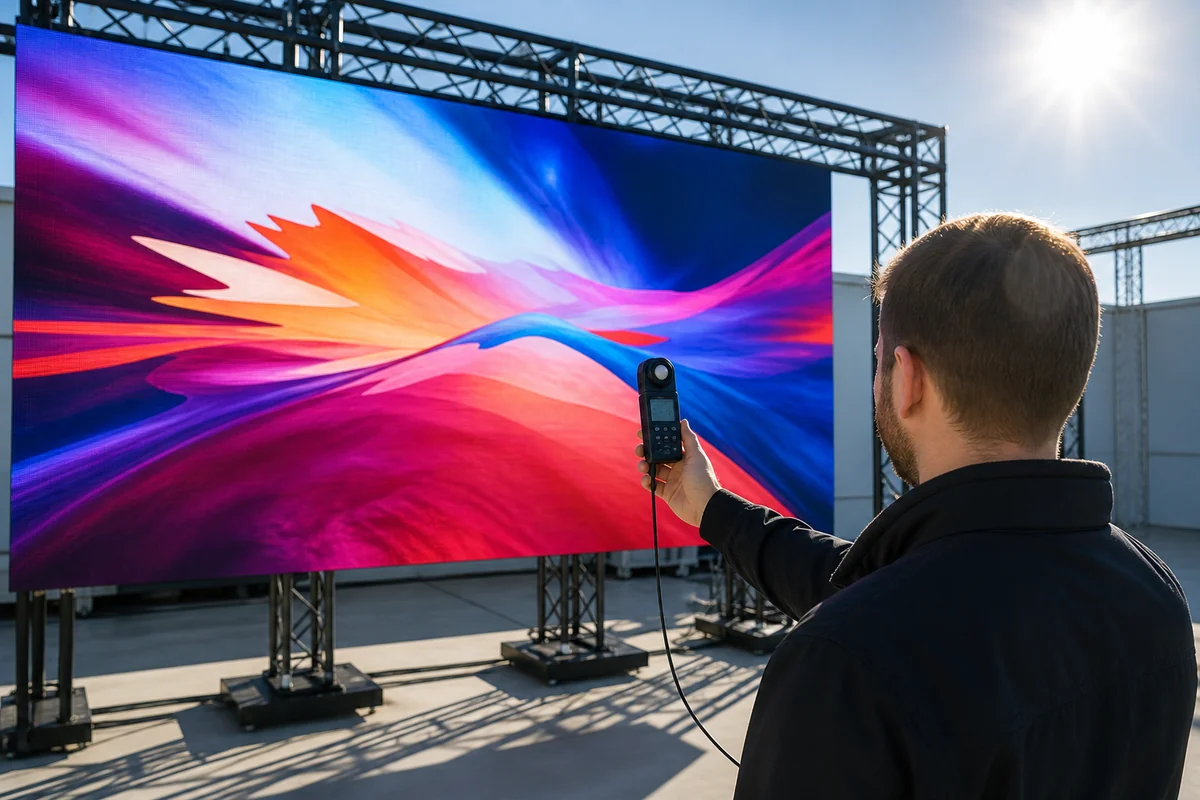
Most outdoor LED screens require roughly 5,000–10,000+ nits, but the correct brightness depends on sunlight exposure, screen orientation, installation location, content, and automatic brightness control.
Brightness determines whether viewers can clearly see content in daylight. However, maximum brightness should not become the sole purchasing target. A display that constantly operates at unnecessarily high brightness can increase electrical load and thermal stress.
Why Outdoor Screens Need Higher Brightness
Outdoor screens compete with natural ambient light. Direct sunlight can reduce perceived contrast and make dark areas of an image appear less distinct.
A manufacturer therefore needs to balance LED output with optical performance. The screen should provide enough luminance for the installation environment while maintaining reasonable power and thermal conditions.
For this reason, buyers should specify the actual installation environment instead of simply requesting “the brightest outdoor LED screen.”
Brightness Requirements Under Different Sunlight Conditions
A shaded installation and a south-facing billboard exposed to direct sunlight do not necessarily need identical configurations.
| Environment | Brightness Consideration |
|---|---|
| Shaded outdoor | ~4,000–6,000 nits |
| Standard outdoor | ~5,000–8,000 nits |
| Strong sunlight | ~8,000–10,000+ nits |
| High-brightness advertising | Project-specific |
These ranges provide a planning reference rather than a universal specification. The final requirement should consider geographic location, screen orientation, seasonal sunlight, viewing distance, and content.
Why Maximum Brightness Does Not Equal Better Image Quality
A brighter screen cannot compensate for poor calibration, weak contrast performance, unsuitable viewing angles, or poor image processing.
For example, excessive brightness can make some content look harsh while increasing power consumption. A professional manufacturer should therefore recommend an operating range rather than simply maximizing the LED drive current.
Reverse Recommendation: If the installation receives limited direct sunlight, do not pay for extreme brightness without a project reason. The additional capacity may increase cost without improving the viewer experience.
Brightness, Power Consumption, and Heat Generation
Brightness and electrical load are closely related. The actual relationship depends on LED package characteristics, drive current, content, scan configuration, and control strategy.
Heat also matters because outdoor cabinets operate through changing ambient temperatures. A manufacturer should consider power supply placement, airflow, cabinet construction, and thermal paths during engineering.
Factory Perspective: When we review a brightness requirement, we should also review power distribution and heat dissipation. Raising brightness without checking the cabinet’s thermal design can create a specification that looks attractive on paper but increases operating stress.
Automatic Brightness Control for Outdoor Displays
Automatic brightness control can adjust screen output according to ambient light. The goal is to maintain readability without operating at maximum brightness throughout the day.
For a commercial installation, this can improve viewing comfort and help control unnecessary energy consumption.
Buyers should ask whether brightness control is included in the control system and whether the installation can configure brightness schedules or sensor-based adjustments.
Conclusion: Most outdoor LED screens require approximately 5,000–10,000+ nits depending on sunlight exposure, viewing direction, installation location, and application.
| Environment | Brightness Consideration | Main Concern |
|---|---|---|
| Shaded outdoor | ~4,000–6,000 nits | Avoid unnecessary over-specification |
| Standard outdoor | ~5,000–8,000 nits | Daylight visibility |
| Strong sunlight | ~8,000–10,000+ nits | Sunlight competition |
| Advertising | Project-specific | Visibility and operating load |
Factory Perspective: Excessive brightness can increase power consumption and thermal load, so brightness should match the actual installation environment.
Show an outdoor LED screen operating under strong daylight at different brightness levels. The video should demonstrate actual image visibility, black-level appearance, text readability, and brightness adjustment rather than using edited promotional footage.
Outdoor LED Screen Durability: IP Rating Is Only Part of the Story

Outdoor LED reliability depends on enclosure protection, cabinet sealing, thermal management, component quality, corrosion resistance, drainage, and environmental testing in addition to IP rating.
IP protection provides an important reference, but it does not describe every aspect of outdoor durability. A display can meet a stated ingress-protection requirement while still facing problems caused by heat, condensation, corrosion, poor drainage, or component stress.
What IP65 Means for Outdoor LED Displays
The IP code comes from the IEC 60529 standard and classifies protection provided by enclosures against solids and water.
For IP65, the first digit indicates protection against dust ingress, while the second digit indicates protection against water jets under the specified test conditions.
IP65 does not mean that a cabinet can withstand every possible outdoor condition. Installation, drainage, connectors, cable entry points, cabinet joints, and maintenance practices still matter.
Front and Rear Protection
Outdoor LED cabinets can require different protection strategies depending on maintenance access.
A front-maintenance design allows technicians to service modules from the display face. This can simplify maintenance where rear access is restricted.
Rear-maintenance structures can provide convenient access when the installation includes sufficient service space.
The correct choice depends on the building structure, installation clearance, maintenance plan, and cabinet design.
Waterproofing and Cabinet Sealing
Water can enter through more than the main cabinet surface. Cable interfaces, cabinet joints, module connections, and improperly sealed openings can create additional exposure points.
Manufacturers should therefore consider sealing and drainage as part of the complete cabinet architecture.
Factory Perspective: During production, sealing quality needs process control. A factory should not rely solely on applying sealant manually without checking consistency at critical joints and interfaces.
Heat Dissipation and Thermal Management
Outdoor LED displays can operate for long periods under sunlight and elevated ambient temperatures. Heat generated by LEDs, driver ICs, and power supplies adds to the environmental load.
A cabinet therefore needs an appropriate thermal path. The manufacturer should evaluate component placement, cabinet structure, airflow, and heat accumulation.
Corrosion Protection in Coastal Environments
Coastal installations can expose electronics and metal structures to humid, salty environments. Corrosion protection therefore becomes more important near shorelines and in other aggressive environments.
The manufacturer may need to consider PCB protection, cabinet materials, coatings, fasteners, connectors, and drainage.
Do not treat an IP rating as a substitute for corrosion planning. Water resistance and corrosion resistance address different risks.
Temperature and Continuous-Operation Testing
Outdoor LED screens can face large temperature changes between daytime and nighttime operation. Continuous operation also increases the cumulative thermal load.
A manufacturer should conduct appropriate aging and operational tests before shipment. Buyers should ask what the factory actually tests rather than accepting a generic “24-hour aging test” statement without details.
Why Outdoor Reliability Depends on More Than IP Rating
The following factors work together:
| Reliability Factor | What It Controls |
|---|---|
| IP protection | Water and dust exposure |
| Cabinet sealing | Moisture intrusion |
| Thermal design | Operating temperature |
| Power supply | Electrical stability |
| PCB protection | Corrosion resistance |
| LED package | Long-term optical performance |
| Aging test | Early component failures |
Factory Perspective: Two displays can carry the same IP rating while having different long-term reliability because sealing quality, drainage design, coatings, thermal paths, and component selection can differ.
Conclusion: Outdoor LED reliability depends on enclosure protection, sealing, thermal management, component quality, corrosion resistance, drainage, and environmental testing in addition to IP rating.
| Reliability Factor | What It Controls |
|---|---|
| IP protection | Water and dust exposure |
| Cabinet sealing | Moisture intrusion |
| Thermal design | Operating temperature |
| Power supply | Electrical stability |
| PCB protection | Corrosion resistance |
| LED package | Long-term optical performance |
| Aging test | Early component failures |
Factory Perspective: IP65 should be treated as one verification point, not the complete definition of outdoor durability.
Outdoor LED Screen Price: What Determines the Cost?
Outdoor LED screen price depends primarily on screen area, pixel pitch, component configuration, brightness, cabinet design, control system, customization, and project logistics.
A quotation becomes difficult to compare when suppliers use different configurations under the same product name. One manufacturer may quote a basic cabinet, while another includes a different control system, higher brightness, spare parts, or a more robust power configuration.
The correct approach is to compare the same technical scope and BOM, not only the price per square meter.
Pixel Pitch and LED Quantity
Pixel pitch has a direct relationship with pixel density. A smaller pitch requires more LEDs within each square meter, which increases component count.
That increase can affect more than LED cost. It can also affect driver IC quantity, PCB design, power requirements, calibration workload, and replacement inventory.
Screen Size and Cabinet Configuration
Larger screens require more cabinets, modules, power supplies, receiving cards, cables, and structural components.
Cabinet size also changes installation efficiency. A larger cabinet may reduce cabinet count, while a smaller cabinet may simplify handling or fit complex structures.
LED Package and Driver IC
Component selection can significantly influence the quotation. Buyers should ask whether the quoted configuration uses the same LED package and driver IC across competing quotations.
A cheaper quotation may not represent the same product configuration.
Brightness and Power Configuration
Higher brightness can require a different electrical design. The manufacturer may need higher-capacity power supplies or different power distribution depending on the target configuration.
Buyers should therefore request both maximum and typical operating power when comparing project costs.
Cabinet Material and Structural Design
Cabinet material affects weight, strength, corrosion resistance, thermal behavior, and manufacturing cost.
A lightweight cabinet may reduce transportation and installation demands, but the manufacturer still needs to verify whether the structure meets the project’s environmental and mechanical requirements.
Control System
The control system determines how content reaches and synchronizes the display. A project may require different processing and control capabilities depending on resolution, signal sources, redundancy, monitoring, and content workflow.
Front vs. Rear Maintenance
Front-maintenance cabinets can increase initial hardware cost in some configurations, but they may reduce maintenance labor where rear access is difficult.
The cheapest cabinet is not necessarily the cheapest system to own.
Customization Requirements
Custom dimensions, unusual cabinet shapes, special mounting structures, customized brightness, branding, or specific maintenance requirements can increase engineering and production costs.
However, customization can also prevent expensive on-site modifications later.
Shipping, Installation, and Project Costs
The factory quotation may represent only the display equipment. Buyers should clarify whether the quotation includes:
- LED cabinets and modules
- Power supplies
- Receiving cards
- Sending/control equipment
- Cables
- Spare parts
- Packaging
- Shipping
- Steel structure
- Installation
- Commissioning
Conclusion: Outdoor LED screen price is primarily determined by screen area, pixel pitch, component configuration, brightness, cabinet design, control system, customization, and project logistics.
| Cost Factor | Cost Impact |
|---|---|
| Screen area | Direct |
| Pixel pitch | High |
| LED package | Medium-high |
| Driver IC | Medium |
| Brightness | Medium |
| Cabinet design | Medium-high |
| Control system | Medium |
| Customization | Variable |
| Shipping | Project-specific |
| Installation | Project-specific |
Factory Perspective: A low quotation can result from lower-cost components, simplified cabinet construction, lower brightness, reduced testing, or omitted accessories. Buyers should compare the BOM and project scope before comparing unit prices.
How to Verify a China Outdoor LED Screen Manufacturer
Buyers can reduce supplier risk by verifying factory production, component sourcing, QC records, international project experience, certifications, samples, warranty terms, and spare-parts support before placing a bulk order.
The verification process should start before the purchase order. A buyer does not need to inspect every production detail, but the buyer should gather enough evidence to determine whether the supplier can deliver the quoted configuration consistently.
Check Factory Production Capability
Ask for evidence of the actual production process. Look for information about assembly, testing, aging, calibration, and final inspection.
The objective is not to judge factory appearance. The objective is to determine whether the manufacturer can control the product you are buying.
Request Production and QC Evidence
Ask the supplier to explain its incoming inspection, process inspection, finished-product testing, and aging procedures.
For large projects, ask how the factory records production batches and handles non-conforming components.
Verify Component Sources
Request the major component configuration before comparing quotations. The manufacturer should identify the specifications that materially affect performance.
This step can prevent a common procurement error: comparing two products with identical pixel pitch but different internal configurations.
Review Previous International Projects
Project references can help verify whether the manufacturer has experience with similar environments, quantities, installation requirements, and export markets.
Focus on projects that resemble yours rather than simply counting the total number of installations.
Request Sample or Sample Cabinet
A sample cabinet allows buyers to inspect physical construction, module access, cable layout, cabinet finishing, connectors, and maintenance procedures.
For large orders, a sample can also establish a reference standard for production acceptance.
Conduct Factory Inspection
A factory inspection can verify production equipment, material storage, assembly areas, testing stations, and QC procedures.
For international B2B buyers, third-party inspection can also provide additional verification when an in-person factory visit is impractical.
Confirm Certifications for the Target Market
Certification requirements vary by destination and product configuration. Buyers should ask the manufacturer to provide documentation relevant to the actual market and electrical configuration.
Do not rely on logos displayed on a website without requesting supporting documents.
Evaluate After-Sales and Spare Parts Support
Outdoor LED screens contain replaceable components. Buyers should establish how the manufacturer supplies spare modules, power supplies, receiving cards, and other critical parts.
For distributors, long-term configuration consistency can matter as much as the initial purchase price because customers may need replacement components years after installation.
Conclusion: Buyers can reduce supplier risk by verifying factory production, component sourcing, QC records, international project experience, certifications, samples, warranty terms, and spare-parts support before placing a bulk order.
Factory Verification Checklist:
- Factory address and production capability
- Production equipment
- QC process
- Component documentation
- Aging-test records
- Calibration process
- Sample testing
- Certifications
- Warranty
- Spare parts
- Technical support
- Export experience
Conclusion
Selecting an Outdoor LED Screen Manufacturer should start with the project rather than the product catalog. Evaluate pixel pitch, brightness, durability, components, production control, quotation scope, and after-sales support together. The right specification is the one that solves the operating requirement without paying for unnecessary performance.
As your next-week action plan, prepare your project dimensions, minimum viewing distance, sunlight conditions, application, and target quantity; request matching BOM-based quotations from manufacturers; then compare samples, QC evidence, warranty terms, and spare-parts support before choosing a supplier.
NSELED can provide more than an outdoor LED screen quotation. Share your project requirements with our team for a configuration review covering pixel pitch, brightness, cabinet design, control system, maintenance method, and cost-performance balance, so you can make a technically informed purchasing decision rather than simply choosing the lowest bid.