


Introduction
Choosing the right outdoor LED screen manufacturer affects image quality, maintenance cost, and project reliability.
Many B2B buyers compare suppliers by price and catalog size, then discover later that component selection, thermal design, or quality control drives the real cost. A factory quotation can look attractive while excluding critical items such as calibration, spare modules, structural work, or suitable power capacity.
This guide helps buyers evaluate an LED screen factory through technical specifications, production controls, pricing, customization, and after-sales support. It focuses on decisions that can materially change project performance and total cost.
What Should You Look for in an Outdoor LED Screen Manufacturer?
A suitable outdoor LED screen manufacturer should demonstrate controlled production, consistent components, documented testing, customization capability, export experience, and technical support. A large product catalog alone does not prove manufacturing capability.
For B2B buyers, the first task should be separating a manufacturer from a trading company or reseller. The second task should be checking whether the factory can reproduce the same specification across multiple production batches.
Manufacturer vs. Supplier vs. Distributor: What Is the Difference?
An LED manufacturer controls at least part of the production process, while a supplier may source products from several factories. A distributor normally focuses on sales, inventory, installation, or local support rather than manufacturing.
The distinction matters when your project requires a non-standard cabinet, specific pixel pitch, OEM branding, repeated orders, or engineering changes. The more customized the project becomes, the more valuable direct access to the production team becomes.
| Purchasing Channel | Typical Strength | Main Buyer Risk |
|---|---|---|
| Manufacturer | Customization and direct production communication | Requires factory verification |
| Supplier | Flexible product sourcing | Component consistency may vary |
| Distributor | Local service and inventory | Higher supply-chain cost |
| Trading Company | Broad supplier access | Limited production visibility |
From a factory perspective, one useful test is simple: ask the company to explain which production steps it performs internally and which components or processes it outsources. A credible manufacturer should be able to discuss module assembly, cabinet integration, calibration, aging tests, and final inspection without relying on generic marketing language.
How to Verify Whether an LED Company Is a Real Factory
A factory verification process should combine documentation with production evidence. Buyers can request factory photos, production videos, business registration information, product test reports, quality-control records, and a live factory tour when order value justifies the effort.
However, photographs alone provide weak evidence. The strongest verification comes from matching the company’s claimed production capability with observable manufacturing processes and consistent technical documentation.
Before placing a bulk order, ask for:
- Production-line photographs or live video
- Factory address and company registration information
- Sample production records
- Component specifications
- Aging-test procedures
- Calibration process
- Quality inspection standards
- Previous project references where disclosure is permitted
- Warranty and spare-parts policy
A useful factory-level question concerns calibration. Ask whether the supplier calibrates modules individually, cabinet by cabinet, or only performs basic testing before shipment. The answer reveals how seriously the factory manages brightness and color consistency.
NSELED factory perspective: During mass production, component consistency matters as much as individual component quality. A premium LED package cannot compensate for inconsistent batches, poor soldering, unstable power distribution, or inadequate calibration.
Production Capacity, R&D, Quality Control, and Export Capability
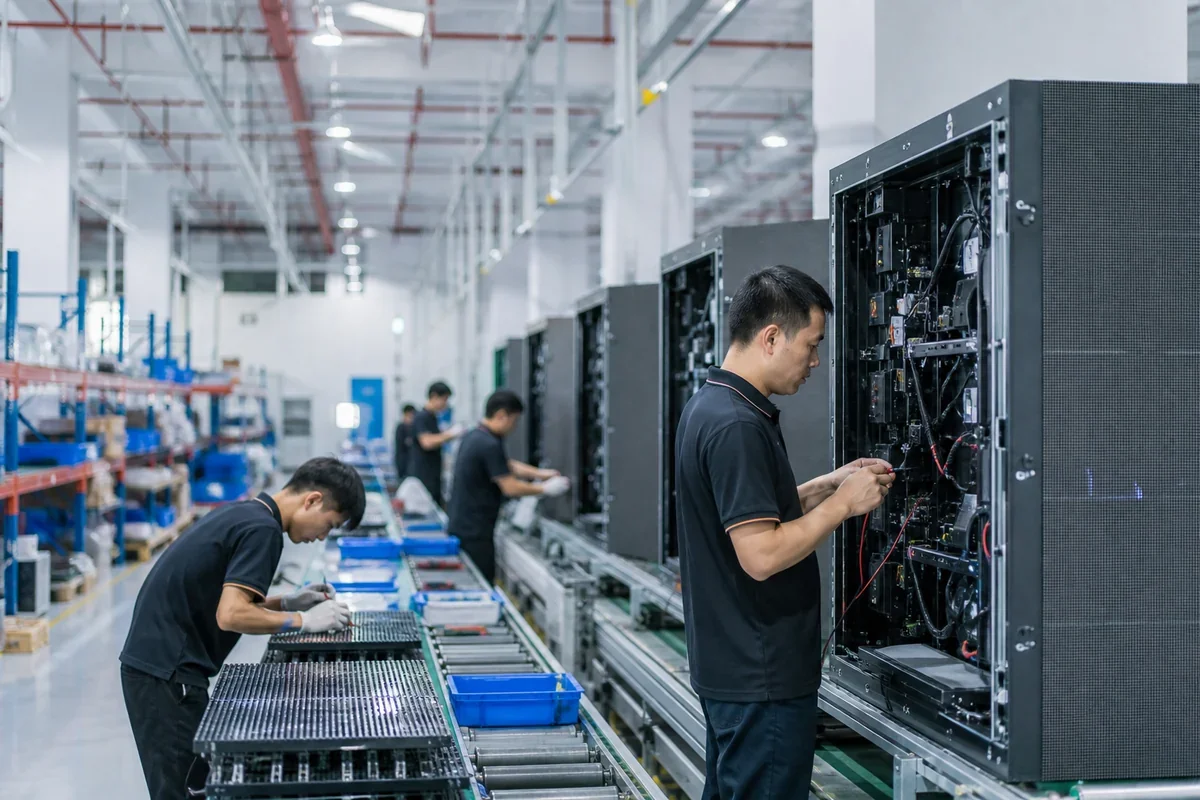
A serious outdoor LED screen manufacturer needs more than assembly capacity. The factory should have a defined process for incoming-material inspection, production testing, calibration, aging, final inspection, and shipment preparation.
R&D capability also matters when projects require structural changes or unusual operating conditions. For example, a screen installed on a building facade may need different cabinet dimensions and maintenance access from a standard billboard.
Export capability adds another layer. International buyers should verify whether the manufacturer understands destination-market electrical requirements, packaging, documentation, shipping terms, and remote technical support.
Why Factory Capability Matters More Than Product Catalog Size
A long product catalog does not automatically indicate stronger engineering capability. Manufacturers often reuse similar modules and cabinets across several product families.
For a B2B buyer, repeatable production is more important than the number of products displayed on a website. A factory that can maintain the same pixel pitch, brightness, cabinet dimensions, calibration standard, and component specification across repeat orders creates more value for distributors and project contractors.
This becomes particularly important when a buyer needs 100 m² for an initial project and expects another 300 m² six months later. If the factory changes LED packages, driver ICs, or cabinet structures without controlling the change, the two batches may show visible differences.
Conclusion: A reliable outdoor LED screen manufacturer should be evaluated by production capability, component control, quality testing, customization, project experience, warranty, and after-sales support rather than product variety alone.
| Evaluation Factor | What B2B Buyers Should Check |
|---|---|
| Manufacturing | In-house assembly, testing, aging |
| Components | LED package, driver IC, PCB, power supply |
| Quality Control | Incoming inspection, production testing, calibration |
| Customization | Cabinet size, pixel pitch, brightness, structure |
| Certifications | Destination-market requirements |
| Support | Installation guidance, spare parts, warranty |
Outdoor LED Screen Specifications Buyers Need to Compare
Buyers should compare pixel pitch, brightness, refresh rate, IP protection, cabinet design, maintenance access, and power consumption together, because each specification affects the others and influences the final operating cost.
A specification sheet becomes useful only when it describes the conditions under which the values apply. For example, maximum power consumption and average operating power represent different operating conditions and should never appear as interchangeable figures.
Pixel Pitch and Viewing Distance
Pixel pitch determines the distance between neighboring LED pixels. A smaller pitch increases pixel density and can improve image detail at closer viewing distances.
However, smaller pixel pitch also increases LED count and manufacturing cost. Do not automatically choose the smallest pixel pitch available. If viewers stand far from the screen, the additional pixel density may provide little visible benefit.
Brightness and Sunlight Visibility
Outdoor LED displays need enough luminance to remain readable under ambient daylight. The required brightness depends on sunlight exposure, screen orientation, viewing conditions, and automatic brightness control.
A screen facing direct afternoon sunlight may require substantially different settings from a screen installed beneath a covered structure. Buyers should therefore ask manufacturers about the intended operating environment instead of comparing brightness numbers in isolation.
Refresh Rate and Camera Performance
Refresh rate describes how frequently the display refreshes its image. Higher refresh rates can reduce visible scanning artifacts when cameras record the LED display.
For many commercial outdoor applications, 3,840 Hz provides a practical baseline, while camera-intensive applications such as broadcast, virtual production, and professional filming may justify higher specifications such as 7,680 Hz.
The important point is not simply selecting the highest number. Buyers should match refresh rate to the actual content and camera requirements.
IP Rating and Outdoor Environmental Protection
The IP code comes from IEC 60529 and describes protection against intrusion, dust, and water under specified test conditions. Buyers should not treat an IP rating as a complete guarantee of outdoor durability.
IP protection applies to the tested enclosure configuration, not every installation condition. Cable entries, connectors, cabinet joints, drainage, rear protection, and installation workmanship can still influence field performance.
Cabinet Material, Weight, and Structural Design
Cabinet design affects transportation, installation, wind loading, maintenance, and structural requirements. A lightweight cabinet may reduce installation effort, but the project still needs adequate mechanical strength for its environment.
For permanent outdoor installations, buyers should also ask how the cabinet interacts with the supporting structure. The LED display should not be evaluated as an isolated electronic product when structural loads affect the project.
Front Maintenance vs. Rear Maintenance
Front-service cabinets allow technicians to remove modules or access components from the display face. Rear-service designs require access behind the screen.
Choose the maintenance method before finalizing the cabinet structure. A rear-service cabinet can create substantial maintenance problems when the screen sits directly against a building facade.
Maximum Power Consumption vs. Average Operating Power
Maximum power indicates the higher electrical load under defined conditions. Average operating power reflects typical consumption under normal content and brightness conditions.
B2B buyers should request both figures because electrical infrastructure, cooling, and operating-cost calculations depend on different power conditions.
Conclusion: Outdoor LED screen specifications should be selected according to viewing distance, sunlight exposure, content type, climate, maintenance access, and operating conditions.
| Parameter | Typical Selection Consideration |
|---|---|
| Pixel Pitch | Smaller pitch for shorter viewing distance |
| Brightness | Match direct sunlight exposure |
| Refresh Rate | 3,840 Hz for general use; higher for camera-intensive use |
| Protection | Verify IP rating and enclosure design |
| Maintenance | Front access where rear access is restricted |
| Power | Compare maximum and average consumption |
| Cabinet | Match structure, wind, weight, and maintenance requirements |
Factory perspective: When comparing two quotations, request the same technical specification sheet and ask suppliers to identify any component substitutions. This simple step can prevent apparently similar quotations from representing different products.
How to Choose the Right Pixel Pitch for an Outdoor LED Screen?
The right outdoor LED screen pixel pitch depends on viewing distance, content detail, screen size, and project budget. A smaller pitch does not automatically produce better value.
Pixel pitch measures the distance between the centers of adjacent LED pixels. A smaller pitch packs more pixels into the same physical area, while a larger pitch uses fewer pixels and usually costs less per square meter.
Pixel Pitch vs. Minimum Viewing Distance
Viewing distance provides a practical starting point for pixel-pitch selection. The closer the audience stands, the more useful a smaller pitch becomes because the viewer can resolve finer image details.
However, buyers should treat viewing-distance formulas as planning tools rather than absolute rules. Content type, display dimensions, camera use, and audience movement can change the practical result.
For a long-distance billboard, paying for an extremely small pixel pitch can add substantial cost without producing a meaningful improvement for the actual audience.
From a factory perspective, pixel pitch also changes production economics. A smaller pitch requires greater LED density and tighter manufacturing tolerances. That difference affects not only the module price but also inspection, calibration, spare-parts planning, and potential replacement cost.
P2.5, P3.9, P4.8, P6.67, P8, and Larger Pixel Pitches
Different outdoor applications require different compromises between image detail and cost. The following ranges provide a procurement starting point rather than a universal specification.
| Application | Common Pixel Pitch Direction | Main Consideration |
|---|---|---|
| Close-view commercial display | P2.5–P4.8 | Image detail |
| Outdoor advertising | P4.8–P10 | Viewing distance |
| Large roadside billboard | P6.67–P10+ | Long-distance visibility |
| Stadium | P4.8–P10 | Viewing distance and camera use |
| Large public display | P6.67–P10+ | Screen size and viewing distance |
A buyer should also consider the physical dimensions of the screen. A very large screen with a coarse pitch can still deliver strong visual impact from a long distance, while a compact display installed near pedestrians may need finer pixel density.
NSELED factory perspective: We would not recommend choosing P2.5 simply because it has a higher pixel density. If the audience remains tens of meters away, the buyer should first calculate whether viewers can actually benefit from the additional pixels.
Why Screen Size Alone Cannot Determine Pixel Pitch
Screen size and pixel pitch solve different problems. Screen size determines the physical viewing area, while pixel pitch determines how densely the display reproduces image information.
For example, two outdoor screens can both measure 6 × 3 meters but serve completely different environments. One may face pedestrians at a retail entrance, while the other may sit beside a highway.
The buyer should therefore provide the manufacturer with:
- Screen dimensions
- Typical viewing distance
- Minimum viewing distance
- Content type
- Camera requirements
- Installation environment
- Expected audience position
A manufacturer can then evaluate whether the proposed pixel pitch fits the actual use case instead of simply quoting the smallest available model.
Pixel Pitch Selection for Billboards, Retail, Stadiums, and Public Spaces
Outdoor advertising usually prioritizes visibility, readability, and operating economics. Retail applications often place viewers closer to the screen, so image detail can become more important.
Stadium projects introduce another variable. Cameras may capture the screen from different angles and distances, which can make refresh performance and scan-related artifacts more important than they would be for a simple roadside display.
The best pixel pitch is therefore application-specific, not universally “better” at the smallest number.
How Over-Specifying Pixel Pitch Increases Project Cost
A smaller pitch increases the number of pixels required for a given screen area. That change affects LED count, module density, replacement inventory, and potentially the cost of spare parts.
The buyer should compare the incremental visual benefit against the incremental project cost. If viewers cannot distinguish the additional resolution from the intended distance, the extra expenditure becomes difficult to justify.
Conclusion: Choose outdoor LED pixel pitch according to viewing distance, screen dimensions, content detail, camera requirements, and budget instead of selecting the smallest available pitch.
| Application | Common Pixel Pitch Direction | Main Consideration |
|---|---|---|
| Close-view commercial display | P2.5–P4.8 | Image detail |
| Outdoor advertising | P4.8–P10 | Viewing distance |
| Large roadside billboard | P6.67–P10+ | Long-distance visibility |
| Stadium | P4.8–P10 | Viewing distance and camera use |
| Large public display | P6.67–P10+ | Screen size and viewing distance |
Procurement test: Ask the manufacturer to provide a pixel-pitch recommendation based on your actual minimum and typical viewing distances. If the supplier recommends a pitch without asking about viewing conditions, request a technical explanation before accepting the quotation.
How Bright Should an Outdoor LED Screen Be?

An outdoor LED screen generally needs substantially higher luminance than an indoor display, but the correct brightness depends on sunlight exposure, screen orientation, viewing conditions, and automatic brightness control.
Many outdoor projects use brightness levels around 5,000–10,000+ nits, but buyers should treat this as a design range rather than a universal requirement. A screen installed under shade does not face the same optical conditions as a roadside billboard exposed to direct sunlight.
Recommended Brightness for Different Outdoor Environments
The manufacturer should evaluate the installation environment before specifying maximum brightness. The screen’s orientation, local climate, surrounding buildings, and daily sunlight exposure can all affect the requirement.
| Environment | Brightness Consideration |
|---|---|
| Shaded outdoor area | Lower brightness may be sufficient |
| General outdoor commercial area | About 5,000–7,000 nits |
| Strong direct sunlight | About 7,000–10,000+ nits |
| High-sunlight applications | Select according to measured conditions |
The key issue involves usable brightness rather than the headline number. Buyers should ask how the manufacturer measures brightness and under what test conditions.
Do not compare a 10,000-nit claim from one supplier with a 7,000-nit claim from another until you confirm that both suppliers use comparable measurement conditions.
Direct Sunlight vs. Shaded Outdoor Locations
Direct sunlight can reduce perceived contrast because ambient light reaches the viewer’s eyes along with light from the LED display. The screen must produce enough luminance to maintain readable content.
Screen orientation also matters. A south-facing or west-facing display in a high-sunlight environment can experience different conditions from a display that faces away from the strongest sunlight.
For this reason, buyers should give the manufacturer the installation direction and location during the quotation stage.
Automatic Brightness Adjustment and Light Sensors
Automatic brightness control can adjust display output according to ambient light conditions. This approach can help the screen maintain visibility while avoiding unnecessary maximum output during darker periods.
The system should support the project’s control architecture and operating schedule. Buyers should ask whether brightness control operates automatically, manually, or through scheduled settings.
Why Higher Brightness Does Not Always Mean Better Performance
Excessive brightness can create unnecessary power demand and thermal load when the environment does not require maximum output.
A higher specification only creates value when the installation can use that specification. A buyer should therefore optimize brightness around real ambient conditions instead of selecting the largest number on a datasheet.
Brightness, Heat, and Long-Term LED Performance
Brightness and thermal management interact. Higher optical output can increase electrical and thermal demands, depending on LED package efficiency, drive conditions, cabinet design, and operating strategy.
From the factory side, engineers should consider airflow, power distribution, cabinet structure, and thermal paths together. A high-brightness specification without an adequate thermal design can create a difficult operating environment for electronic components.
Conclusion: Outdoor LED screens commonly require approximately 5,000–10,000+ nits depending on sunlight exposure, installation direction, location, and content requirements.
| Environment | Brightness Consideration |
|---|---|
| Shaded outdoor area | Lower brightness may be sufficient |
| General outdoor commercial area | About 5,000–7,000 nits |
| Strong direct sunlight | About 7,000–10,000+ nits |
| High-sunlight applications | Select according to measured ambient conditions |
Suggested Short Field Video 1
Place a 20–40 second field video here showing an outdoor LED screen operating under strong daylight.
The video should show:
- Camera position and viewing distance
- Screen orientation
- Daylight conditions
- White, dark, and mixed-color content
- Automatic brightness adjustment
- Real viewing visibility without artificial studio lighting
This video gives B2B buyers evidence that a brightness specification corresponds to a practical viewing condition rather than a number on a quotation.
How Outdoor LED Screen Components Affect Long-Term Reliability
Long-term outdoor LED reliability depends on the interaction between LED packages, driver ICs, PCB design, power supplies, receiving cards, thermal management, cabinet construction, and production quality.
Two displays can list the same pixel pitch and brightness while using different internal components. Those differences can affect heat generation, electrical stability, calibration consistency, maintenance requirements, and long-term operating behavior.
LED Package Quality and Brightness Consistency
LED packages determine important optical and electrical characteristics. Buyers should consider brightness consistency, color consistency, viewing angle, operating conditions, and batch stability rather than evaluating the package only by brand name.
A manufacturer also needs to manage LED binning and batch consistency. If different production batches contain significantly different optical characteristics, calibration becomes more difficult during repeat orders.
For distributors and brand owners, component consistency across repeat orders can matter more than a small initial price difference.
Driver IC Selection and Heat Generation
Driver ICs control LED current and affect display driving behavior. Different IC architectures can provide different functions and operating characteristics.
Factory engineers should evaluate the IC together with refresh requirements, grayscale performance, current settings, thermal conditions, and module design.
The practical procurement question is not simply “Which driver IC brand do you use?” A better question asks which driver IC model you use, why you selected it, and whether the same model remains fixed across production batches.
PCB Design and Signal Stability
The PCB carries electrical power and signal paths throughout the LED module. Poor layout, weak solder joints, or inadequate current distribution can create localized failures or unstable operation.
A serious manufacturer should inspect soldering quality and electrical performance during production rather than discovering problems after installation.
Power Supply Quality and Voltage Stability
The power supply affects voltage stability and system reliability. Buyers should confirm rated output, operating conditions, protection functions, quantity per cabinet, and replacement availability.
A quotation that lists only “power supply included” gives the buyer insufficient information for technical comparison.
Receiving Cards and Data Transmission
Receiving cards process and distribute display data. Compatibility between the receiving system, control processor, software, and module configuration affects commissioning and maintenance.
For large projects, buyers should keep configuration records. A technician should know which receiving-card configuration belongs to each cabinet or module group.
Cooling and Heat Dissipation Design
Outdoor cabinets operate in changing ambient conditions. Direct sunlight can increase cabinet temperature, while enclosed installation structures can restrict airflow.
Manufacturers should therefore consider ventilation, heat paths, component placement, and cabinet construction together.
Do not judge thermal performance from cabinet thickness alone. Ask the manufacturer how heat moves away from the driver and power components under operating conditions.
Why Two Outdoor LED Screens With the Same Specifications Can Have Different Lifespans
A datasheet summarizes selected performance parameters, but it does not fully describe manufacturing quality. Two screens can both specify P4.8, 6,000 nits, and 3,840 Hz while using different components, current settings, thermal designs, and calibration processes.
That difference explains why B2B buyers should compare the bill of materials, test procedures, and production controls, not only the headline specifications.
Conclusion: Long-term outdoor LED reliability depends on the interaction of LED packages, driver ICs, PCB design, power supplies, receiving cards, thermal management, cabinet construction, and manufacturing quality.
| Component | Main Reliability Risk | Factory QC Focus |
|---|---|---|
| LED Package | Brightness/color variation | Batch consistency |
| Driver IC | Heat and signal instability | Model and operating parameters |
| PCB | Signal/power failure | Layout and soldering |
| Power Supply | Voltage instability | Load and aging tests |
| Receiving Card | Signal interruption | Compatibility testing |
| Cabinet | Water ingress/heat buildup | Sealing and thermal testing |
Outdoor LED Screen Waterproofing: Is IP65 Enough?

IP65 can provide a useful level of enclosure protection for outdoor LED applications, but the IP code alone does not guarantee complete field weather resistance. Buyers must also evaluate cabinet joints, connectors, cable entries, drainage, rear protection, installation, and maintenance practices.
IEC 60529 defines the IP Code as a classification system for degrees of protection provided by electrical enclosures. The standard covers enclosure protection under specified test conditions.
What IP65 Actually Means
The IP code contains two digits. The first digit addresses protection against solid foreign objects, while the second addresses protection against water under the conditions defined by the standard.
Therefore, “IP65” describes a tested protection classification; it does not mean that every part of an installed LED system automatically has identical protection.
This distinction matters when a display contains external cables, connectors, service openings, drainage paths, and structural interfaces.
Front-Side and Rear-Side Protection
Some outdoor LED cabinets use stronger protection on the display-facing side while the rear follows a different construction approach.
The buyer should ask the manufacturer to specify which cabinet surfaces received the claimed protection rating and under what configuration the test occurred.
A front panel may resist rain effectively while an exposed rear connection area remains vulnerable if installers do not protect it properly.
Waterproof Cabinet Design vs. IP Rating on Paper
Manufacturers should combine enclosure sealing with practical water-management features. Gaskets, cabinet joints, connectors, cable routing, and drainage all influence the result.
A supplier that only writes “IP65 waterproof” on a quotation has not provided enough information for a serious outdoor project.
Ask for the relevant test documentation and clarify whether the tested configuration matches the production cabinet you will receive.
Drainage, Sealing, Connectors, and Cable Protection
Water can enter through interfaces rather than directly through the LED module surface. Cable entries and cabinet joints therefore deserve particular attention.
A well-designed cabinet should manage water instead of simply attempting to block every possible entry point. Drainage paths can help prevent accumulated water from remaining inside the enclosure.
How Climate Affects Outdoor LED Screen Selection
Rain is only one environmental factor. Buyers should also consider humidity, temperature variation, dust, salt exposure near coastal areas, wind, and direct solar heating.
The manufacturer should know the installation environment before finalizing cabinet construction and electrical specifications.
Conclusion: IP65 protection is commonly used for outdoor LED display applications, but real weather resistance also depends on cabinet sealing, connectors, drainage, cable protection, testing, and installation design.
| Protection Area | What Buyers Should Verify |
|---|---|
| Front Cabinet | Weather sealing |
| Rear Cabinet | Outdoor construction |
| Connectors | Outdoor-rated design |
| Cable Entry | Sealed cable routing |
| Drainage | Water management |
| Testing | Applicable test records |
Authority source: IEC 60529 defines the international IP Code classification for enclosure protection.
Factory perspective: When reviewing an outdoor LED quotation, ask the manufacturer to identify the exact cabinet configuration covered by the IP test. This prevents buyers from assuming that a single IP rating automatically covers every connector, cable, and installation interface.
Outdoor LED Screen Manufacturing Quality Control
A reliable outdoor LED screen manufacturer should control quality from incoming components through module assembly, calibration, aging, and final inspection. Final testing alone cannot identify every production risk.
B2B buyers should therefore evaluate the manufacturer’s process rather than relying only on a finished sample. A sample can perform well while a large production batch develops consistency problems if the factory does not control component batches, soldering, calibration, and electrical testing.
Incoming Component Inspection
The manufacturing process starts before the first LED module enters assembly. A factory should inspect LED packages, driver ICs, PCBs, power supplies, receiving cards, connectors, and structural components against the approved specification.
The factory should also control component batches. A component substitution can change display performance even when the final product keeps the same pixel pitch and cabinet dimensions.
For repeat B2B orders, buyers should ask whether the manufacturer maintains an approved bill of materials and whether engineering approval is required before changing a major component.
SMT and LED Module Production
Surface-mount technology places electronic components onto the PCB and forms an important part of module production. Soldering quality, component placement, and process control influence electrical stability.
A factory should monitor production parameters rather than depend entirely on visual inspection. Automated equipment can improve placement consistency, but technicians still need to inspect process results and investigate abnormal production data.
The factory perspective matters here because mass production changes the risk profile. A single good sample does not prove that hundreds or thousands of modules will maintain the same soldering and electrical quality.
Module Calibration and Color Consistency
LED modules can show differences in brightness and color because LED chips and packages have manufacturing tolerances. Calibration reduces visible variation between modules and cabinets.
For large displays, the calibration process becomes especially important because viewers can notice differences across large continuous surfaces.
A buyer should ask:
- Does the factory calibrate individual modules?
- Does the factory record calibration data?
- Does cabinet-level calibration follow module calibration?
- Can the factory reproduce the same calibration standard for repeat orders?
- How does the factory handle replacement modules?
The last question often receives too little attention. A replacement module that does not match the original calibration can become visibly different even when its pixel pitch is identical.
Cabinet Assembly and Electrical Testing
Cabinet assembly combines modules, power supplies, receiving cards, cables, connectors, and mechanical structures. The factory should verify wiring, signal paths, electrical connections, and cabinet-level operation.
A proper inspection should also identify incorrect cable routing, loose connections, and configuration errors before shipment.
For a large B2B project, the buyer should request a clear cabinet configuration and wiring standard. This documentation can reduce troubleshooting time when technicians replace components months or years later.
Aging Test and Full-Screen Testing
Aging tests operate the display for an extended period under controlled conditions. The purpose is to identify early failures before shipment rather than after installation.
The exact aging procedure varies between manufacturers and products, so buyers should ask what the factory actually tests. A useful record should identify the test duration, operating conditions, display status, and inspection criteria.
“100% aging tested” has little procurement value unless the manufacturer can explain the test method and acceptance criteria.
Dead Pixel Control in Mass Production
Dead pixels can originate from LED package failures, soldering defects, electrical problems, driver issues, or module damage. A manufacturer should monitor dead-pixel performance during production rather than only inspect the finished screen.
Factories can reduce the risk through component inspection, production-process control, module testing, aging, and final inspection.
However, buyers should avoid treating a claimed dead-pixel rate as a universal industry number without defining the measurement method and acceptance standard. The contract should specify the agreed quality criteria.
Why Factory Quality Control Should Be Verified Before Bulk Orders
A production sample answers one question: Can the factory build this product?
A bulk-order quality system answers another: Can the factory build the same product repeatedly?
That distinction matters to distributors, system integrators, and brand owners. A buyer who plans repeated orders needs consistency in components, cabinet dimensions, calibration, firmware configuration, and mechanical interfaces.
Conclusion: A manufacturer should control quality from component inspection through assembly, calibration, aging, and final inspection rather than relying only on final product testing.
| Production Stage | Key QC Check |
|---|---|
| Incoming Materials | Specification and batch consistency |
| SMT | Soldering and component placement |
| Module Assembly | Electrical and visual testing |
| Calibration | Brightness and color uniformity |
| Cabinet Assembly | Wiring and signal testing |
| Aging | Continuous operation testing |
| Final Inspection | Appearance and functional performance |
Procurement recommendation: Ask for a documented production and inspection flow before approving a bulk order. The document should identify inspection points, acceptance criteria, and the process for handling non-conforming units.
How Much Does an Outdoor LED Screen Cost?
The cost of an outdoor LED screen depends on screen area, pixel pitch, LED components, brightness, cabinet construction, control equipment, installation, logistics, and maintenance requirements. A single price-per-square-meter figure cannot represent a complete project cost.
B2B buyers should first define the technical specification and then compare quotations. Otherwise, a cheaper quotation may simply contain a lower pixel density, lower brightness, different components, fewer accessories, or fewer included services.
What Determines Outdoor LED Screen Price?
Pixel pitch usually has a strong effect because a smaller pitch requires more pixels within the same physical area. However, the quotation also reflects the LED package, driver IC, PCB, cabinet, power system, control system, structural requirements, and customization.
The buyer should therefore ask suppliers to separate the display hardware from installation, structure, logistics, control equipment, and other project costs.
A transparent quotation is more useful than a low headline price.
Pixel Pitch and Cost per Square Meter
Smaller pixel pitch increases LED density. That increase can raise module complexity and material consumption.
For example, a buyer may consider a fine-pitch outdoor display because it looks technically superior. If the audience remains at a long viewing distance, however, the additional pixel density may not produce a proportional visual benefit.
This creates one of the easiest areas for B2B buyers to control cost: select the pixel pitch based on actual viewing conditions instead of maximum available image resolution.
LED Package and Driver IC Effects on Price
The LED package and driver IC influence both cost and performance. Different components can affect brightness, grayscale behavior, refresh performance, thermal characteristics, and long-term consistency.
Buyers should avoid comparing quotations that use vague descriptions such as “premium LED” or “high-quality IC.” Ask for the exact component model or approved specification.
From a factory perspective, component changes can also affect calibration and production settings. A supplier that changes a driver IC to reduce cost should disclose the engineering change before production.
Cabinet Material and Structural Requirements
Cabinet design affects material cost, weight, transportation, installation, and maintenance. A lightweight cabinet can simplify handling, while a customized structural design may increase manufacturing cost.
Permanent outdoor installations may also require structural engineering outside the LED display itself. Buyers should clarify whether the quotation includes mounting structures, brackets, steelwork, electrical distribution, and installation labor.
Brightness, Refresh Rate, and Protection Level
Higher brightness, higher refresh rates, and more demanding environmental protection can affect component selection and system design.
However, buyers should not automatically pay for the highest specification. A billboard with no professional camera requirement may not need the same refresh specification as a broadcast-oriented application.
The correct question is not “What is the highest specification?” but “What specification does this project actually need?”
Control System, Installation, Shipping, and Spare Parts
The LED cabinets represent only part of a complete system. A project may also require a sending system, receiving cards, video processor, control software, cables, spare modules, spare power supplies, structural work, installation, commissioning, packaging, and transportation.
International B2B buyers should also separate factory pricing from destination costs. Freight, customs duties, local installation, electrical work, and lifting equipment can materially change the final project budget.
Why the Lowest Initial Price May Not Be the Lowest Total Cost
A low initial price can become expensive if the display consumes more power, requires frequent module replacement, lacks readily available spare parts, or creates longer maintenance downtime.
A useful B2B comparison should therefore consider total cost of ownership:
TCO = Purchase Cost + Installation + Energy + Maintenance + Spare Parts + Logistics + Downtime Risk
This formula does not produce one universal number, but it forces buyers to consider costs beyond the first invoice.
Conclusion: Outdoor LED screen cost depends on screen area, pixel pitch, components, brightness, cabinet structure, control system, installation, shipping, and maintenance requirements.
| Cost Factor | Effect on Project Cost |
|---|---|
| Pixel Pitch | Smaller pitch increases LED density |
| Screen Size | More modules and cabinets increase material |
| LED Package | Component quality affects price and performance |
| Driver IC | Features and electrical performance affect cost |
| Cabinet | Material, weight, and customization affect price |
| Brightness | Higher output can increase system requirements |
| Control System | Processor and receiving equipment add cost |
| Installation | Structure, labor, and electrical work |
| Logistics | Packaging, freight, customs, destination costs |
| Spare Parts | Supports long-term maintenance |
Warranty, Spare Parts, and After-Sales Support
A complete outdoor LED support system should include defined warranty coverage, spare parts, technical documentation, remote troubleshooting, and a clear replacement process.
B2B buyers should evaluate after-sales support before signing the purchase order because the supplier’s response process can directly affect project downtime.
What Should an LED Display Warranty Cover?
The warranty should identify the covered components, warranty period, exclusions, replacement procedure, and shipping responsibility.
A vague statement such as “three-year warranty” does not provide enough operational information.
The buyer should clarify whether the warranty covers LED modules, power supplies, receiving cards, control equipment, and other components separately.
Recommended Spare Parts for B2B Projects
Spare parts should reflect the project scale and maintenance strategy.
Typical inventory may include:
- LED modules
- Power supplies
- Receiving cards
- Data cables
- Power cables
- Connectors
- Masks or mechanical parts where applicable
The correct spare-parts quantity depends on project size, operating environment, maintenance response time, and component architecture.
Remote Technical Support and Troubleshooting
International buyers often need remote assistance before a technician can visit the site.
A useful support process should identify the information required for diagnosis, such as cabinet number, module position, receiving-card status, power status, error behavior, and photographs or videos.
The manufacturer should also maintain configuration records for repeat projects.
Module Replacement and Calibration
Module replacement does not always end with physical installation. The replacement module may require configuration or calibration to match the surrounding display.
A manufacturer should provide a documented replacement procedure.
For large displays, replacement consistency matters because one visibly different module can become more noticeable than the original failure.
Why After-Sales Capability Should Be Evaluated Before Purchase
A buyer should test the supplier’s support process before the first order. Send a technical question and evaluate the response quality, technical accuracy, and response time.
This simple test can reveal more about after-sales capability than a marketing statement.
Conclusion: A complete outdoor LED screen support system should include warranty terms, spare parts, technical documentation, troubleshooting support, and replacement procedures.
| Support Item | Buyer Should Confirm |
|---|---|
| Warranty | Duration and covered components |
| Spare Parts | Quantity and recommended inventory |
| Technical Support | Remote response process |
| Documentation | Installation and maintenance manuals |
| Replacement | Module/cabinet procedure |
| Calibration | Recalibration support |
Conclusion
Choosing the right outdoor LED screen manufacturer requires more than comparing price per square meter. Buyers should evaluate pixel pitch, brightness, IP protection, component configuration, quality control, certifications, maintenance access, warranty, spare parts, and total project cost. The best specification is the one that matches the installation environment and business objective without adding unnecessary cost.
Before placing an order, B2B buyers should standardize their RFQ, verify the manufacturer’s production and QC capabilities, and compare quotations using identical technical and commercial requirements. A factory that can explain why each specification is recommended provides more procurement value than a supplier that simply offers the highest specifications at the lowest price.
For billboards, DOOH, stadiums, retail buildings, transportation projects, architectural displays, and OEM applications, NSELED provides customized outdoor LED display manufacturing and B2B project support based on your actual installation requirements. If you need help selecting the right pixel pitch, brightness, cabinet structure, components, or project configuration, Contact Us at NSELED to discuss your requirements and receive a project-specific solution.