


Introduction
A TAA compliant LED video wall meets applicable U.S. government procurement requirements related to the Trade Agreements Act and product origin.
The challenge starts when buyers see “TAA compliant” on a quotation and assume the label alone proves eligibility. LED video walls contain modules, cabinets, electronics, power supplies, and software from complex supply chains, so buyers need to verify the actual procurement requirement and product origin.
This guide explains how TAA applies to LED video walls, what buyers should verify, and how to evaluate suppliers before committing project funds.
Procurement note: This guide provides general purchasing information, not legal advice. Requirements can vary by solicitation and agency; verify the current contract clauses and obtain qualified compliance guidance for the offered end product.
What Is a TAA Compliant LED Video Wall?
A TAA compliant LED video wall is an LED display system that satisfies the applicable Trade Agreements Act procurement requirements for a specific government acquisition. The key issue usually involves whether the offered end product qualifies under the applicable country-of-origin rules and procurement conditions.
TAA stands for the Trade Agreements Act of 1979. In federal procurement, the rules can restrict covered acquisitions to U.S.-made or designated-country end products, subject to the specific solicitation and applicable acquisition rules.
That distinction matters because “TAA compliant” does not describe an LED display’s image quality. It does not tell you whether the screen uses P1.5, P2.5, COB, SMD, 3840Hz, or 7680Hz technology. Instead, it addresses a procurement question: Can this particular product satisfy the applicable sourcing requirement for this particular project?
What Does TAA Stand For?
The Trade Agreements Act (TAA) is a U.S. federal law that governs certain government purchases involving eligible products and designated countries. Federal Acquisition Regulation (FAR) Part 25 contains the procurement rules that implement trade-agreement requirements.
For an LED video wall buyer, the practical implication is more important than memorizing the regulation. The buyer needs to determine whether the project falls under a procurement clause that requires eligible end products.
The exact requirement depends on the solicitation, contract, agency, acquisition value, and applicable trade-agreement rules. Therefore, buyers should confirm the requirement in the actual procurement documents instead of assuming that every government LED display project requires TAA compliance.
What Does TAA Compliance Mean?
TAA compliance means that a product satisfies the applicable TAA-related procurement requirement for the transaction.
For an LED video wall, buyers should look beyond the supplier’s marketing label and examine the product’s origin and manufacturing circumstances. A display may contain components manufactured in several countries, while the procurement rules may focus on the origin of the finished end product.
This creates an important sourcing distinction:
| Procurement Question | What the Buyer Should Determine |
|---|---|
| What product is being purchased? | Exact LED video wall model and configuration |
| Where is the product manufactured? | Relevant manufacturing location |
| Where do components originate? | Major component sourcing information |
| What is the declared country of origin? | Supplier’s written country-of-origin statement |
| Does the project require TAA? | Applicable solicitation or contract requirement |
| Can the supplier support the claim? | Written documentation and traceable records |
From a factory perspective, this distinction changes how we prepare a quotation. A responsible manufacturer should know which product configuration the compliance statement applies to. A generic statement covering an entire product catalog gives a buyer much less protection than documentation tied to a specific model and configuration.
Is TAA Compliance the Same as Made in USA?
No. TAA compliance and “Made in USA” are not interchangeable concepts.
A TAA procurement requirement can allow eligible products from designated countries as well as U.S.-made products, depending on the applicable acquisition rules. The FAR therefore treats “U.S.-made” and “designated country” end products as distinct categories within covered procurements.
The current FAR list includes numerous designated countries, including Australia, Canada, Japan, South Korea, Singapore, and members of the WTO Government Procurement Agreement framework. The applicable list and procurement conditions should always be checked against the current solicitation.
This point matters for international LED sourcing. A buyer should not reject every overseas manufacturer simply because the supplier is outside the United States. Instead, the buyer should determine whether the offered end product satisfies the project’s applicable origin requirement.
Why Does TAA Compliance Matter for LED Video Walls?
TAA compliance matters because an LED video wall can represent a significant procurement commitment, and an incorrect compliance assumption can create problems after the purchase order, installation, or government review.
A government contractor may need to demonstrate that the supplied product matches the requirements stated in the contract. If the buyer discovers a mismatch after production begins, changing the product can affect manufacturing schedules, shipping plans, installation dates, and project budgets.
The risk becomes more complicated with LED displays because a finished video wall is not a single electronic component. A typical system can include:
- LED modules
- LED packages
- PCB assemblies
- Driver ICs
- Receiving cards
- Power supplies
- LED cabinets
- Control systems
- Signal processors
- Structural components
- Cables and accessories
The buyer should therefore evaluate TAA compliance at the finished-product and procurement level, while also understanding the underlying manufacturing chain.
A factory sees another practical risk that a simple supplier comparison can miss. Two suppliers may quote the same P2.5 LED video wall with similar brightness and refresh rate, yet their manufacturing records can differ substantially. One supplier may maintain model-specific production records and traceability. Another may rely on a generic declaration that does not identify the actual configuration.
That difference has little effect on a product brochure, but it can matter during procurement verification.
For this reason, we recommend that B2B buyers establish the compliance requirement before comparing quotations. The buyer should first identify the applicable procurement clause, then ask each supplier to respond against the same product model, country-of-origin requirement, manufacturing information, and documentation standard.
TAA should be treated as a procurement verification step, not as another performance specification on an LED video wall datasheet.
How Does TAA Compliance Apply to LED Video Walls?
A TAA requirement for an LED video wall depends on the applicable procurement rules, country-of-origin determination, manufacturing circumstances, and project-specific contract requirements. TAA does not depend on pixel pitch, brightness, refresh rate, or other display specifications.
The important point for B2B buyers is that an LED video wall usually contains products and components from multiple stages of a global supply chain. Therefore, buyers should not use a single component’s country of origin as a shortcut for determining the origin of the complete display.
| Factor | What Buyers Should Check |
|---|---|
| Country of Origin | Origin of the finished product |
| Manufacturing | Location of applicable manufacturing processes |
| Components | Origin of major display components |
| Final Product | Country-of-origin determination |
| Documentation | Supplier declarations and supporting records |
| Contract | Specific procurement requirements |

Country of Origin vs Component Origin
The country of origin of an LED component is not automatically the country of origin of the finished LED video wall. Buyers need to distinguish component sourcing from the origin of the completed end product.
For example, an LED cabinet can incorporate LED packages, driver ICs, PCBs, power supplies, receiving cards, connectors, and mechanical parts from different countries. The supplier may then perform module assembly, cabinet assembly, system testing, calibration, and configuration at another location.
The procurement question therefore becomes more specific: What manufacturing activity determines the origin of the finished product under the applicable rule?
This is where buyers should avoid making assumptions from a bill of materials alone. A component list can show where individual parts came from, but it does not necessarily answer the legal country-of-origin question for the completed product.
From a manufacturing perspective, we recommend that buyers request two separate pieces of information:
- The declared country of origin of the finished LED video wall.
- The manufacturing location and major production processes used for that product.
That approach gives the procurement team a clearer audit trail.
How Manufacturing Location Affects Country of Origin
Manufacturing location can become an important factor when determining the origin of a finished product, but buyers should apply the specific country-of-origin rule required by the procurement.
U.S. federal procurement rules can use different origin concepts depending on the applicable acquisition and regulation. For this reason, a supplier should not casually promise that moving final assembly to another country automatically changes the product’s TAA status.
The factory process matters because LED display manufacturing involves multiple stages rather than one simple assembly step.
A typical production sequence can include:
- LED module production and soldering.
- PCB and electronic component assembly.
- Driver and receiving-card installation.
- Cabinet mechanical assembly.
- Power distribution and wiring.
- System integration.
- Aging and functional testing.
- Brightness and color calibration.
- Final inspection and packing.
At NSELED, this manufacturing sequence also provides a practical quality-control lesson. The location of final assembly alone does not tell a buyer how much manufacturing value or technical processing occurred there.
For example, a supplier may receive partially assembled modules and perform only cabinet integration. Another manufacturer may perform module assembly, cabinet production, electrical integration, testing, and calibration as part of a controlled production process.
Those scenarios can look similar on a commercial quotation, but they represent very different manufacturing chains.
Buyers should therefore ask suppliers to explain the production process instead of relying only on statements such as “assembled in” or “shipped from.”
How LED Modules and Cabinets Fit Into the Supply Chain
LED modules and cabinets form critical manufacturing stages, but neither term alone determines the TAA status of the finished video wall.
An LED module typically integrates the LED packages, PCB, driver components, connectors, and mechanical structure required to form a display unit. Multiple modules then combine with power supplies, receiving cards, cables, and a cabinet structure to create the display cabinet.
For a large LED video wall, dozens or hundreds of cabinets can form one complete display system. The manufacturer may then configure the cabinets according to the project’s required dimensions, resolution, maintenance method, control architecture, and installation environment.
This creates a useful procurement distinction:
| Manufacturing Stage | What Buyers Should Ask |
|---|---|
| LED Package | Where is the package sourced? |
| PCB / Module | Where does module manufacturing occur? |
| Cabinet | Where does cabinet production occur? |
| Electronics | Where are driver and control components integrated? |
| System Assembly | Where is the complete display configured? |
| Testing | Where does functional testing occur? |
| Calibration | Where does final calibration occur? |
| Documentation | Can the supplier document the relevant origin information? |
The factory perspective becomes especially useful when buyers evaluate long-term consistency. A display supplier that controls module assembly, cabinet integration, testing, and calibration can generally provide more direct production records than a trading company that sources finished cabinets from several factories.
That does not automatically make one supplier TAA compliant. It does, however, make the manufacturing chain easier to investigate and document.
Can an LED Video Wall Contain Components From Multiple Countries?
Yes. An LED video wall can contain components sourced from multiple countries, but component diversity does not by itself determine the country of origin of the finished product.
Global sourcing is normal in the LED industry. A manufacturer may source different electronic components, mechanical materials, LED packages, power supplies, or control products from specialized suppliers.
The procurement risk appears when the supplier cannot clearly explain the relationship between those components and the finished product.
A stronger supplier response should identify:
- The exact LED display model.
- The manufacturing location.
- The declared country of origin.
- The major manufacturing stages.
- The relevant supplier documentation.
- Any project-specific limitations.
For TAA-sensitive procurement, transparency is more valuable than a broad “TAA compliant” badge.
A buyer should also keep the project contract in view. If the solicitation imposes additional sourcing, security, cybersecurity, domestic preference, or agency-specific requirements, TAA alone may not cover the full procurement obligation.
How to Verify TAA Compliance Before Buying an LED Video Wall?
Buyers should verify the procurement requirement, country of origin, actual manufacturer, exact product model, manufacturing information, and supporting documentation before issuing a purchase order.
This process protects the buyer from a common procurement mistake: treating a supplier’s marketing statement as the final compliance determination. The Federal Acquisition Regulation provides the framework for federal acquisition requirements, but the buyer still needs to review the specific solicitation and contract.
| Verification Item | Buyer Question |
|---|---|
| Product Model | Does the document identify the exact model? |
| Manufacturer | Who actually manufactures the product? |
| Country of Origin | What is the declared origin? |
| Manufacturing Location | Where is the relevant manufacturing performed? |
| Documentation | Can the supplier provide written evidence? |
| Contract Requirement | Does the documentation satisfy the project requirement? |

Confirm the Applicable Procurement Requirement
First confirm that the specific project actually requires TAA compliance.
Do not start by asking suppliers for a “TAA LED display.” Start with the solicitation, contract, statement of work, or procurement guidance that governs the purchase.
Look for the applicable clauses, country-of-origin requirements, designated-country requirements, and any additional agency or contractor conditions.
This step can prevent unnecessary supplier restrictions. A commercial project may not require TAA at all, while a government project may impose several procurement requirements beyond TAA.
A useful internal procurement record should identify:
- Contract or solicitation number.
- Procuring agency or prime contractor.
- Applicable compliance clause.
- Required product category.
- Country-of-origin requirement.
- Required supporting documents.
- Person responsible for final compliance review.
Verify the Country of Origin
Ask the supplier to provide the declared country of origin for the exact LED video wall configuration being quoted.
Do not accept a country-of-origin answer that refers only to the supplier’s headquarters. The supplier may operate in one country while manufacturing the product in another.
For example, a company can maintain an American sales office while importing display products manufactured elsewhere. Conversely, an overseas supplier can manufacture different product lines in different locations.
The buyer should therefore separate three questions:
Who sells the product? Where is the product manufactured? What country of origin does the supplier declare for the finished product?
Those answers should appear consistently across the quotation, compliance statement, product documentation, and purchase records.
Identify the Actual Manufacturer
The seller and the manufacturer are not always the same company.
This distinction matters in LED display procurement because the international market includes manufacturers, distributors, system integrators, trading companies, and project contractors.
Ask the supplier to identify:
- Legal manufacturer name.
- Manufacturing facility location.
- Exact product model.
- Production responsibility.
- Relevant quality-control process.
- Documentation issuer.
At the factory level, model traceability provides an additional layer of protection. A manufacturer should be able to connect the quoted model with its production records, inspection records, configuration details, and shipment documentation.
Request a Written Compliance Statement
A TAA-related representation should appear in writing and identify the product or project scope to which it applies.
A buyer should not rely solely on a salesperson’s email saying “Yes, this is TAA compliant.” Ask for a formal statement or other documentation appropriate to the contract.
The document should avoid vague language. It should identify the product model, manufacturer, applicable requirement, country-of-origin representation, date, and authorized issuer where appropriate.
The buyer should also understand the limits of supplier documentation. A supplier declaration supports procurement verification, but it does not replace the buyer’s responsibility to follow the applicable government contract requirements.
Match Documentation to the Exact Product Model
Compliance documentation should match the LED video wall that the buyer actually purchases.
This point becomes important when a supplier offers several cabinet types, module designs, or manufacturing locations under one product family.
A buyer may originally approve one model and later accept a substitute because of availability. If the substitute changes the product configuration or manufacturing source, the original documentation may no longer describe the delivered product accurately.
The procurement team should therefore record:
- Model number.
- Cabinet dimensions.
- Pixel pitch.
- Module specification.
- Manufacturing location.
- Country-of-origin statement.
- Relevant compliance documents.
Verify Compliance Before Issuing the Purchase Order
The best time to discover a documentation problem is before production begins, not after the LED cabinets arrive at the project site.
A practical workflow looks like this:
- Review the procurement requirement.
- Define the required product and compliance criteria.
- Send the same RFQ requirements to each supplier.
- Collect written origin and manufacturing information.
- Compare documentation against the quoted model.
- Obtain internal or contractual compliance approval.
- Issue the purchase order only after verification.
This sequence also improves commercial comparisons. Buyers can compare suppliers on the same technical and compliance basis instead of choosing the lowest initial quotation and discovering additional requirements later.
For a TAA-sensitive project, the lowest LED video wall quotation is not necessarily the lowest-risk quotation. A slightly higher initial price may provide clearer documentation, stronger traceability, better spare-parts planning, and fewer compliance uncertainties.
That is the procurement decision NSELED recommends buyers make: compare the complete project solution, not just the LED display price per square meter.
What Technical Specifications Should Buyers Evaluate Besides TAA Compliance?
TAA compliance does not determine LED video wall performance. Buyers should also evaluate pixel pitch, brightness, refresh rate, power consumption, cabinet design, maintenance access, reliability, and spare-parts requirements against the actual installation environment.
A government procurement team can verify country of origin correctly and still purchase the wrong display. For example, a fine-pitch indoor wall can deliver excellent image detail but create unnecessary cost if viewers stand far away. Likewise, an outdoor display with insufficient brightness can struggle under direct sunlight even if its procurement documentation is complete.
| Technical Parameter | Key Purchasing Question |
|---|---|
| Pixel Pitch | What viewing distance is required? |
| Brightness | What ambient light conditions apply? |
| Refresh Rate | Is camera or broadcast capture required? |
| Power Consumption | What are maximum and typical loads? |
| Cabinet Design | What installation and maintenance method is required? |
| IP Rating | Does the environment require weather protection? |
| Serviceability | How quickly can modules be replaced? |
| Spare Parts | What replacement components should be stocked? |
Pixel Pitch and Viewing Distance
Pixel pitch should match the actual viewing distance, content type, and required image detail rather than simply using the smallest available pitch.
Pixel pitch represents the distance between the centers of adjacent LED pixels. A smaller pitch increases pixel density and can improve close-range image detail, but it also increases the amount of LED material and electronics required for a given screen area.
For example, a command center where operators sit only a few meters from the display may justify a fine-pitch solution. A large auditorium screen viewed from 15–30 meters may not need the same pixel density.
We do not recommend choosing a fine-pitch display simply because the specification looks better on paper. If the audience sits far from the screen, paying for a much smaller pixel pitch can waste budget without creating a visible benefit at the intended viewing distance.
A practical evaluation should consider:
- Minimum viewing distance.
- Typical viewing distance.
- Maximum viewing distance.
- Content type.
- Text size.
- Camera requirements.
- Screen dimensions.
- Budget per square meter.
The factory perspective adds another consideration: finer pixel pitch increases the number of LED pixels and driver channels within the same area. That increases the importance of module consistency, calibration, thermal management, and production inspection.
Brightness and Ambient Light
Brightness should match ambient lighting rather than simply targeting the highest possible nit value.
Indoor government facilities often have controlled lighting, while transportation areas, public-facing entrances, and outdoor installations can experience much stronger ambient light.
A buyer should therefore evaluate the screen together with the environment:
| Application | Main Brightness Consideration |
|---|---|
| Conference Room | Controlled indoor lighting |
| Control Room | Low-reflection viewing |
| Lobby | Variable artificial lighting |
| Retail/Public Space | Strong ambient lighting |
| Outdoor Wall | Direct and indirect sunlight |
| Transportation Area | Day/night operating conditions |
Excessive brightness can also create problems. A screen operating much brighter than necessary can increase power demand and produce an uncomfortable viewing experience.
For outdoor installations, the manufacturer should also explain how brightness control works across different operating periods. A practical outdoor design should support appropriate brightness adjustment instead of running at maximum output continuously.
At the factory level, brightness consistency matters as much as the headline brightness specification. LED bins, module assembly, calibration, and aging characteristics can affect uniformity across a large wall.
This is particularly important for large government installations where a replacement module may need to match an existing screen months or years after the original installation.
Refresh Rate and Camera Capture
A 3840Hz refresh rate is generally sufficient for many commercial LED video wall applications, while camera-heavy applications may justify higher refresh rates depending on the camera system and content requirements.
Buyers should not treat refresh rate as a simple “higher is always better” specification. The correct choice depends on whether the screen will appear on camera, how the camera captures the display, and what signal-processing chain the project uses.
For standard presentations, dashboards, signage, and many conference-room applications, 3840Hz can provide a strong balance between image performance and system cost.
Virtual production, broadcast studios, high-speed photography, and other camera-critical applications may require 7680Hz or a carefully matched processing system.
The buyer should ask:
- Will cameras record the LED wall?
- What camera frame rate will the project use?
- Does the receiving system support the required refresh rate?
- Does the controller support the intended signal chain?
- Has the complete system been tested on camera?
Do not purchase 7680Hz simply because the number looks better on a quotation. If the project never records the display, the additional specification may provide little practical value.
At the factory level, we also inspect the interaction between driver IC selection, refresh configuration, thermal behavior, and grayscale performance. High-frequency operation can increase switching activity, so the complete driver architecture matters more than the refresh-rate number alone.
Maximum vs Typical Power Consumption
Buyers should request both maximum power consumption and expected operating power before calculating electrical infrastructure or operating cost.
LED manufacturers often publish maximum power because it helps engineers size electrical systems. However, the display rarely operates at maximum output continuously during normal use.
A government facility should therefore evaluate at least:
- Maximum power per square meter.
- Typical operating power per square meter.
- Expected daily operating hours.
- Brightness operating range.
- Content characteristics.
- Local electricity cost.
- HVAC implications where relevant.
A simple example shows why the distinction matters.
Suppose a project uses a 50 m² LED video wall. If the specified maximum power is 800 W/m², the theoretical maximum load reaches 40 kW. That figure can matter when engineers size power distribution.
However, if the screen normally operates at a substantially lower average load, the annual energy model should use the expected operating condition rather than automatically multiplying the maximum specification by every operating hour.
The factory perspective goes one step deeper. Power consumption depends on more than LED brightness. Driver architecture, power supply efficiency, scan configuration, content, brightness control, and thermal conditions all influence real operation.
That is why buyers should request a power-consumption definition from the supplier instead of comparing two numbers that use different test conditions.
Cabinet Design and Maintenance Access
Cabinet design should match the installation method and the project’s maintenance strategy before the buyer approves the LED video wall.
Front-maintenance cabinets can simplify service where technicians cannot access the rear of the screen. Rear-maintenance designs can work well when the installation provides sufficient service space.
Cabinet dimensions also affect transportation, installation speed, structural requirements, and replacement logistics.
A buyer should evaluate:
| Cabinet Factor | Procurement Impact |
|---|---|
| Cabinet Size | Affects transport and installation |
| Cabinet Weight | Affects structural requirements |
| Front Maintenance | Useful where rear access is limited |
| Rear Maintenance | Requires service clearance |
| Locking System | Affects installation accuracy |
| Module Design | Affects replacement time |
| Cable Design | Affects service and troubleshooting |
The manufacturing perspective matters here because cabinet tolerances affect the final wall. Poor mechanical consistency can create uneven seams or alignment problems even when the LED modules themselves meet their electrical specifications.
For large installations, we recommend requesting actual cabinet drawings and maintenance clearance requirements before finalizing the structure.
LED Display Reliability and Serviceability
Reliability should be evaluated through measurable production controls, maintenance design, and replacement procedures rather than through words such as “premium” or “industrial grade.”
A buyer should ask how the manufacturer controls:
- LED module consistency.
- Soldering quality.
- Driver IC performance.
- Power supply quality.
- Cabinet assembly.
- Aging tests.
- Pixel defects.
- Calibration.
- Final inspection.
Mass production also creates a practical issue that buyers rarely see in marketing materials: dead-pixel control.
A factory does not control dead pixels simply by checking the finished screen once. Production teams can reduce risk through incoming-material inspection, controlled soldering processes, module testing, aging tests, calibration, and final inspection.
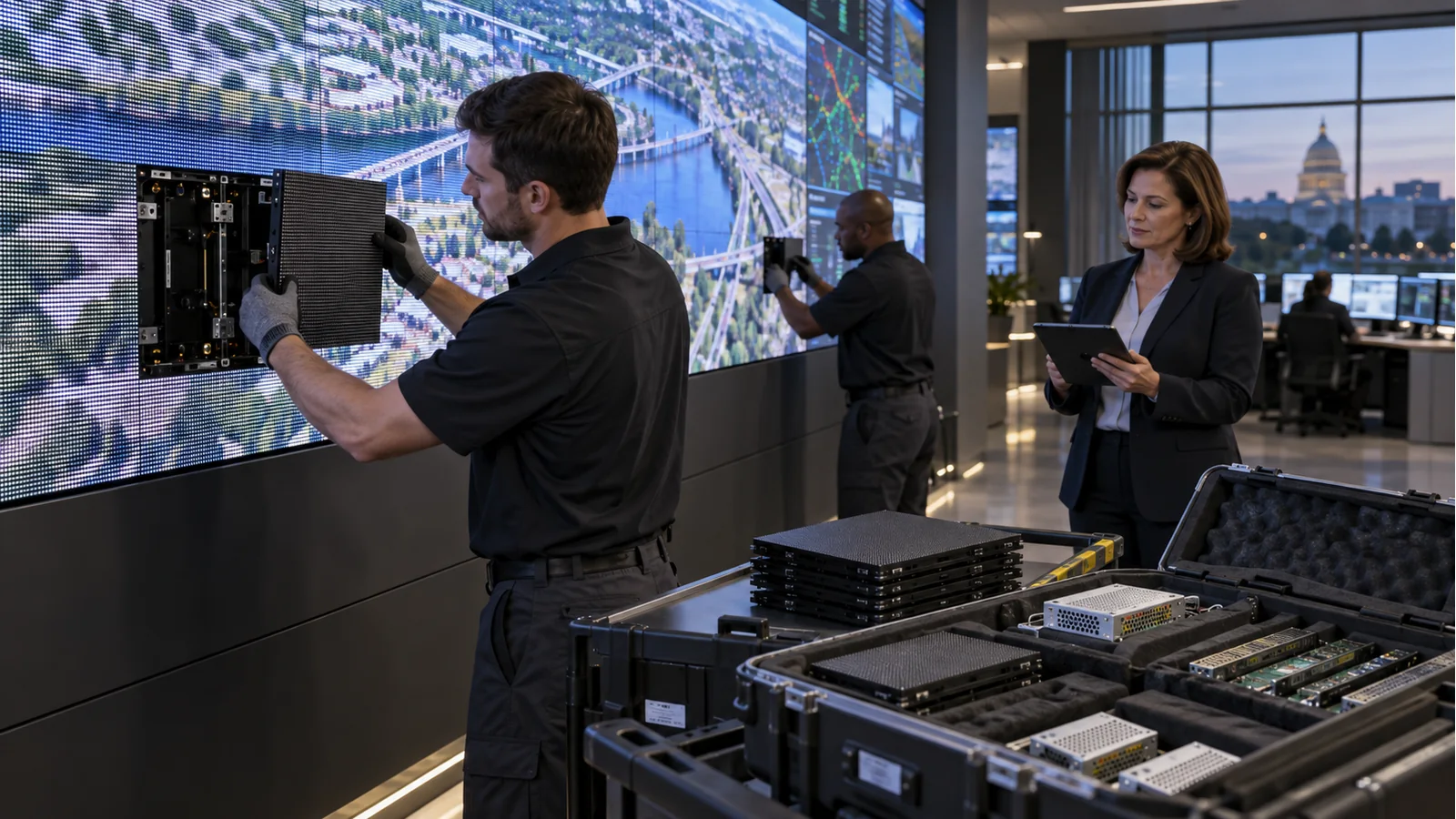
For large B2B projects, the supplier’s replacement-module strategy can matter almost as much as the initial failure rate. If a module needs replacement after several years, the new module should match the existing wall in brightness, color, and visual characteristics.
This is also where a manufacturer can provide more useful information than a reseller. A factory can explain which production stage controls a particular defect and how technicians diagnose the issue.
A TAA-compliant display that becomes difficult to maintain is still a poor B2B investment. Procurement compliance and lifecycle engineering must work together.
Does TAA Compliance Affect LED Video Wall Pricing?
TAA-related procurement requirements can influence supplier selection, manufacturing arrangements, documentation, logistics, and total project cost, so buyers should compare complete compliant solutions rather than unit prices alone.
TAA itself should not be treated as a universal surcharge added to every LED cabinet. The actual price impact depends on the project requirements, sourcing structure, supplier, manufacturing location, documentation needs, logistics, and contractual conditions.
| Cost Factor | Potential Impact |
|---|---|
| Manufacturing | May affect available production options |
| Documentation | Requires compliance verification |
| Components | May vary by project configuration |
| Logistics | Production and shipping location affect landed cost |
| Installation | Project requirements affect labor costs |
| Service | Warranty and spare parts affect lifecycle cost |
TAA Compliance and Initial Purchase Cost
The initial LED display price can change when a project imposes additional sourcing or documentation requirements, but buyers should not assume that every TAA-sensitive project automatically costs more.
The biggest commercial difference often comes from the supplier options available to the project.
If a project has strict procurement conditions, the buyer may have fewer eligible suppliers or product configurations to compare. That reduced sourcing flexibility can affect negotiation.
However, buyers should compare the actual bill of materials and technical requirements first. A higher quotation may include a different pixel pitch, brighter LEDs, more sophisticated processing, redundant power supplies, or additional spare modules.
This creates a common B2B comparison mistake: buyers sometimes attribute the entire price difference to TAA when the two quotations do not describe equivalent products.
A proper comparison should normalize:
- Pixel pitch.
- Screen area.
- Brightness.
- Refresh rate.
- Cabinet dimensions.
- Controller.
- Power supply.
- Spare parts.
- Warranty.
- Installation scope.
- Documentation.
Compliance Documentation Costs
Documentation creates administrative work, but the cost should be evaluated against the financial risk of unclear procurement eligibility.
A supplier may need to prepare country-of-origin statements, manufacturing information, product identification, technical documentation, and project-specific declarations.
The actual documentation cost may be small compared with the value of a large LED video wall project. The bigger issue is whether the supplier can produce consistent documentation before the purchase order.
From our factory perspective, model-specific records reduce this risk. When production records, inspection records, product configuration, and shipment information connect to the same model, the supplier can answer buyer questions faster.
For a B2B buyer, that capability has practical value because procurement teams often need to coordinate information among the end customer, contractor, integrator, and manufacturer.
Logistics and Delivery Costs
Manufacturing location can affect freight, lead time, customs handling, and installation scheduling, so buyers should evaluate landed cost instead of factory price alone.
An LED video wall quotation should clarify whether the price includes only the display equipment or also packaging, freight, insurance, customs-related charges, installation, commissioning, and local service.
Large LED projects can involve hundreds of cabinets. Packaging volume and cabinet weight can therefore influence logistics costs.
Lead time also matters. A supplier that needs additional production or documentation steps may require more project planning.
We recommend that buyers ask for:
- Production lead time.
- Shipping method.
- Estimated transit time.
- Packaging method.
- Spare-parts shipment plan.
- Installation schedule.
- Documentation delivery schedule.
A lower unit price does not create savings if delayed equipment pushes the installation beyond the contractor’s planned schedule.
Warranty and Spare Parts Costs
The purchase price should include a realistic plan for warranty service and replacement components.
A large LED video wall can remain in service for years. The buyer should therefore ask how the supplier will handle failed modules, power supplies, receiving cards, cables, and other replaceable components.
A sensible spare-parts plan should consider:
- Number of LED modules.
- Power supplies.
- Receiving cards.
- Common cables.
- Critical control components.
- Expected maintenance period.
- Local technician capability.
The factory perspective matters because component continuity becomes harder as product generations change. Buyers should confirm the supplier’s spare-parts policy before the project starts, not after the first replacement is needed.
Total Cost of Ownership
TAA-sensitive procurement should compare total cost of ownership rather than the initial price per square meter.
A practical TCO model can include:
Purchase + Freight + Installation + Power + Maintenance + Spare Parts + Warranty Risk + Replacement Cost
This approach helps buyers compare suppliers on a common financial basis.
For example, a cheaper display may require rear access that the facility cannot provide. The project may then require additional structural work or longer maintenance downtime.
Another display may cost more initially but provide front-service modules, better documentation, planned spare parts, and a more suitable power architecture.
The right procurement decision is the solution that meets the compliance requirement while controlling technical risk and lifecycle cost—not simply the quotation with the lowest unit price.
How to Choose an LED Video Wall Supplier for a TAA-Sensitive Project?
A suitable supplier should demonstrate manufacturing transparency, compliance documentation capability, technical expertise, quality control, customization capability, and long-term project support.
TAA-related documentation should therefore become one part of a broader supplier evaluation. A supplier can provide a country-of-origin statement and still fail to meet the project’s technical requirements.
Conversely, a technically excellent LED manufacturer may not provide the documentation structure that a government contractor needs.
The best evaluation process combines both sides.
Compliance Documentation Capability
Choose a supplier that can identify the exact product and provide documentation that matches the project requirement.
The supplier should understand the difference between:
- Product specification.
- Country of origin.
- Manufacturing location.
- Technical certification.
- Procurement compliance.
- Contract-specific requirements.
This distinction reduces confusion during quotation review.
A strong supplier should also identify who signs or issues the relevant documentation and maintain consistency between the quotation, product model, production records, and shipment documents.
Manufacturing Transparency
Direct manufacturing capability can make technical communication and product traceability easier.
Buyers should determine whether the company actually controls production or simply resells products from multiple factories.
For an LED video wall, manufacturing control can affect:
- Module consistency.
- Cabinet tolerances.
- Calibration.
- Quality inspection.
- Product customization.
- Spare-parts planning.
- Production scheduling.
From the factory perspective, this matters during project changes. A B2B customer may request a custom cabinet size, front-maintenance structure, special brightness level, or unusual screen ratio.
A manufacturer with direct engineering and production coordination can evaluate those changes before production rather than forwarding every question to an unknown third party.
Quality Control Processes
Ask suppliers to explain measurable quality-control procedures rather than accepting generic claims such as “premium quality.”
A practical LED manufacturing quality process can include:
| Production Stage | Quality-Control Focus |
|---|---|
| Incoming Components | Component consistency |
| Module Assembly | Soldering and electrical integrity |
| Cabinet Assembly | Mechanical accuracy |
| Aging Test | Early defect detection |
| Calibration | Brightness and color uniformity |
| Final Inspection | Functional and visual inspection |
| Packing | Protection during transportation |
Factory experience also shows why quality control needs several checkpoints.
A dead pixel or intermittent electrical problem may originate from a component, solder joint, connector, driver circuit, or power path. Final inspection can identify the symptom, but upstream inspection helps identify the cause.
A supplier should be able to explain where defects are detected, how production teams record them, and how corrective actions reach the manufacturing line.
Technical Customization Capability
Government and commercial B2B projects rarely need a generic LED wall without modification.
The project may require a specific pixel pitch, cabinet size, brightness range, maintenance method, mounting structure, signal-processing configuration, or spare-parts package.
A supplier should therefore evaluate the application before recommending a model.
For example, a control room may prioritize close viewing, low brightness, fine pixel pitch, and long operating hours. A public lobby may prioritize viewing angles, content visibility, serviceability, and structural integration.
The correct configuration comes from the application, not from the product with the longest specification sheet.
Spare Parts and Service Support
A supplier should define the spare-parts strategy before the LED video wall enters production.
The buyer should clarify:
- Recommended spare-module quantity.
- Spare power supplies.
- Receiving cards.
- Common cables.
- Replacement procedure.
- Warranty response.
- Remote technical support.
- Availability period for critical components.
This issue deserves attention because LED video walls can remain operational for many years.
A manufacturer may launch a newer product generation during the project’s lifecycle. If the supplier cannot support the original configuration, a future module replacement may require additional calibration or configuration work.
A good spare-parts plan protects visual consistency as well as uptime.
International B2B Project Experience
International project experience matters when a supplier must coordinate technical specifications, production, documentation, packaging, shipping, installation support, and after-sales communication across different organizations.
Government-related projects can involve several parties:
- End customer.
- General contractor.
- AV integrator.
- Electrical contractor.
- Procurement team.
- LED manufacturer.
- Installation team.
The manufacturer should understand how technical information moves between these parties.
A clear approval process can prevent problems such as incorrect cabinet dimensions, incompatible signal systems, missing spare parts, or unapproved product substitutions.
For NSELED, this is where the factory and B2B roles meet. Our value should not stop at manufacturing the cabinets; the manufacturer should help the buyer convert a project requirement into a buildable and documented LED display solution.
Procurement Specification Support
The strongest LED supplier can help the buyer turn project requirements into a clear RFQ instead of simply sending a product catalog.
Before requesting a quotation, buyers should prepare the following:
TAA Compliant LED Video Wall FAQs
Does every U.S. government LED video wall purchase require TAA compliance?
No. The applicable solicitation, agency rules, acquisition value, contract clauses, and product category determine the requirement. Buyers should confirm the governing procurement documents before limiting suppliers.
Can an LED video wall use components from multiple countries and still qualify?
Potentially. Component origin and finished-product origin are not always the same analysis. Eligibility depends on the applicable procurement rule and the manufacturing facts for the exact offered product.
What documentation should a buyer request from an LED video wall supplier?
Request a written statement tied to the exact model and configuration, identifying the manufacturer, manufacturing location, declared country of origin, relevant production records, and any project-specific limitations.
Conclusion
A TAA compliant LED video wall should be evaluated as a procurement requirement, not simply as a product label. Buyers should verify the applicable contract requirement, country of origin, manufacturing location, exact product configuration, and supporting documentation before placing an order. They should then evaluate pixel pitch, brightness, refresh rate, power consumption, maintenance access, spare parts, and lifecycle cost to confirm that the display fits the actual project.
As a B2B buyer, your next step should be practical: review the project documents, confirm every applicable TAA and country-of-origin requirement, then send the same technical RFQ to qualified suppliers. Compare their responses based on compliance documentation, manufacturing transparency, technical specifications, warranty, spare-parts planning, and total project cost rather than comparing price per square meter alone.
If you are planning a TAA-sensitive LED video wall project, NSELED can provide more than a display quotation. We can help you evaluate viewing distance, pixel pitch, brightness, maintenance access, power requirements, cabinet configuration, customization, and project documentation to build a solution that fits your application and procurement process. Contact NSELED through nseledcloud.com to discuss your project requirements and customized LED display solution.