


Digital signage is no longer a simple display tool. It is becoming an AI-driven, cloud-connected visual communication infrastructure that supports real-time content delivery across global markets.
Many B2B buyers still evaluate LED displays using outdated logic. They focus on resolution, brightness, or price alone, but ignore system-level engineering factors such as thermal load distribution, driver IC stability, and long-term calibration drift. In real factory experience, these hidden variables often determine whether a project performs consistently for 3 years or fails within 12–18 months.
At NSELED, we have seen that most long-term failures do not come from “bad screens,” but from wrong system matching. This article breaks down the top 4 digital signage display trends in 2026 using a manufacturing and engineering lens. You will understand not only what is changing, but also why these changes directly affect your procurement risk, ROI, and system reliability.
Quick Answer
The top 4 digital signage display trends in 2026 are ultra-fine pixel pitch LED displays, AI-powered content optimization, cloud-based CMS platforms, and interactive digital signage experiences.
These trends are not independent innovations. They form a system-level transformation where LED hardware, software intelligence, and network infrastructure converge. From a factory perspective, each trend increases system complexity, especially in power management, heat dissipation, and signal synchronization.
For buyers, this means one critical shift: you are no longer buying a screen—you are buying a full visual computing system.

What Is a Digital Signage Display System?
A digital signage display system is an integrated solution combining LED display hardware, control systems, and content management software into a synchronized communication platform.
Unlike traditional display products, modern digital signage operates as a distributed system. Each cabinet functions as an independent processing unit while remaining synchronized across the full display wall. This architecture improves scalability but also introduces engineering risks such as latency drift, thermal imbalance, and signal desynchronization.
Beyond Screens: A Complete Visual Communication Infrastructure
In modern deployments, LED displays behave like a lightweight computing cluster. Each module receives data, processes grayscale signals, and renders output in real time.
From factory testing experience, we observe a critical pattern:
Small instability at component level becomes amplified at system scale.
For example:
- A 2% voltage drop in one power loop may not be visible on a single cabinet
- But in a 20-cabinet LED wall, it creates noticeable brightness inconsistency
This is why professional LED systems require full-load aging tests, typically 72–96 hours under continuous high-brightness operation, to simulate real-world stress conditions.
Core Components of a Digital Signage System
A complete system includes:
- LED modules (pixel-level light emission units)
- Driver ICs (grayscale and refresh control)
- Power supply systems (voltage stability control)
- Receiving/sending cards (signal distribution)
- CMS software platform (content scheduling and management)
Each component affects system reliability. For example, driver ICs with poor current compensation may show acceptable performance in static content but fail under high-refresh dynamic video scenarios such as sports broadcasting or retail advertising loops.
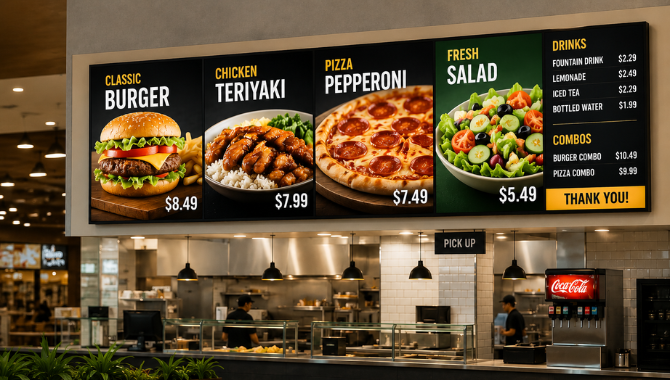
LED vs Traditional Display Technologies
LCD, LED, and projection systems differ not only in visual output but also in engineering behavior under long-term operation.
LED displays dominate large-scale applications because they scale modularly and maintain brightness in high ambient light environments. However, they also require more advanced thermal and electrical design.
LED vs LCD vs Projection Systems
| Technology | Strength | Limitation |
| LED Display | High brightness, seamless scaling, outdoor-ready | Higher engineering complexity and cost |
| LCD Display | Stable indoor performance, low cost | Limited size scalability, bezels visible |
| Projection | Flexible setup, lower upfront cost | Poor brightness in daylight environments |
LED systems maintain 5,000–10,000 nits depending on configuration, making them suitable for outdoor advertising and large indoor venues with strong ambient lighting.
LCD systems typically peak at 700–1,000 nits, which limits their usability in bright environments.
Brightness, Image Quality, and Maintenance Differences
Brightness stability is not only a specification issue—it is a degradation process.
In LED systems, brightness deviation greater than 10% across modules becomes visible in uniform backgrounds. This usually occurs after long-term operation if thermal balance is not properly designed.
Projection systems degrade due to light source aging, while LCD panels suffer from backlight unevenness over time.
LED has a structural advantage: module-level replacement, which reduces downtime and allows partial maintenance instead of full-system replacement.

Trend 1 — Ultra-Fine Pixel Pitch & High-Resolution LED Displays
Ultra-fine pixel pitch LED displays are rapidly becoming the standard for premium indoor applications such as corporate boardrooms, broadcast studios, luxury retail stores, and simulation environments.
However, the industry is also facing a hidden problem: over-specification driven by marketing rather than real viewing needs.
Why Demand for Fine Pixel Pitch Is Increasing
Pixel pitch below P1.5 is increasingly adopted in high-end indoor environments due to demand for sharper visuals and closer viewing distances.
According to TrendForce LED Display Market Reports (https://www.trendforce.com), fine-pitch LED demand continues to grow due to corporate digital transformation and hybrid meeting environments.
But from a manufacturing standpoint, smaller pixel pitch introduces exponential engineering complexity:
- LED density increases significantly
- Heat per square meter rises sharply
- Power consumption becomes more concentrated
- Yield rate decreases during mass production
This directly impacts system stability and long-term reliability.
COB, MIP, and Micro LED Technology Trends
COB (Chip on Board) technology improves protection by encapsulating LED chips directly on the substrate. It improves durability and reduces dead pixel risk.
MIP (Mini LED in Package) improves production efficiency and cost control, making it suitable for mid-to-high-end applications.
Micro LED represents the next-generation display architecture, offering self-emissive micro-scale pixels. However, current mass production is limited by yield instability and extremely high cost per square meter.
Factory Insight: When High Resolution Becomes Waste
We regularly advise clients not to use ultra-fine pitch such as P1.2 or below for viewing distances beyond 3–4 meters.
At that range, human visual perception cannot differentiate additional pixel density. However, cost increases significantly due to higher LED density and stricter production tolerances.
In real projects, this can lead to 30–60% unnecessary budget waste without visible improvement in image quality.
Trend 2 — AI-Powered Content Optimization in Digital Signage
AI is transforming digital signage from a static playback system into a dynamic decision-making platform.
This shift is not purely software-driven. It directly changes hardware requirements, especially in refresh rate stability, signal processing speed, and synchronization accuracy across multi-screen environments.
How AI Is Changing Digital Display Content Delivery
Modern AI systems adjust content in real time based on:
- Audience density
- Time of day
- Environmental brightness
- Behavioral tracking data
This requires LED systems to maintain stable frame output even under frequent content switching.
If system latency exceeds 200–300ms, synchronization errors become visible across large video walls, especially in multi-cabinet installations.
Real-Time Audience Data and Dynamic Advertising
Retail environments now use AI vision systems to analyze customer dwell time, attention zones, and engagement behavior.
This data is fed into content engines that dynamically adjust advertising content.
However, this increases system load significantly. Without optimized CMS architecture, LED receiving systems may experience frame drops or delayed refresh cycles.
Factory Insight: IC Stability Defines AI Performance
Many buyers assume AI performance depends only on software platforms. In reality, LED driver IC stability is the limiting factor.
We test IC performance under continuous grayscale switching conditions to simulate AI-driven dynamic content updates.
Poor IC design leads to:
- Flickering under high-frequency updates
- Uneven grayscale rendering
- Frame inconsistency across cabinets
This is why hardware selection is as important as software integration in AI signage systems.
Trend 3 — Cloud-Based Digital Signage Systems
Cloud-based CMS platforms are replacing traditional local control systems due to scalability and operational efficiency.
This transformation is especially important for global enterprises managing multi-country display networks.
Evolution from Local Control to Cloud CMS Platforms
Traditional systems required USB or LAN-based updates. This model is inefficient for large-scale deployment.
Cloud CMS platforms now allow:
- Real-time content updates
- Centralized scheduling across thousands of screens
- Remote monitoring of system health
This reduces operational workload significantly, especially for retail chains and franchise businesses.
Remote Multi-Screen Management Benefits
Cloud systems improve operational efficiency by enabling:
- Centralized content control
- Cross-region synchronization
- Automated scheduling workflows
In large deployments, this can reduce operational cost by up to 50–70% compared to manual systems.
Factory Insight: Network Becomes the Weakest Link
In many real-world failures, LED hardware performs correctly, but network instability causes system-level issues.
We often observe:
- Content delay between cabinets
- Frame mismatch in video walls
- Interrupted playback in high-load environments
These problems are not hardware failures—they are network architecture limitations.
Trend 4 — Interactive Digital Signage Experiences
Interactive digital signage transforms displays from passive visual tools into active engagement systems.
This includes touch interaction, motion tracking, gesture recognition, and sensor-based content triggering.
From Passive Display to Customer Engagement Systems
Retailers increasingly deploy interactive LED walls to increase engagement time and conversion rates.
According to Deloitte insights on customer experience (https://www2.deloitte.com), interactive digital environments can increase engagement time by more than 30% compared to static displays.
This creates a direct impact on advertising effectiveness and brand recall.
Touch and Sensor-Based Applications in Retail and Events
Interactive LED systems are widely used in:
- Shopping malls
- Exhibition booths
- Museums
- Brand experience centers
However, touch functionality requires additional protective layers and controller integration, increasing system complexity.
Factory Insight: Mechanical Stress is Often Ignored
Interactive systems experience repeated physical impact cycles.
Without reinforced cabinet structures, micro-vibration stress accumulates over time, potentially causing:
- Surface deformation
- Module misalignment
- Reduced lifespan in high-traffic environments
This is a common failure mode that buyers often underestimate during procurement.

Key Factors to Consider Before Buying
Choosing a digital signage system requires evaluating long-term operational behavior, not just initial specifications, because factors such as heat dissipation efficiency, driver IC stability, and maintenance accessibility directly determine system reliability and total cost over years of continuous operation.
Pixel Pitch and Viewing Distance
Pixel pitch must align with real viewing distance to ensure optimal visual clarity under actual usage conditions. Over-specification increases cost without improving perceived image quality, because beyond a certain viewing distance threshold, the human eye cannot distinguish additional pixel density, making the extra investment inefficient from both a performance and ROI perspective.
Brightness and Installation Environment
Outdoor environments require 5,000–10,000 nits depending on sunlight exposure to maintain visibility under direct daylight conditions and varying weather conditions. Indoor environments require controlled brightness levels, typically much lower, to avoid visual fatigue, reduce eye strain during long viewing periods, and ensure comfortable audience engagement in enclosed spaces such as retail stores, conference rooms, and exhibitions.
System Compatibility and Control Platform
Closed CMS systems limit future scalability because they restrict third-party integration, reduce flexibility in content management, and often lock users into a single vendor ecosystem. Open architecture systems, on the other hand, allow easier integration with AI tools, cloud platforms, and external data sources, making them more adaptable for long-term upgrades and multi-location digital signage expansion strategies.

Conclusion
Digital signage is more than just display specifications. Real performance depends on balancing pixel pitch, viewing distance, brightness, and system design based on actual application needs. For most commercial projects, a properly engineered LED system delivers better ROI and long-term efficiency than over-designed configurations with unnecessary ultra-fine pitch or advanced features.
If you are planning a commercial signage or large-scale LED display project, working with an experienced manufacturer can help you avoid costly specification mistakes. At NSELED, we provide complete system support, including pixel pitch selection, IC matching, thermal management, and structural design. Contact us today for a professional consultation and customized project quotation.
FAQ
What are the latest digital signage display trends in 2026?
The main trends include ultra-fine pixel pitch LED displays, AI-powered content optimization, cloud-based CMS platforms, and interactive digital signage systems.
What is the best LED display technology for digital signage?
COB and MIP technologies are preferred for high-resolution indoor environments due to better protection and efficiency, while SMD LED remains widely used for large-scale outdoor advertising due to cost and brightness advantages.