


Touch LED panels are transforming how businesses deliver interactive visual experiences.
Many companies still rely on traditional displays that only broadcast content. As customer expectations rise, passive screens struggle to capture attention or drive engagement. According to Statista, digital interaction and immersive experiences continue to grow across retail and commercial environments, making static displays less effective in competitive spaces.
This guide will help you understand what touch LED panels are, how they work, and how to choose the right solution. By the end, you will have a clear framework to evaluate interactive LED displays for your next project.

What Are Touch LED Panels?
Touch LED panels are advanced display systems that combine LED screen technology with touch interaction, allowing users to control and engage with digital content directly.
Unlike traditional LED displays that only show visuals, touch LED panels respond to gestures such as tapping, swiping, and multi-touch input. This transforms a standard screen into an interactive communication tool, widely used in modern commercial environments.
Interactive Touch LED Display Panels
Interactive touch LED display panels are large-format LED screens integrated with touch technologies such as infrared (IR) or capacitive sensing.
These panels support real-time interaction and often allow multiple users to engage with content at the same time. You will commonly see them in retail stores, exhibitions, and corporate showrooms where engagement is critical.
Key features include:
• Seamless large-size display through modular design
• Multi-touch capability for interactive experiences
• High brightness suitable for indoor and semi-outdoor use
• Compatibility with interactive software systems
These panels represent the core solution for B2B projects that require both display and interaction.
Touch LED Light Panels
Touch LED light panels are touch-responsive lighting products designed for decoration rather than content display.
They allow users to change colors or lighting effects through touch, but they do not support video playback or interactive digital content. These panels are typically used in home decoration or ambient lighting setups.
Key features include:
• Small modular lighting units
• Limited touch interaction (basic control only)
• No display or content system
• Focus on visual ambiance rather than communication
For commercial projects, it is important not to confuse these products with interactive LED display panels, as their functions and value are completely different.

How Do Touch LED Panels Work?
Touch LED panels work by combining LED display technology with touch sensing systems, enabling users to interact directly with visual content in real time.
The display shows images and videos, while the touch layer detects user input and sends signals to a control system. The system then processes the input and updates the content instantly. This seamless integration creates an interactive experience instead of passive viewing.
LED Display Technology Basics
At the core of every touch LED panel is a standard LED display made up of tiny light-emitting diodes (LEDs). These LEDs form pixels that produce images, colors, and brightness.
Each pixel typically includes red, green, and blue (RGB) diodes, which combine to create full-color visuals. The distance between pixels, known as pixel pitch, determines the resolution and viewing clarity.
According to Energy.gov, LEDs are highly efficient light sources, offering better brightness and energy performance compared to traditional display technologies.
This makes LED displays ideal for commercial environments where visibility and durability are essential.
Touch Sensing Technologies
Touch LED panels rely on different sensing technologies to detect user interaction. The most common types include infrared (IR) and capacitive touch systems.
Here is a simple comparison:
| Technology | How It Works | Best For |
| Infrared (IR) | Uses invisible light beams to detect touch points | Large screens, multi-user interaction |
| Capacitive | Detects electrical changes when a finger touches the surface | High precision, smooth interaction |
Infrared touch is widely used in large LED video walls because it scales easily and supports multiple users. Capacitive touch, on the other hand, offers higher accuracy but is more common in smaller or high-end applications.
Choosing the right touch technology depends on your project size, interaction needs, and budget.
Interaction Workflow
The interaction process in a touch LED panel follows a simple but efficient workflow:
- A user touches the screen surface
- The touch sensor detects the position of the input
- The system converts the touch into a digital signal
- The control software processes the input
- The display updates content in real time
This entire process happens within milliseconds, creating a smooth and responsive user experience.
As a result, touch LED panels enable real-time engagement, which is critical for applications like retail interaction, exhibitions, and data visualization.
Types of Touch LED Panels for Different Commercial Needs
Touch LED panels come in different formats, each designed to meet specific commercial goals and environments.
The right choice depends on factors such as installation space, interaction level, and project complexity. Understanding these types helps you match the technology with your business objectives more effectively.
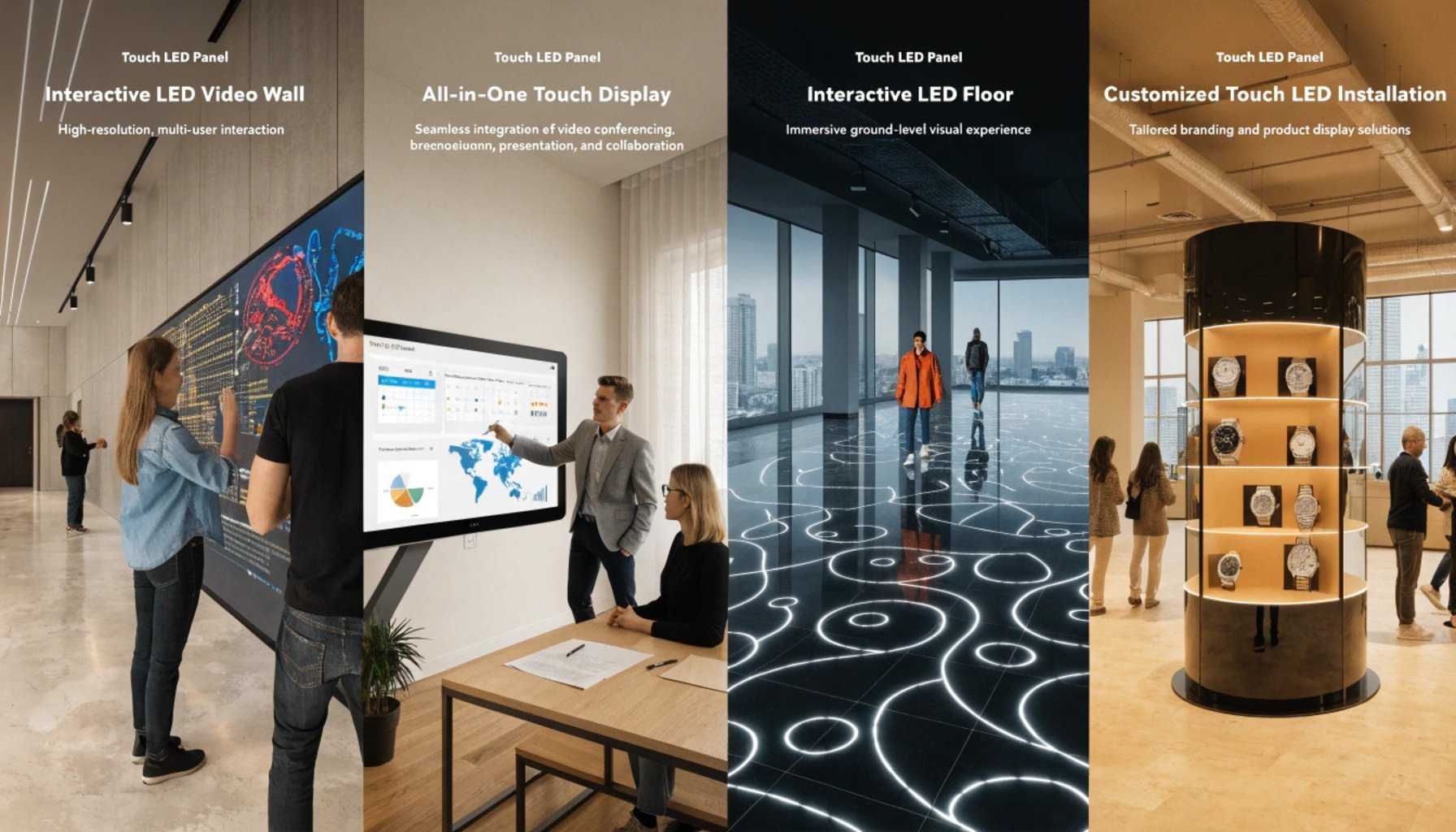
Interactive LED Video Walls
Interactive LED video walls are large-scale display systems created by combining multiple LED panels into one seamless screen with touch functionality.
These systems deliver strong visual impact and support multi-user interaction at the same time. Businesses often use them in exhibitions, brand showrooms, and control centers where both scale and engagement matter.
Because of their modular structure, video walls can expand to almost any size. They are ideal for projects that require high visibility and immersive interaction in high-traffic environments.
All-in-One Touch LED Displays
All-in-one touch LED displays integrate the display, touch system, and control unit into a single device. This design simplifies both installation and operation.
Companies commonly use these systems in meeting rooms, classrooms, and corporate environments where ease of use is a priority. Compared to video walls, they require less setup and technical expertise.
They are a practical choice for businesses that want reliable interaction without complex system integration.
Floor & Creative Interactive LED Panels
Floor and creative interactive LED panels focus on delivering unique and immersive experiences. These panels can be installed on floors, walls, or custom structures to create dynamic environments.
They respond to touch or movement, making them highly engaging for users. You will often find them in entertainment venues, museums, and experiential marketing spaces.
Their main value lies in attracting attention and encouraging participation through creative interaction.
Customized Touch LED Solutions
Customized touch LED solutions are designed to meet specific project requirements that standard products cannot address.
In many commercial projects, factors such as unusual installation spaces, brand identity, or special interaction features require tailored solutions. Customization allows businesses to align the display system with both technical and visual goals.
For large or design-driven projects, customized solutions often provide better long-term performance and flexibility.
Key Benefits of Touch LED Panels for Businesses
Touch LED panels provide a combination of visual impact and real-time interaction, helping businesses move beyond passive communication.
They allow companies to engage users directly, deliver dynamic content, and create memorable experiences. For commercial environments, this often translates into higher engagement, stronger branding, and improved business outcomes.
Stronger Customer Engagement
Touch LED panels turn viewers into active participants. Instead of just watching content, users can interact with it through touch, gestures, or movement.
This interaction naturally captures attention and encourages deeper involvement. In retail or exhibition environments, this can significantly improve how customers connect with products or brand messages.
Interactive experiences are proven to increase user engagement compared to static displays, making them a valuable tool for modern marketing.
Increased Dwell Time and Conversion
When users interact with a display, they tend to spend more time engaging with the content. This increased dwell time creates more opportunities to influence decision-making.
According to National Retail Federation, immersive and interactive technologies can improve in-store engagement and positively impact purchase behavior.
Longer engagement often leads to higher conversion rates, especially in retail and exhibition settings.
Flexible Content and Real-Time Interaction
Touch LED panels allow businesses to update and control content instantly. This flexibility makes it easy to adapt messaging based on campaigns, events, or user behavior.
You can integrate these systems with content management platforms or interactive software to deliver personalized experiences. For example, users can browse products, access information, or trigger animations in real time.
This level of flexibility ensures that your content stays relevant and responsive to your audience.
Enhanced Brand Image
Using touch LED panels helps position your brand as innovative and forward-thinking. Interactive displays create a modern, high-tech impression that stands out in competitive markets.
In environments like showrooms or trade shows, this visual and interactive appeal can significantly enhance brand perception. It also signals that your business invests in advanced technology and customer experience.
A strong visual presence combined with interactivity can elevate brand identity and leave a lasting impression on customers.
Key Applications of Touch LED Panels
Touch LED panels are widely used across commercial environments where interaction, engagement, and visual impact are critical.
Businesses adopt these solutions to improve customer experience, deliver information more effectively, and differentiate their spaces. The ability to combine display and interaction makes them suitable for a wide range of industries.
- Retail Stores and Brand Showrooms
- Exhibitions and Trade Shows
- Corporate and Control Environments
- Entertainment and Immersive Spaces

How to Choose the Right Touch LED Panel for Your Project?
Choosing the right touch LED panel requires aligning technical specifications with your project goals, environment, and user experience expectations.
There is no one-size-fits-all solution. You need to evaluate several key factors to ensure the system delivers both performance and long-term value. A well-informed decision can reduce costs, improve reliability, and maximize return on investment.
Define Your Application Scenario
Start by clearly defining where and how you will use the touch LED panel. The environment and purpose directly influence the type of solution you need.
For example, a retail showroom focuses on customer interaction and visual appeal, while a control room requires precision and data clarity. Indoor and outdoor environments also demand different brightness and protection levels.
You should consider factors such as space size, lighting conditions, user interaction level, and content type.
A clear application scenario helps you avoid over-specifying or under-specifying your system.
Choose the Right Touch Technology
Different touch technologies offer different levels of performance, scalability, and cost. The two most common options are infrared (IR) and capacitive touch.
Infrared touch works well for large screens and supports multi-user interaction, making it suitable for exhibitions and video walls. Capacitive touch offers higher precision and smoother interaction, which is often preferred for smaller or high-end applications.
Your choice should depend on screen size, number of users, and interaction requirements.
Selecting the right technology ensures a smooth and responsive user experience.
Consider Pixel Pitch and Viewing Distance
Pixel pitch determines the resolution and clarity of your display. A smaller pixel pitch provides higher resolution but comes at a higher cost.
You should match pixel pitch with the expected viewing distance. For close viewing, such as in retail or meeting rooms, a finer pixel pitch is necessary. For larger spaces where users view from a distance, a larger pixel pitch can be more cost-effective.
Here is a simple guideline:
| Viewing Distance | Recommended Pixel Pitch |
| < 2 meters | P1.2 – P1.9 |
| 2 – 5 meters | P2 – P3 |
| > 5 meters | P3 – P6 |
Choosing the right balance between clarity and cost is critical for project success.
Evaluate System Compatibility
A touch LED panel is not just hardware. It also involves software, control systems, and content integration.
You need to ensure the display works seamlessly with your existing systems, such as content management platforms, interactive software, or external devices. Compatibility issues can lead to delays and additional costs.
You should also consider future scalability. A flexible system allows you to upgrade or expand without replacing the entire setup.
Proper system integration improves efficiency and long-term usability.
Work with a Professional Manufacturer
Partnering with an experienced LED display manufacturer is one of the most important decisions in your project.
A professional supplier can provide technical guidance, customization options, and reliable after-sales support. This is especially important for complex or large-scale installations.
According to Deloitte, selecting the right technology partner plays a key role in the success of digital transformation projects.
Working with a qualified manufacturer helps ensure product quality, smooth implementation, and long-term performance.
Conclusion
Touch LED panels are transforming how businesses communicate, engage, and deliver experiences. By combining high-quality visual display with real-time interaction, they help companies move beyond static content and create more meaningful connections with users.
From retail and exhibitions to corporate and immersive environments, these solutions offer clear advantages in engagement, flexibility, and brand positioning.
If you are planning an interactive display project, choosing the right solution and partner is critical. NSELED provides customized touch LED panel solutions designed for commercial applications worldwide.