


Introduction
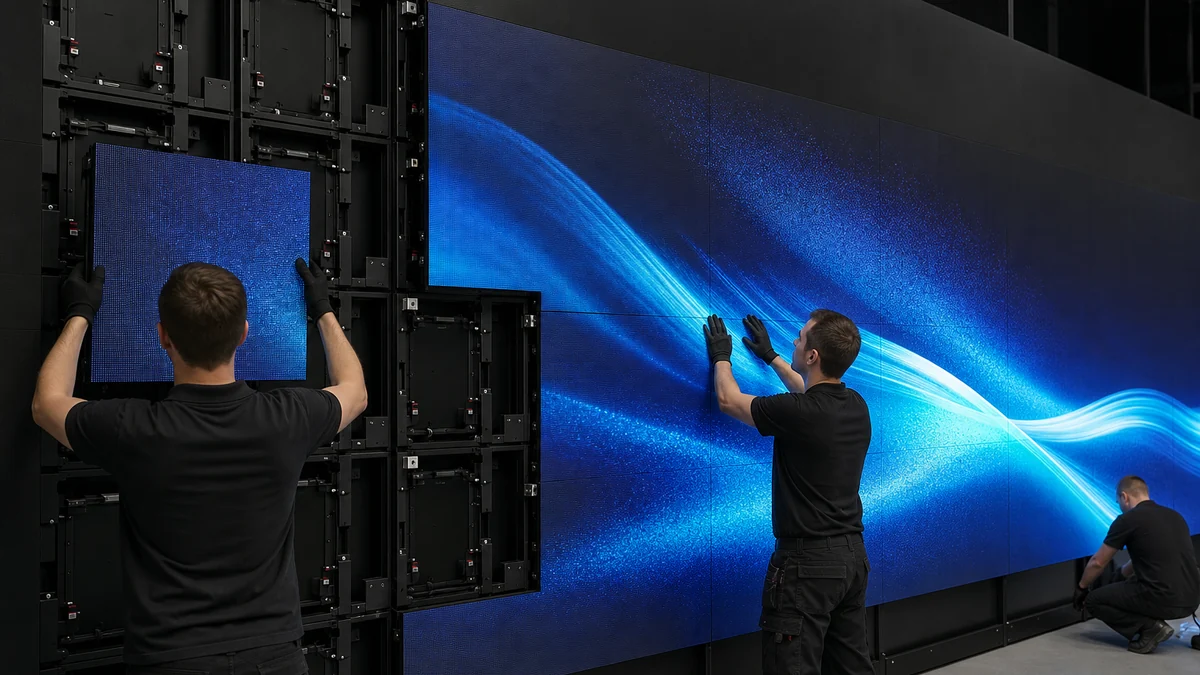
A modular LED screen uses replaceable LED modules and cabinets to build large digital displays.
Businesses choose modular LED displays because they can scale screen dimensions, replace damaged components, and adapt the display structure to different projects. However, buyers still face difficult choices around pixel pitch, cabinet design, brightness, maintenance, component quality, and total project cost. A lower quotation does not always deliver lower ownership costs.
This guide explains how modular LED screens work, compares major types, and covers selection, installation, maintenance, pricing, and manufacturer evaluation so you can specify the right system with fewer costly mistakes.
What Is a Modular LED Screen?
A modular LED screen is a large-format display assembled from multiple smaller LED modules and cabinets that work together as one video display. This architecture allows manufacturers to configure different screen sizes while technicians can replace individual modules or components instead of removing the entire display.
Definition and Working Principle
A modular LED screen creates images by controlling thousands or millions of individual RGB LED pixels. Each pixel contains red, green, and blue LED elements that combine at different brightness levels to produce colors and images.
The screen uses a modular structure rather than one continuous display surface. An LED module contains a defined pixel matrix, while several modules normally form a cabinet. Multiple cabinets then form the complete LED wall.
The basic signal path looks like this:
Video source → video processor/controller → receiving card → LED modules → visible image
This structure gives modular LED displays an important practical advantage. A technician can usually isolate a faulty section instead of replacing the complete screen.
The actual design varies by product. Indoor fine-pitch displays may use compact cabinets and front-service modules. Outdoor displays normally require stronger mechanical structures, higher brightness, and environmental protection.
LED Modules, Cabinets, and Control Systems
The LED module represents the basic display unit, but the cabinet provides the mechanical and electrical framework that connects several modules.
A typical modular LED display includes:
- LED modules
- PCB boards
- Driving ICs
- Receiving cards
- Power supplies
- LED cabinets
- Signal cables
- Power cables
- Video processor or controller
- Mounting structure
The receiving card distributes image data to specific modules. The power supply converts incoming electrical power into the DC voltage required by the LED modules and electronics. Meanwhile, the cabinet keeps components aligned and provides the mechanical connection between display sections.
The cabinet is not just a box around the LED modules. Its dimensional accuracy affects screen flatness, cabinet alignment, installation time, and long-term maintenance.
Modular LED Screen vs. Traditional LED Display
The word “modular” describes the construction approach rather than a completely different LED technology.
A modular LED screen offers several advantages when a project requires a large or customized display. A buyer can combine cabinets to create different screen dimensions, while technicians can access individual components for service.
Compared with a fixed-size display product, modular construction usually provides more flexibility in:
| Factor | Modular LED Screen | Fixed-Format Display |
|---|---|---|
| Screen size | Highly configurable | More limited |
| Component replacement | Individual modules/components | Depends on design |
| Installation | Cabinet-based assembly | Product-specific |
| Custom shape | Often possible | Usually limited |
| Maintenance | Section-based | Product-dependent |
| Expansion | Possible with compatible systems | Often difficult |
However, modular construction does not automatically guarantee better quality. The quality of the LED package, PCB, driving system, cabinet structure, power supply, and calibration process still determines actual display performance.
Main Types of Modular LED Screens
Modular LED screens come in different configurations for indoor, outdoor, fixed, rental, fine-pitch, and creative applications. Buyers should classify them according to the environment, installation method, viewing distance, and maintenance requirements rather than choosing a type based only on appearance.
Indoor vs. Outdoor Modular LED Screens
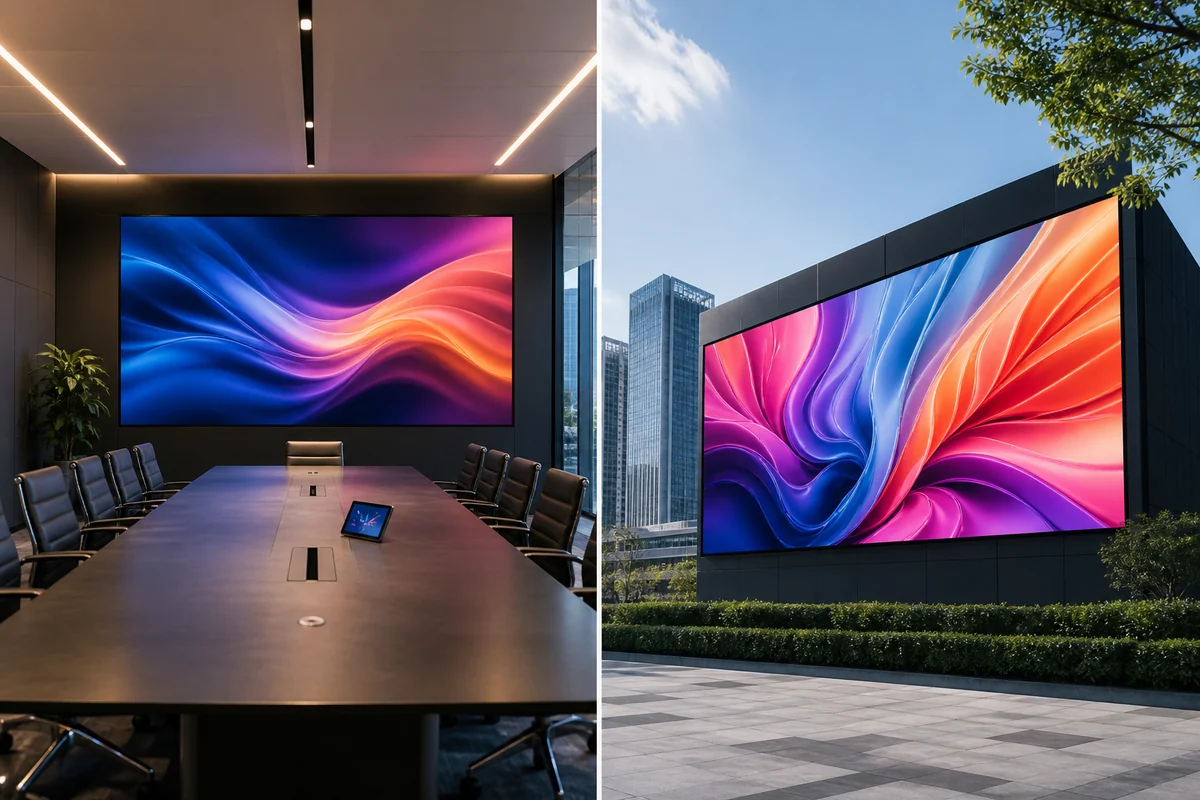
Indoor modular LED screens normally prioritize fine pixel pitch, close viewing distances, low operating noise, and compact cabinet structures.
Outdoor modular LED screens need to handle sunlight, rain, temperature changes, dust, and other environmental conditions. Their design therefore requires stronger protection and higher brightness.
For outdoor projects, buyers should check the actual enclosure protection specification instead of relying on terms such as “weatherproof.” IEC 60529 defines the IP Code used to classify protection provided by electrical equipment enclosures against conditions such as dust and water ingress. (IEC Webstore)
The correct choice depends on the installation environment. A fine-pitch indoor cabinet does not become an outdoor product simply because a supplier increases its brightness.
Fixed Installation vs. Rental LED Screens
Fixed-installation modular LED screens usually remain in one location for years. Manufacturers can optimize their cabinets, mounting structure, cabling, and maintenance method around the specific project.
Rental LED screens need a different priority. Event companies frequently assemble, dismantle, transport, and rebuild them. Therefore, cabinet weight, locking mechanisms, structural strength, cable connections, and setup speed become important.
A rental company should not select a fixed-installation cabinet simply because it has a lower purchase price. Frequent transportation can expose unsuitable cabinets to mechanical stress and increase maintenance requirements.
Fine-Pitch and Creative Modular LED Screens
Fine-pitch modular LED screens use smaller pixel spacing to increase pixel density. They suit applications where viewers stand relatively close to the display, such as boardrooms, broadcast environments, premium retail spaces, and control rooms.
Creative modular LED screens can use curved cabinets, flexible modules, irregular shapes, or special mounting structures. These products can support architectural and entertainment applications where a standard flat wall cannot achieve the required visual effect.
However, creative design adds engineering requirements. The manufacturer must consider cabinet geometry, module alignment, signal mapping, structural loading, and maintenance access.
Front-Maintenance vs. Rear-Maintenance Screens
Front-maintenance displays allow technicians to access modules and selected components from the front. This design helps when the display sits directly against a wall or when rear access remains limited.
Rear-maintenance designs provide access from the back of the display. They can simplify servicing when the installation includes sufficient maintenance space behind the screen.
Choose the maintenance method according to the installation site, not according to the product brochure alone. A low-profile display against a solid wall usually benefits from front access, while a freestanding structure may allow easier rear service.
Modular LED Screen Components and Key Specifications
A modular LED screen combines optical, electrical, mechanical, and control components. Buyers should evaluate these parts as one system because a strong LED module cannot compensate for poor power distribution, inadequate cooling, inaccurate cabinets, or weak control electronics.
LED Modules, PCB, and Driving IC
The LED module contains the LED pixels and the PCB that connects and controls them. The PCB carries electrical signals and power to the relevant components.
The driving IC controls pixel output and helps determine important display characteristics such as grayscale performance, refresh behavior, and image stability.
Manufacturers also select different LED packages according to application requirements. Outdoor screens often prioritize brightness and environmental durability, while fine-pitch indoor displays place greater emphasis on pixel density and close-range image quality.
Buyers should ask which LED package, PCB design, and driving IC the manufacturer uses instead of comparing only the pixel pitch.
Cabinet, Power Supply, and Cooling System
The cabinet provides the mechanical structure for the modules and electronics. Its material, dimensions, locking system, tolerances, and weight affect installation and maintenance.
The power supply must provide stable electrical output under the screen’s operating conditions. Engineers also need to consider heat because LED displays convert electrical energy into both light and heat.
Poor thermal management can accelerate component stress. Manufacturers therefore need to consider airflow, cabinet design, power distribution, operating environment, and thermal load during product development.
Brightness, Refresh Rate, and Viewing Angle
Brightness determines how clearly the screen remains visible under ambient lighting. Outdoor screens generally require substantially higher brightness than indoor screens because direct and indirect sunlight can reduce perceived contrast.
Refresh rate matters when the display appears on camera or when content contains rapid motion. A high refresh rate can reduce visible scanning artifacts and camera-related problems, but buyers should evaluate it together with the driving system and camera requirements.
Viewing angle describes how well viewers can see the image away from the central viewing position. The actual result depends on LED package characteristics, optical design, and display construction.
IP Rating, Power Consumption, and Maintenance
Outdoor buyers should evaluate IP protection based on the actual installation conditions. IEC 60529 provides the international framework for IP enclosure classification. (IEC Webstore)
Power consumption also affects operating costs. Buyers should distinguish between maximum power consumption and typical or average operating consumption, because actual energy use changes with image content, brightness settings, and control strategy.
Maintenance requirements also affect the total project value. A screen that costs less initially but requires extensive dismantling for basic service can become more expensive over its operating life.
How to Choose the Right Pixel Pitch
Pixel pitch represents the center-to-center distance between adjacent pixels, measured in millimeters. The correct pixel pitch depends primarily on viewing distance and application, not on the smallest available number.
Pixel Pitch and Viewing Distance
Smaller pixel pitch places more pixels into the same display area. This can improve image detail at close viewing distances, but it also increases component density and usually raises the product cost.
For example, a P2.5 display provides closer pixel spacing than a P5 display. If both displays have the same physical dimensions, the P2.5 version contains substantially more pixels.
A buyer should therefore begin with the expected viewing distance. A large outdoor advertising screen viewed from a long distance does not automatically need fine-pitch technology.
Image Quality and Application
Pixel pitch affects perceived image detail, but content type also matters.
A corporate meeting room may display presentations, spreadsheets, text, and detailed graphics. A stadium display may show scores, animations, and branded content viewed from much farther away.
For close-view applications, finer pixel pitch can produce a smoother image. For long-distance applications, larger pixel pitch can provide sufficient visual performance without unnecessary hardware cost.
We do not recommend selecting the smallest pixel pitch simply because it looks better on a specification sheet. If viewers remain far from the screen, the additional pixel density may provide little practical benefit.
Pixel Pitch and Project Cost
Smaller pixel pitch requires more pixels per square meter. That increase affects LED packages, driver channels, PCB design, data processing, and production cost.
A simple comparison helps explain the decision:
| Pixel Pitch | Typical Use | Main Advantage | Cost Consideration |
|---|---|---|---|
| P1.x–P2.x | Close-view indoor | Fine image detail | Higher |
| P2.5–P3.9 | Corporate, retail, events | Balance of detail and cost | Medium |
| P4–P6 | Larger indoor/outdoor | Longer viewing distance | Lower |
| P8+ | Large outdoor viewing distances | Cost-effective large format | Lower |
These ranges are practical categories rather than universal rules. The manufacturer should confirm pixel pitch after reviewing screen size, viewing distance, content, ambient light, and budget.
Benefits and Applications of Modular LED Screens
Modular LED screens combine configurable dimensions with replaceable components, making them suitable for projects that require large display areas, customized structures, or long-term serviceability.
Flexible and Scalable Screen Design
Cabinet-based construction allows manufacturers to create different screen widths and heights by combining compatible units.
A distributor can also standardize selected cabinet formats across several projects. This approach can simplify spare-parts management and technician training.
For custom projects, manufacturers can modify cabinet dimensions, module configuration, maintenance access, and structural solutions according to the site.
Easy Maintenance and Component Replacement
A modular architecture allows technicians to identify and replace specific components. A failed module does not necessarily require replacement of an entire cabinet or display wall.
However, easy maintenance depends on the actual product design. Front access, magnetic modules, cable organization, spare-part compatibility, and calibration procedures all influence service time.
A modular screen reduces maintenance complexity only when the manufacturer designs the service process into the product from the beginning.
Commercial, Corporate, Advertising, and Event Applications
Modular LED screens support many applications because manufacturers can adapt their configuration to different environments.
Common applications include:
- Retail stores and shopping malls
- Corporate meeting rooms
- Advertising displays
- Sports venues
- Stage and event production
- Transportation facilities
- Churches and large public venues
- Control rooms
- Exhibition spaces
The application should determine the product specification. For example, a boardroom requires different brightness and pixel-pitch priorities from an outdoor advertising screen.
Installation, Maintenance, and Reliability
A successful modular LED project starts with site planning rather than cabinet assembly. The installation structure, power system, viewing distance, maintenance access, and environmental conditions should be confirmed before production begins.
Site Assessment and Cabinet Installation
The project team should check wall strength, mounting points, power availability, ventilation, maintenance clearance, and cable routing.
Outdoor installations require additional attention to wind loads, water exposure, temperature, and structural engineering. The LED cabinet represents only part of the installation system.
After mounting, technicians need to align cabinets carefully. Small alignment errors can become visible across a large display wall.
Front and Rear Maintenance
Front maintenance reduces the need for rear service space. It can therefore help installations in tight environments.
Rear maintenance can provide easier access to some components when the screen has adequate clearance behind it.
Before purchasing, buyers should ask:
- Which components can technicians replace from the front?
- Which tools are required?
- How long does a typical module replacement take?
- Can replacement modules use the original calibration data?
- How will the manufacturer supply spare parts?
Calibration, Heat Management, and Dead Pixel Control

Calibration keeps brightness and color performance consistent across modules. A screen assembled from individually manufactured modules can show visible differences if the modules do not receive proper calibration.
Heat management also deserves attention. LED components, driving ICs, power supplies, and other electronics generate heat during operation. The manufacturer needs to manage that heat through appropriate electrical and mechanical design.
Dead pixel control begins during production. Manufacturers should screen components, test modules, age displays, and inspect finished cabinets before shipment.
A low dead-pixel rate should come from production control rather than from replacing defective modules after the customer receives the screen.
How Much Does a Modular LED Screen Cost?
The cost of a modular LED screen depends on pixel pitch, screen area, LED components, cabinet structure, brightness, control equipment, installation, and logistics rather than one universal price per square meter.
Main Factors Affecting Price
The most important pricing factors include:
- Pixel pitch
- Screen dimensions
- Indoor or outdoor construction
- LED package and component grade
- Cabinet material and design
- Brightness requirement
- Maintenance method
- Control system
- Mounting structure
- Installation
- Shipping and customs
A buyer should compare complete project costs rather than only the LED cabinet price.
Pixel Pitch, Screen Size, and Components
Pixel pitch has a direct relationship with pixel density. A smaller pitch requires more pixels within the same physical area.
Screen size also increases the quantity of modules, cabinets, power supplies, receiving cards, cables, and structural materials.
Component selection creates another major difference. Two screens with the same P2.5 specification can still use different LED packages, driving ICs, PCBs, power supplies, and cabinet structures.
A quotation becomes meaningful only when the buyer compares the technical configuration behind the price.
Installation, Control System, and Shipping Costs
The display itself represents only one part of the project budget. Buyers may also need a video processor, sending equipment, receiving cards, mounting structures, electrical work, installation labor, transportation, packaging, and commissioning.
International B2B buyers should also consider shipping dimensions and cabinet weight because logistics costs can change with the packaging configuration.
For this reason, a manufacturer should provide a project-based quotation instead of giving a price based only on square meters.
How to Choose a Modular LED Screen Manufacturer
The right manufacturer should provide more than a product catalog. You should evaluate production capability, quality control, engineering support, customization, spare parts, and after-sales service together.
Manufacturing Capability and Quality Control
A real manufacturer should be able to explain its production process and quality-control procedures.
Ask about:
- LED module production
- PCB assembly
- Cabinet manufacturing
- Aging tests
- Calibration
- Finished-screen testing
- Quality inspection
- Spare-parts management
A factory with stronger process control can usually provide more consistent modules across large orders.
Calibration, Aging Tests, and Component Quality
Ask the supplier how it controls brightness and color consistency between modules.
You should also ask whether the finished display undergoes aging or burn-in testing before shipment. The exact test process varies by manufacturer, so buyers should request documented procedures rather than accepting a generic “quality tested” statement.
Component traceability also matters for long-term projects. If a project needs replacement modules several years later, the manufacturer should have a clear method for maintaining compatibility.
OEM/ODM, Warranty, and After-Sales Support
OEM and ODM capability matters when distributors or integrators need custom cabinet sizes, branding, electrical configurations, or application-specific designs.
Warranty terms should define more than a period. Buyers should clarify what the warranty covers, how replacement parts are handled, who pays shipping, and how technical support works.
For international projects, after-sales support should be evaluated before the purchase, not after a failure occurs.
Factory Insight: What Determines Modular LED Screen Quality?
A modular LED screen’s long-term performance depends on component consistency, electrical design, mechanical accuracy, thermal management, calibration, and production testing. The specification sheet shows the target performance, but manufacturing controls determine whether the finished product can maintain that performance.
LED Packaging and Color Consistency
LED packages can vary in optical characteristics. Even small differences between batches can become visible when a large number of modules form one continuous wall.
Manufacturers therefore need to manage LED sourcing, batch consistency, module calibration, and replacement compatibility.
This becomes especially important for long-term projects. A replacement module that has noticeably different brightness or color characteristics can create a visible patch on the screen.
Driving IC, PCB, and Heat Management
The driving IC affects how the system controls individual pixels. The PCB determines electrical routing and contributes to signal and power distribution.
High operating loads also increase thermal requirements. Engineers need to consider component heat, cabinet ventilation, power-supply placement, ambient temperature, and continuous operating conditions.
A display should be evaluated as an electrical and thermal system rather than as a collection of LED lamps.
Cabinet Precision and Production Testing
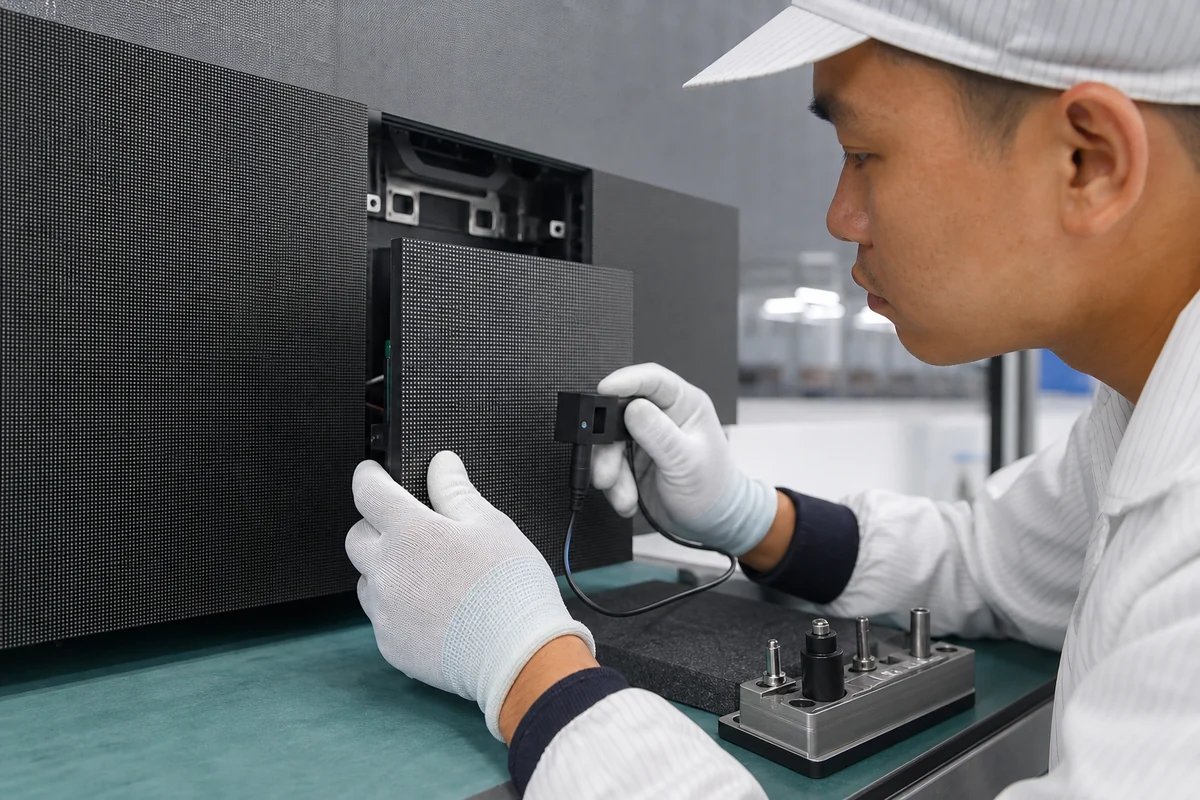
Cabinet dimensions and alignment affect the final flatness of the LED wall. Manufacturing tolerances become increasingly important as the display area grows.
Production testing should cover more than whether the screen can display an image. Manufacturers should inspect module uniformity, cabinet assembly, signal stability, power distribution, brightness, color consistency, and mechanical condition.
Common Buying Mistakes to Avoid
Many modular LED screen purchasing problems occur because buyers compare specifications without connecting them to the project environment.
Choosing Only by Price
The lowest quotation may use a different LED package, power supply, cabinet structure, control system, or warranty arrangement.
A better approach compares the complete technical bill of materials and service terms.
Ignoring Viewing Distance and Installation Conditions
A buyer who chooses pixel pitch without measuring viewing distance can spend too much or achieve insufficient image quality.
The same principle applies to brightness and IP protection. An indoor screen does not need the same environmental design as an outdoor display.
Comparing Quotations Without Checking Specifications
Two quotations can use the same pixel-pitch label while providing different hardware configurations.
Before comparing prices, confirm:
- LED package
- Driving IC
- Module size
- Cabinet dimensions
- Brightness
- Refresh rate
- IP rating
- Power supply
- Maintenance method
- Control system
- Warranty
- Spare-parts policy
Compare equivalent configurations first. Compare prices second.
FAQs About Modular LED Screens
What Is a Modular LED Screen?
A modular LED screen is a large LED display assembled from smaller LED modules and cabinets. The modular structure allows manufacturers to configure different screen sizes and gives technicians access to individual components for maintenance. The system normally combines LED modules, PCBs, driving ICs, power supplies, receiving cards, cabinets, cables, and a control system.
How Much Does a Modular LED Screen Cost?
Modular LED screen pricing varies according to pixel pitch, screen size, LED components, cabinet design, brightness, maintenance method, control equipment, installation, and shipping. Buyers should request a project-based quotation that specifies the complete hardware configuration instead of comparing a simple price per square meter.
Conclusion
A modular LED screen gives commercial buyers a flexible way to build large displays while keeping individual modules and components serviceable. The best configuration depends on viewing distance, application, environment, pixel pitch, cabinet design, maintenance access, and total project cost.
If you are planning a modular LED project, NSELED can help you evaluate the required pixel pitch, cabinet configuration, maintenance method, and technical specifications based on your application. Provide your screen size, viewing distance, installation environment, and target application to receive a project-specific modular LED screen solution and quotation.