


Introduction
Businesses today need more powerful visual communication tools to attract audiences, improve collaboration, and deliver information effectively. Traditional displays often fail to provide the brightness, flexibility, and immersive viewing experience required for modern commercial environments.
Large-scale digital display solutions such as LED video walls are becoming increasingly popular in corporate offices, retail stores, control rooms, entertainment venues, and public spaces. These systems provide seamless images, customizable sizes, and reliable operation for both indoor and outdoor applications.
Why Businesses Are Replacing Traditional Display Systems
Many organizations are replacing projection systems and LCD video walls because these technologies have limitations in brightness, size, maintenance, and visual consistency. Projection systems require controlled lighting conditions, while LCD video walls usually have visible bezels between panels that interrupt the viewing experience.
An LED video wall creates a seamless digital canvas by combining multiple LED modules into one large display surface. It delivers higher brightness, wider viewing angles, longer lifespan, and better adaptability for different environments.
From a manufacturer’s perspective, we have seen more companies focus not only on screen size but also on long-term operating costs. A well-designed LED video wall can reduce maintenance frequency, improve energy efficiency, and provide stable performance for many years.
This guide explains what an LED video wall is, how it works, its benefits, different types, applications, cost factors, and how buyers can select the right solution and manufacturer.
What Is an LED Video Wall?
Definition and Working Principle of an LED Video Wall
An LED video wall is a large-format digital display system made up of multiple LED cabinets or modules assembled together to create a single continuous screen. Unlike traditional displays that use backlight technology, LED video walls generate images directly through millions of tiny light-emitting diodes.
Each LED pixel contains red, green, and blue LED chips. By controlling the brightness of each individual LED chip, the system can produce millions of colors and display high-resolution images, videos, and real-time content.
From an LED factory perspective, the display performance depends heavily on the quality of every component, including LED chips, driving ICs, PCB design, power supplies, and calibration processes. A professional manufacturer must control these details during production to ensure consistent brightness and color performance after installation.
Main Components of an LED Video Wall System
A complete LED video wall is not simply a collection of LED panels. It is an integrated system that includes several hardware and software components working together.
LED Modules
LED modules are the basic display units containing LED chips, PCB boards, and electronic components. Multiple modules are installed into cabinets to form a larger display.
The quality of LED modules directly affects image uniformity, brightness consistency, and product lifespan.
During manufacturing, professional factories perform aging tests on LED modules to detect potential failures before shipment. This process helps reduce dead pixels and improve long-term reliability.
LED Cabinets
LED cabinets provide mechanical support and protect internal components. They also determine installation efficiency and maintenance methods.
Common cabinet materials include aluminum and die-cast aluminum because they provide lightweight construction and better heat dissipation.
For rental LED video walls, manufacturers usually design cabinets with quick-lock systems for faster installation and removal. Fixed installation displays often focus more on structural stability and protection.
Receiving Cards and Control Systems
Receiving cards control how image data reaches each LED module. They ensure synchronization between cabinets and maintain accurate image reproduction.
The control system determines important performance factors such as:
- Refresh rate
- Grayscale performance
- Signal stability
- Multi-screen management capability
High-quality control systems are especially important for applications such as broadcasting studios, command centers, and live events where image errors can create serious problems.
Power Supply System
LED video walls require stable power management because thousands or millions of LEDs operate simultaneously.
High-quality power supplies improve energy efficiency and reduce failure risks. Some professional LED video walls also support redundant power systems, allowing the display to continue operating even if one power unit fails.
At the factory level, power distribution design is an important factor that many buyers overlook. Poor power management can create uneven brightness, overheating, and higher maintenance costs.
Video Processor
A video processor manages input sources and optimizes content before it reaches the LED display.
Advanced processors support features such as:
- Multiple signal inputs
- 4K and 8K content processing
- Image scaling
- Picture-in-picture functions
- Real-time monitoring
For large LED video walls, the processor plays an important role in maintaining smooth image performance.
Key Benefits of LED Video Walls
Flexible Installation Options and Custom Designs

One of the biggest advantages of LED video walls is their flexibility. Unlike fixed-size LCD panels or projection screens, LED displays can be customized according to specific project requirements.
Businesses can create LED video walls in different shapes and sizes, including:
- Large rectangular displays
- Curved LED video walls
- Creative-shaped screens
- Corner installations
- Hanging LED structures
- Interactive LED solutions
This flexibility makes LED video walls suitable for applications ranging from corporate meeting rooms to large outdoor advertising displays.
For example, a luxury retail store may require a curved LED video wall behind a product showcase, while a control center may need a large flat display covering an entire monitoring wall.
Manufacturers with strong customization capability can adjust cabinet sizes, installation structures, brightness levels, and pixel pitches according to the project environment.
From a factory perspective, customization is not only about changing the screen size. It requires engineering experience in cabinet structure, signal distribution, thermal management, and installation safety.
LED Video Wall vs LCD Video Wall vs Projection
Businesses often compare LED video walls with LCD video walls and projection systems when planning large displays. Each technology has advantages, but LED video walls provide unique benefits for many commercial applications.
LED Video Wall vs LCD Video Wall
LCD video walls combine multiple LCD panels to create a larger display surface. They have been widely used in control rooms, retail spaces, and corporate environments.
However, LCD video walls have several limitations.
Visible Bezels
The biggest disadvantage of LCD video walls is the bezel gap between panels.
Even with narrow-bezel LCD panels, small lines remain visible. These interruptions can affect the viewing experience, especially for large images and video content.
LED video walls create a seamless surface because individual LED cabinets connect directly together without visible borders.
Limited Size Flexibility
LCD video walls usually follow fixed panel sizes. Expanding the display requires adding more panels according to manufacturer specifications.
LED video walls provide much greater customization. Manufacturers can build displays according to specific dimensions, aspect ratios, and architectural requirements.
Brightness Performance
LED video walls generally provide stronger brightness performance, especially for outdoor and large commercial environments.
LCD displays can experience reduced visibility under strong lighting conditions.
Maintenance
LCD panels often require replacing complete panels when failures occur.
LED video walls usually allow module-level maintenance, meaning technicians can replace only the damaged LED module instead of the entire display section.
From a factory perspective, modular maintenance design significantly reduces long-term service costs for large projects.
LED Video Wall vs Projection System
Projection systems have been widely used for meeting rooms, theaters, and event spaces. However, they have several limitations compared with LED technology.
Brightness Limitations
Projectors depend on reflected light. Strong ambient lighting can reduce image clarity.
LED video walls generate their own light, allowing them to maintain better visibility in bright environments.
Installation Restrictions
Projection systems require:
- Suitable projection distance
- Proper screen positioning
- Controlled lighting conditions
LED video walls offer more flexible installation options because they can be mounted directly on walls, structures, or custom frames.
Maintenance Requirements
Projectors require regular maintenance, including:
- Lamp replacement
- Lens cleaning
- Calibration
LED video walls typically require less frequent maintenance when manufactured and installed correctly.
For organizations that operate displays daily, LED technology often provides better reliability and lower total ownership costs.
Why Businesses Prefer LED Video Walls for Large Displays
More businesses are choosing LED video walls because they provide a combination of performance, flexibility, and long-term value.
Key advantages include:
Seamless Large-Scale Visual Experience
LED video walls can create extremely large displays without visible borders, making them ideal for immersive experiences.
Better Content Flexibility
Businesses can display:
- Videos
- Presentations
- Advertisements
- Live feeds
- Interactive content
Lower Long-Term Operating Costs
Although the initial LED video wall cost may be higher than some alternatives, the longer lifespan and lower maintenance requirements often make LED solutions more economical over time.
Custom Engineering Possibilities
Professional LED manufacturers can customize:
- Screen dimensions
- Pixel pitch
- Cabinet design
- Brightness level
- Installation structure
This capability allows businesses to create displays that match their specific environment rather than adapting their project around standard products.
How to Choose the Right LED Video Wall?
Selecting an LED video wall requires more than comparing prices. Buyers should evaluate technical specifications based on viewing conditions, application requirements, and future maintenance needs.
Pixel Pitch, Viewing Distance, and Screen Size Selection
Pixel pitch is one of the most important factors when choosing an LED video wall.
A smaller pixel pitch provides higher resolution but usually increases the product cost.
The correct choice depends on viewing distance.
General guidelines:
- Close viewing distance → smaller pixel pitch
- Medium viewing distance → medium pixel pitch
- Long viewing distance → larger pixel pitch
For example:
- Conference rooms may require P1.2–P2.5
- Retail advertising screens may use P2.5–P5
- Outdoor billboards may use P6–P10
Screen size also affects the required resolution. A large LED video wall viewed from a distance may not need extremely fine pixel pitch because the human eye naturally blends pixels together.
A professional manufacturer helps customers balance image quality and budget instead of automatically choosing the highest resolution.
LED Components, Calibration, and Long-Term Reliability
The quality of LED components directly affects display performance.
Important components include:
- LED chips
- Driving ICs
- PCB boards
- Power supplies
- Receiving cards
Different component choices can create significant differences in:
- Brightness consistency
- Color accuracy
- Failure rate
- Lifespan
Calibration is another critical factor.
During production, professional factories use brightness and color calibration systems to ensure every module performs consistently.
Without proper calibration, LED video walls may develop uneven brightness or color differences after installation.
Experienced manufacturers also monitor dead pixel rates during mass production. Strict quality control helps reduce problems after delivery and improves customer satisfaction.
Brightness, Refresh Rate, and Image Quality Requirements
When selecting an LED video wall, buyers often focus on pixel pitch and screen size. However, brightness, refresh rate, grayscale performance, and image processing capability also directly affect the viewing experience.
A professional LED video wall should not only display images clearly but also maintain stable performance under different operating conditions.
Brightness Requirements
Brightness determines how clearly viewers can see the content under different lighting environments.
The required brightness depends mainly on installation location:
- Indoor environments: Usually require around 600–1,500 nits
- Bright indoor spaces: May require 1,500–2,500 nits
- Outdoor applications: Usually require 4,000–8,000+ nits
A conference room LED video wall does not need the same brightness level as an outdoor advertising display. Excessive brightness in an indoor environment can reduce viewing comfort and increase unnecessary power consumption.
From a manufacturing perspective, professional LED factories adjust brightness according to application requirements rather than simply maximizing brightness. Higher brightness does not always mean better performance because it can increase heat generation and accelerate component aging.
Refresh Rate and Image Quality
Refresh rate refers to how many times per second the LED display updates the image.
A higher refresh rate improves:
- Motion smoothness
- Camera shooting performance
- Image stability
- Video quality
For normal commercial applications, a refresh rate of 1920Hz is often sufficient. Professional applications such as broadcasting studios, virtual production, and live events may require 3840Hz or higher.
A low refresh rate may create flickering effects when cameras record the screen, which can negatively affect professional video production.
Other image quality factors include:
Grayscale Performance
Grayscale determines how accurately the display reproduces different brightness levels.
High-quality LED video walls can show smoother transitions between dark and bright areas, improving image details.
Color Consistency
Color consistency ensures that every cabinet and module displays the same image quality.
Without proper calibration, large LED video walls may show visible differences between sections.
Image Processing Capability
Advanced video processors improve:
- Signal stability
- Scaling performance
- Multi-source management
- 4K/8K content compatibility
For large commercial projects, image processing quality is just as important as the LED modules themselves.
Maintenance Design, Energy Efficiency, and Heat Dissipation
A reliable LED video wall requires proper engineering beyond visual performance. Maintenance design, power management, and thermal control directly influence the total cost of ownership.
Maintenance Design
Maintenance requirements should be considered before installation because they affect future operating costs.
Common maintenance methods include:
Front Maintenance
Front maintenance allows technicians to remove LED modules from the display surface.
Advantages include:
- Suitable for wall-mounted installations
- Requires less installation space
- Faster module replacement
Rear Maintenance
Rear maintenance provides access from the back of the screen.
It is commonly used for:
- Large outdoor displays
- Stadium screens
- Advertising structures
Rear maintenance allows easier access to internal components but requires additional space behind the display.
A professional manufacturer helps customers choose the correct maintenance structure based on installation conditions.
Energy Efficiency
Energy consumption is an important consideration for large LED video wall projects.
The total power usage depends on:
- Screen size
- Pixel pitch
- Brightness level
- Operating hours
- LED efficiency
- Content type
Modern LED technology has improved significantly through:
- High-efficiency LED chips
- Energy-saving driving ICs
- Optimized power supply systems
- Intelligent brightness adjustment
For businesses operating large displays continuously, energy efficiency can create significant savings over the product lifecycle.
From a factory perspective, reducing power consumption is not only about selecting efficient components. Engineers must also optimize circuit design, cabinet structure, and thermal management.
Heat Dissipation
Heat management is one of the most important factors affecting LED video wall reliability.
LED displays generate heat during operation, especially high-brightness outdoor models.
Poor heat dissipation can cause:
- Reduced LED lifespan
- Component failures
- Brightness inconsistency
- Increased maintenance costs
Professional manufacturers use various approaches to improve thermal performance:
- Aluminum cabinet structures
- Optimized ventilation channels
- High-efficiency power supplies
- Temperature monitoring systems
During production, experienced LED factories evaluate heat distribution through testing to ensure stable operation under long working hours.
Popular Applications of LED Video Walls
LED video walls are widely used across different industries because they provide large-scale, high-impact visual communication.
The best solution depends on the environment, audience distance, and content requirements.
Corporate Conference Rooms and Control Centers
Modern businesses increasingly use LED video walls in professional environments where image quality and reliability are critical.
Common applications include:
- Executive meeting rooms
- Boardrooms
- Training centers
- Command centers
- Security monitoring rooms
In conference rooms, LED video walls provide several advantages:
- Clear presentation content
- Seamless video conferencing experience
- Large viewing area
- Professional appearance
Compared with traditional projectors, LED video walls maintain image clarity even when room lighting changes.
Control centers require additional reliability because displays often operate 24/7.
Important requirements include:
- Stable operation
- High refresh rate
- Accurate color reproduction
- Low maintenance
For these applications, fine-pitch indoor LED video walls are commonly selected.
Events, Concerts, Sports, and Entertainment Venues

LED video walls have become essential components in modern entertainment environments.
Applications include:
- Concert stage backgrounds
- Sports stadium displays
- Live event screens
- Exhibition booths
- Virtual production studios
Rental LED video walls are especially popular because they can be quickly installed and reused for different events.
Event applications require:
- High brightness
- Fast installation
- Lightweight cabinets
- Reliable signal transmission
For live performances, even small display failures can affect the audience experience. Therefore, rental LED manufacturers focus heavily on cabinet durability and connection reliability.
Retail, Advertising, Education, and Public Spaces
LED video walls help organizations create engaging visual experiences in public environments.
Retail Applications
Retail brands use LED video walls for:
- Product promotion
- Digital signage
- Brand storytelling
- Customer engagement
Large, vivid displays can attract attention and improve the shopping experience.
Advertising Applications
Outdoor LED video walls replace traditional static advertising boards because they support dynamic content updates.
Advantages include:
- Multiple advertisements on one screen
- Real-time content updates
- Higher audience engagement
Education Applications
Schools and universities use LED video walls for:
- Lecture halls
- Digital classrooms
- Training spaces
They provide clearer visuals compared with traditional projection systems.
Public Spaces
Airports, transportation hubs, and government facilities use LED video walls for:
- Information displays
- Navigation systems
- Public communication
These applications require high reliability because displays often operate for extended periods.
How to Choose a Reliable LED Video Wall Manufacturer?
Selecting the right manufacturer is one of the most important decisions in an LED display project.
A reliable supplier affects not only product quality but also installation success, maintenance efficiency, and long-term business cooperation.
Manufacturer vs Supplier: Understanding the Difference
Many buyers confuse LED video wall manufacturers with suppliers or trading companies.
An LED video wall manufacturer directly controls:
- Product design
- Component selection
- Production process
- Quality testing
- Custom engineering
A supplier may purchase products from different factories and resell them.
Working directly with a manufacturer provides several advantages:
- Better customization capability
- More competitive pricing
- Faster technical communication
- Stronger quality control
For large projects, choosing a factory with manufacturing experience reduces project risks.
Factory Capability, Quality Control, and OEM Custom Solutions
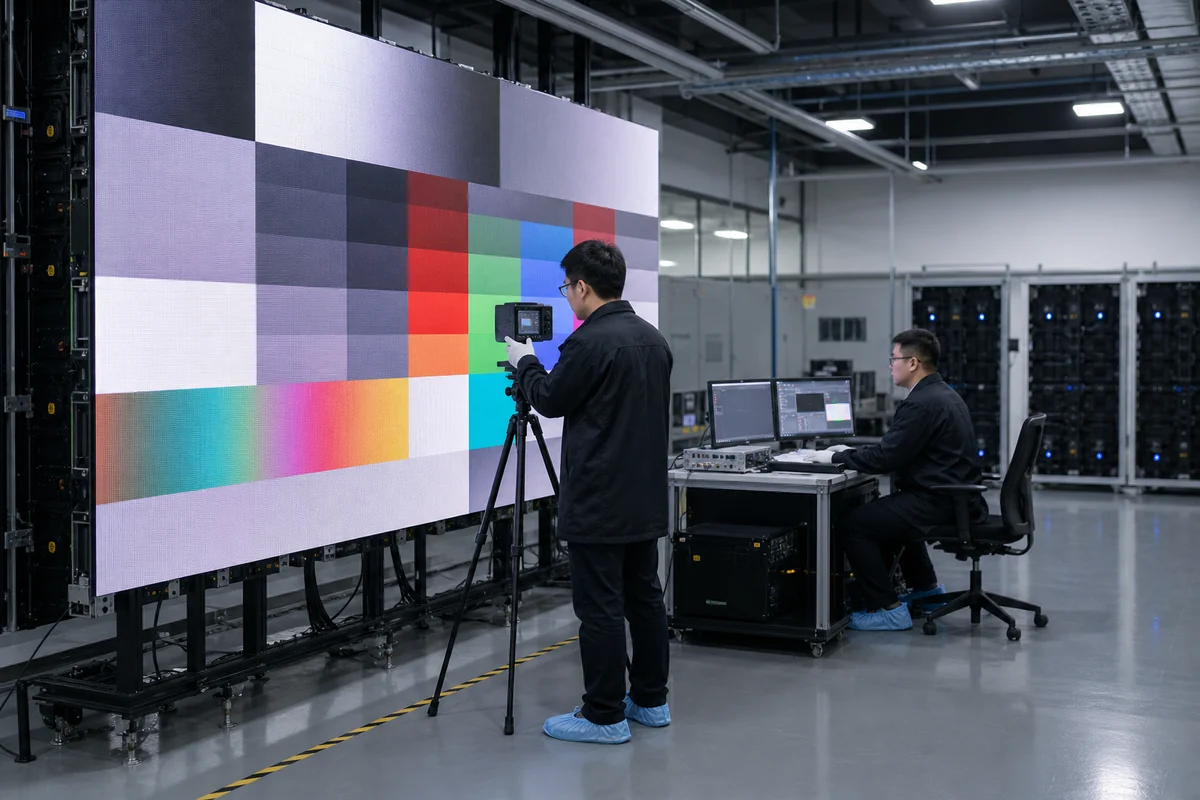
A professional LED video wall manufacturer should have strong production capability and strict quality management.
Important evaluation factors include:
Production Experience
Experienced factories understand different application requirements and can recommend suitable solutions.
Quality Control Process
A reliable factory should perform:
- LED module testing
- Cabinet inspection
- Aging tests
- Brightness calibration
- Signal testing
OEM and ODM Capability
Many businesses require customized LED solutions.
OEM/ODM services may include:
- Customized cabinet design
- Branding options
- Special sizes
- Unique installation structures
- Application-specific solutions
From a factory perspective, customization requires engineering capability rather than simple product modification.
After-Sales Support and Long-Term Partnership
A successful LED video wall project does not end after delivery.
Professional manufacturers provide:
- Installation guidance
- Technical training
- Spare parts support
- Remote troubleshooting
- Long-term maintenance assistance
For international buyers, after-sales capability is especially important because technical support affects project operation.
A reliable LED video wall manufacturer should act as a long-term technology partner instead of only a product supplier.
FAQ
How Long Does an LED Video Wall Last?
A high-quality LED video wall typically lasts 80,000–100,000 hours under proper operating conditions. Actual lifespan depends on component quality, brightness settings, heat management, installation environment, and maintenance practices.
What Pixel Pitch Should I Choose for an LED Video Wall?
The ideal pixel pitch depends on viewing distance and application. Close-viewing environments such as conference rooms usually require smaller pixel pitches like P1.2–P2.5, while outdoor advertising screens often use larger pitches such as P6–P10.
How much does an LED video wall cost?
Cost depends on display area, pixel pitch, brightness, LED components, cabinet design, control equipment, installation structure, customization, shipping, and maintenance requirements.
Is an LED video wall better than an LCD wall or projector?
LED video walls provide seamless scaling, high brightness, modular maintenance, and flexible dimensions. LCD or projection may still suit smaller projects with controlled lighting and lower initial budgets.
Can LED video walls be used outdoors?
Yes. Outdoor systems require high brightness, weatherproof cabinets, safe structural engineering, effective heat dissipation, suitable protection ratings, and environmental testing.
Conclusion
An LED video wall is more than a large digital screen. It is a complete visual communication system designed for professional applications requiring reliability, flexibility, and high-quality image performance.
Businesses should evaluate factors such as pixel pitch, brightness, installation environment, maintenance design, energy efficiency, and manufacturer capability before making a purchase decision. Although the initial LED video wall cost may vary depending on specifications and customization requirements, choosing the right solution can provide long-term value through lower maintenance costs, stable performance, and extended service life.
Working with an experienced LED video wall manufacturer helps ensure better product quality, technical support, and project success. As LED technology continues to develop, LED video walls will remain an important solution for businesses seeking powerful and immersive digital display experiences.